
Travel insurance reasonable expectations arbitration disputes arise when a traveler says the issued coverage or arbitration process materially differs from what a reasonable purchaser would have understood. The doctrine is not one nationwide rule, and a personal hope for coverage is not enough.
This U.S. guide shows how to preserve the transaction, identify the governing doctrine, test policy wording and representations, and separate insurance coverage from arbitration formation, scope, delegation, procedure, and remedies. It is educational, not legal advice.
Define the claimed expectation precisely
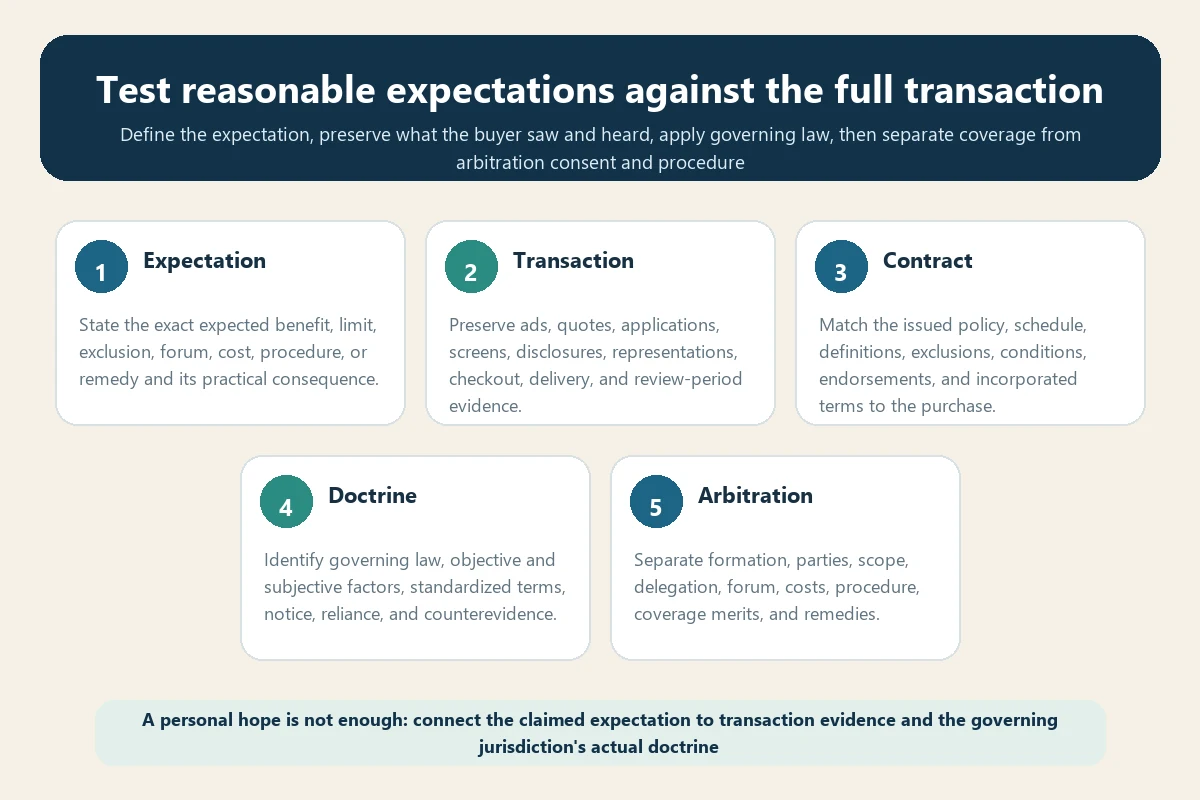
Write one sentence describing the expected result. Identify the benefit, exclusion, limit, deductible, eligibility rule, claim process, arbitration forum, cost, location, decision-maker, or remedy that allegedly differed.
Replace broad statements such as “I expected protection” with the exact event, amount, clause, and consequence. A defined expectation can be tested against evidence; a conclusion cannot.
Preserve the entire purchase journey
Save advertisements, quote inputs, comparison screens, benefit summaries, application questions, checkout pages, disclosures, checkboxes, timestamps, confirmation emails, policy-delivery messages, attachments, and later notices. Capture URLs and screenshots with dates.
Record the device, language, purchaser, travelers, state, plan, trip dates, deposit date, and payment. The evidence must show what was available before assent, not merely what appears online today.
Collect the complete issued contract
Gather the certificate, declarations or schedule, benefits, definitions, exclusions, conditions, endorsements, amendments, application, and incorporated terms. Match form numbers and revision dates to the purchase.
The incorporation-by-reference guide helps test whether external rules or documents were identified, available, and incorporated under governing law.
Separate subjective hope from legally reasonable expectation
A traveler’s actual belief is evidence, but the legal inquiry may examine objective reasonableness, insurer conduct, standardized wording, transaction dynamics, notice, or other jurisdiction-specific factors. Expectations cannot usually contradict unmistakable evidence without a recognized legal basis.
Identify what created the belief: policy language, a benefit label, a salesperson statement, a comparison table, prior course of dealing, or silence about an unusual term.
Determine governing law first
Review choice-of-law language, state of residence, policy situs, purchase location, forum rules, and insurance statutes. States differ significantly in whether and how reasonable expectations affect clear terms, ambiguous terms, standardized contracts, or misleading transactions.
Do not combine cases from Arizona, Pennsylvania, and another state into a single national test. Complete conflicts analysis before selecting elements.
Read the actual words in context
Quote the insuring agreement, definition, exclusion, exception, condition, benefit maximum, and arbitration provision. Preserve headings, punctuation, cross-references, and endorsements.
Apply ordinary meaning and whole-contract structure under governing law. The policy-ambiguity arbitration guide explains why disagreement alone does not prove ambiguous wording.
Identify standardized and negotiated terms
Record whether the traveler received a fixed consumer form or participated in negotiation. Identify who selected the plan, who could change terms, whether alternatives existed, and whether a broker or group sponsor was involved.
A standardized contract can be relevant, but adhesion is not automatically unenforceability. Apply the jurisdiction’s complete doctrine rather than a label.
Audit conspicuousness and placement
Document font, contrast, headings, links, scroll requirements, pop-ups, checkbox language, page order, and proximity to assent. Determine whether the disputed term was delivered before or after purchase and whether a cancellation or review period existed.
An arbitration clause directly above a signature presents different evidence from a term hidden in an unavailable document. Preserve the screen or page rather than describing it from memory.
Test oral and written representations
Collect emails, chats, call recordings, notes, scripts, brochures, and agent messages. Identify speaker, authority, exact words, date, audience, and reliance. Distinguish a factual statement from opinion or general promotion.
Compare each representation with the issued contract and application. Do not paraphrase “covered reason,” “protection,” or “peace of mind” into a promise of a specific benefit.
Map the insurer, administrator, broker, and seller
Travel products can involve multiple entities. Record who underwrote the policy, sold it, administered assistance, decided the claim, drafted terms, and delivered the arbitration provision.
Authority and responsibility cannot be inferred solely from branding. Use the arbitration agency guide where assent or representations depend on an alleged agency relationship.
Compare Arizona’s doctrine carefully
An official Arizona Court of Appeals decision discusses standardized agreements, arbitration, and the state’s reasonable-expectations doctrine. It rejects a separate sweeping reasonable-expectations rule applicable only to arbitration clauses.
Use that decision only after confirming current Arizona law and factual similarity. Its reasoning does not automatically control a traveler residing elsewhere.
Compare Pennsylvania insurance treatment carefully
An official Pennsylvania Superior Court decision reviews reasonable expectations in the insurance transaction, including applications, riders, policies, and agent representations.
That source illustrates a different jurisdictional framework. Confirm its precedential status, later history, and applicability before using it in any live dispute.
Separate coverage expectations from arbitration consent
An expectation about trip-cancellation coverage does not establish assent to arbitration, and an enforceable arbitration clause does not establish coverage. Build two issue maps.
The first should address benefits, exclusions, limits, and claim conditions. The second should address parties, assent, delivery, incorporation, authority, arbitration wording, and applicable contract defenses.
Apply the Federal Arbitration Act accurately
9 U.S.C. §2 addresses written arbitration provisions involving commerce and generally applicable contract grounds. It does not create one reasonable-expectations doctrine for every insurance transaction.
Determine whether the FAA applies, whether another federal statute matters, and whether state insurance law is relevant. Avoid assuming that mentioning travel or interstate commerce resolves every question.
Test formation before scope
Formation asks whether the relevant parties agreed to arbitrate. Preserve the offer, assent mechanism, delivery, incorporation, identity, authority, and version. Scope asks which disputes a formed agreement covers.
A broad scope clause cannot cure missing formation evidence. Conversely, an expectation about court litigation does not defeat documented assent unless governing law supplies a valid ground.
Keep delegation distinct
Quote any provision assigning arbitrability issues to the arbitrator. Identify incorporated rules, availability, clarity, and the challenge directed specifically to delegation.
Map who decides formation, scope, enforceability, coverage, procedure, and remedies. One answer should not be copied across all gateway and merits issues.
Evaluate forum, costs, and procedure separately
Record arbitration location, remote-hearing options, fees, fee shifting, arbitrator selection, discovery, confidentiality, time limits, written-decision requirements, and available remedies.
A traveler may reasonably expect coverage yet separately challenge an allegedly surprising forum or cost term. Each provision needs its own text, evidence, doctrine, and consequence.
Do not merge reasonable expectations with unconscionability
Reasonable expectations, ambiguity, unconscionability, misrepresentation, estoppel, and public policy can overlap factually but have different elements. Pleading one label does not establish another.
Preserve procedural facts such as surprise and bargaining circumstances separately from substantive claims about one-sided or oppressive effects.
Test reliance and causation rather than assuming them
Identify the action allegedly taken because of the representation or omitted term: buying this plan, rejecting another plan, paying a premium, taking the trip, missing a cancellation window, or accepting a dispute procedure. Record when that action occurred and what alternatives were realistically available.
Then connect the claimed mismatch to a measurable consequence. A surprising term does not automatically prove that different disclosure would have changed the purchase or prevented the claimed loss. Preserve comparison quotes, contemporaneous notes, budgets, cancellation rights, and testimony about alternatives.
If a party argues that prior conduct prevents another party from denying an obligation, analyze the distinct elements in the arbitration equitable-estoppel guide. Expectations, reliance, causation, and estoppel should not be collapsed into a single fairness argument.
Distinguish contra proferentem
Contra proferentem may construe unresolved ambiguity against a drafter. Reasonable-expectations analysis can focus on broader transaction evidence depending on state law.
The contra proferentem arbitration guide provides the separate drafting-canon analysis. Do not treat the doctrines as interchangeable.
Preserve claim and dispute chronology
Create a dated sequence covering marketing exposure, quote, application, purchase, delivery, review period, trip deposit, departure, loss, notice, claim, information requests, decision, appeal, arbitration demand, and court filing.
Timing can show what the traveler saw, whether a term changed, when reliance occurred, and which version controls. Save attachments and metadata with each event.
Build an expectation-evidence matrix
Use columns for claimed expectation, source, exact wording, date, speaker or author, accessibility, contract comparison, governing doctrine, counterevidence, decision-maker, and requested remedy.
Mark each proposition proven, disputed, or unknown. This prevents a marketing phrase from being presented as a policy promise without the necessary link.
Connect every theory to a remedy
Specify whether the requested relief is benefit payment, contract construction, rescission, reformation, damages, an order denying or compelling arbitration, severance, a different forum, fee relief, or another result.
Even a supported expectation may not prove loss amount, causation, compliance with claim conditions, or entitlement to every remedy.
Questions for qualified counsel
- Which jurisdiction’s reasonable-expectations doctrine governs?
- What exact evidence created the claimed expectation?
- Were the policy and arbitration terms delivered before assent?
- Does the doctrine affect clear text, ambiguous text, or transaction misconduct?
- Who decides formation, scope, delegation, coverage, and procedure?
- Which deadlines and preservation duties apply?
Practical takeaway
A defensible reasonable-expectations analysis begins with the actual U.S. jurisdiction and the complete travel-insurance transaction. Define the expected result, preserve what the buyer saw and heard, compare it with the issued contract, and test every fact under the governing doctrine.
Keep coverage expectations separate from arbitration consent, scope, delegation, forum, costs, and remedies. That structure exposes missing evidence and gives a court, arbitrator, insurer, traveler, or counsel a record that can be evaluated.
Narrow or conditional travel insurance is not automatically illusory; the central question is whether the promised benefit can ever produce payment for an insured under governing law. Use this travel insurance illusory coverage arbitration guide to test benefits, exclusions, attachment of risk, premium treatment, and the separate arbitration issues.
A condition precedent may govern policy formation, attachment of risk, claim payment, or the timing of arbitration, and those categories produce different consequences. Use this travel insurance condition precedent arbitration guide to classify the clause, document compliance, identify the decision-maker, and test excuse, prejudice, waiver, and remedies.
