
Travel insurance concealment or fraud clause questions arise when an insurer alleges that a traveler hid or misstated a material fact before or after a loss. A mistake, uncertain memory, disputed estimate, incomplete record, and intentionally false statement are not automatically equivalent.
This U.S. guide explains how to preserve the issued clause, identify the exact statement, distinguish application from claim conduct, analyze intent and materiality, and respond without altering evidence. It is educational, not legal advice.
Find the exact concealment or fraud clause
Collect the policy, certificate, application, claim form, endorsements, fraud warning, state notices, and amendments. Search for concealment, misrepresentation, fraud, false statement, material fact, intent, void, rescind, deny, and after a loss.
Quote the entire clause. Some wording addresses any insured, a particular claimant, the application, the claim, or both.
Separate purchase-stage and claim-stage statements
A purchase-stage issue can involve residence, trip cost, travel dates, destination, eligibility, medical history, or answers used to issue coverage. A claim-stage issue can involve cause, timing, ownership, value, refunds, other insurance, or supporting documents.
Different statutes, burdens, remedies, and policy language may apply. Do not merge rescission of the contract with denial of a particular claim.
Identify the exact statement or omission
Create one row for each challenged answer. Record the question, response, speaker, date, medium, document version, benefit, amount, alleged truth, source of that truth, and correction history.
A broad allegation that “the claim was inconsistent” is not a substitute for identifying the words at issue.
Preserve the original record
Keep native emails, portal exports, PDFs, photographs, receipts, metadata, call recordings lawfully available, notes, carrier files, medical records, refund records, and prior versions. Make a working copy for annotation.
Never edit a receipt, recreate a signature, backdate a statement, delete an unfavorable message, or coordinate a false explanation.
Distinguish mistake from knowing falsity
Document what the traveler knew when the statement was made. Consider memory, translation, ambiguous questions, estimates, unavailable records, mistaken identity, vendor descriptions, and later-discovered information.
Correcting an error does not automatically decide intent, but a prompt transparent correction creates a clearer record than silence.
Distinguish opinion and estimate from fact
Replacement value, condition, depreciation, trip interruption cost, and reasonableness can involve judgment. Purchase date, refund received, carrier payment, ownership, and treatment date may be more objectively verifiable.
Label estimates, sources, assumptions, and ranges. Do not present a guess as a verified fact.
Test materiality under the governing rule
Materiality can ask whether accurate information would affect issuance, premium, coverage, investigation, payment, or another claim decision. The exact test varies by law and policy context.
Request the specific decision allegedly affected and the underwriting, claim, or payment evidence supporting that position.
Use New York application law carefully
New York Insurance Law §3105 defines representations and addresses when a misrepresentation is material for avoiding an insurance contract.
It is an application-stage statute from one state. Confirm governing law, product, transaction, and current wording before applying it to travel coverage.
Understand claim-form fraud warnings
New York Insurance Law §403 addresses fraudulent insurance acts and requires specified applications and claim forms to carry an approved warning concerning knowingly false or concealed material information and intent to defraud.
The warning is serious, but its presence does not itself prove that a traveler committed the described act.
Compare state warning requirements
States can prescribe different fraud-warning text, placement, products, and penalties. For example, California Insurance Code §1871.2 addresses a false-or-fraudulent-claim notice on specified insurance forms.
Use the issued form and applicable state law rather than copying another state’s warning.
Study post-loss intent through primary authority
In Azzato v. Allstate Insurance Co., a New York appellate court discussed a concealment-and-fraud provision, inaccurate proof of loss, willful intent, material facts, and the treatment of another insured.
The case concerns property insurance under New York law, not ordinary travel insurance. Use its reasoning only after confirming the actual travel clause and governing authority.
Separate an inconsistency from a false statement
Two records can differ because they describe different dates, currencies, benefits, vendors, time zones, or versions. Build a reconciliation table before inferring deception.
Ask whether both statements can be true, whether a question was ambiguous, and whether later information explains the change.
Reconcile currency and exchange rates
Travel claims can show local currency, card-converted dollars, insurer conversion, fees, and refunds on different dates. Preserve the original amount, currency, conversion date, source, rate, and settlement.
A converted total that differs from a receipt is not necessarily an inflated claim.
Reconcile trip cost and refunds
List prepaid cost, refundable cost, cancellation penalty, voucher, credit, chargeback, carrier refund, supplier refund, tax, and recovered amount. Date every recovery.
Update the insurer when a refund arrives after submission. Do not seek duplicate recovery for the same economic loss.
Reconcile baggage ownership and value
For each item, record owner, purchaser, purchase date, receipt, model, serial number, condition, original price, current value, repair, carrier payment, and policy sublimit.
A family member’s receipt or shared item needs explanation, not an invented ownership trail.
Reconcile medical and travel dates
Compare symptom onset, diagnosis, treatment, advice not to travel, cancellation, departure, policy purchase, deposit, and final payment. Preserve provider records and time zones.
Do not pressure a clinician to change a date or conclusion. Ask for a factual correction only when the original record is actually wrong.
Use the claim file as the control record
The travel-insurance claim-filing guide helps organize benefit, policy, loss, notice, proof, and recovery records. Keep one indexed version history.
Submit corrections as dated supplements that identify the original statement and reason for correction.
Distinguish missing proof from concealment
A missing receipt, unavailable carrier report, delayed medical record, or unresponsive vendor can leave a claim unproved without proving intentional concealment. Document attempts and alternative evidence.
Use the notice and proof-of-loss guide to preserve timely submission while records remain outstanding.
Answer cooperation requests accurately
Track every request, stated reason, materiality, due date, response, objection, extension, and claimed gap. Provide responsive records or explain specifically why they do not exist or cannot be obtained.
The cooperation-clause guide helps separate genuine information needs from duplicative or unclear demands.
Prepare carefully for an examination under oath
If the policy and governing law support an examination, preserve the request, scope, scheduling, representation, exhibits, transcript, corrections, and reservations. Review source documents; do not rehearse a false narrative.
Use the examination-under-oath guide to distinguish that formal process from an ordinary recorded call.
Request the insurer’s complete position
Ask for the exact clause, statement, alleged true fact, evidence, intent theory, materiality theory, affected benefit, governing law, and consequence. Separate a reservation of rights from a final denial.
The claim-denial guide helps organize a response to each stated ground.
Separate possible consequences
Possible actions can include requesting more proof, adjusting an amount, denying a benefit, voiding or rescinding coverage, seeking repayment, referring a matter, imposing a civil consequence, or alleging a crime. They require different authority and procedure.
Do not describe a claim investigation as a criminal finding. Do not ignore a formal fraud allegation.
Handle a special-investigation referral carefully
An insurer may refer a claim for enhanced document review, interviews, database checks, vendor verification, or specialized investigation. Ask for the contact, requested information, contractual authority, purpose, deadline, privacy notice, and method for submitting records securely.
The referral itself does not establish fraud. Continue separating verified facts from allegations and preserve every request and response. Provide accurate, responsive material; identify unavailable records and documented efforts to obtain them.
Do not contact a witness to align stories, create replacement evidence, or guess what an investigator wants to hear. If a request raises privilege, privacy, self-incrimination, licensing, or criminal-exposure concerns, obtain qualified legal advice before responding. Calendar ordinary claim and suit deadlines because an investigation may not pause them.
Protect innocent insured questions
When a policy covers multiple travelers, identify who made or knew of the challenged statement and how the clause treats another insured. Relationship alone may not answer attribution.
Preserve separate applications, signatures, communications, ownership, benefits, and knowledge.
Correct the record without destroying it
Write a dated correction identifying the field, original answer, corrected answer, reason, supporting evidence, and effect on the claimed amount. Keep both versions and delivery proof.
A clean audit trail is more credible than a silently replaced file.
Create a statement matrix
Use columns for question, answer, speaker, date, source, alleged inaccuracy, actual fact, knowledge, intent evidence, materiality, affected decision, correction, insurer response, and consequence.
Mark unknowns and opinions separately from verified facts.
Questions for qualified counsel
- Does the clause govern application conduct, claim conduct, or both?
- What intent and materiality standard applies?
- Which exact statement or omission is challenged?
- What evidence proves knowledge, falsity, reliance, and consequence?
- How does the clause treat another insured or innocent traveler?
- What correction, response, deadline, or preservation step is required now?
Practical takeaway
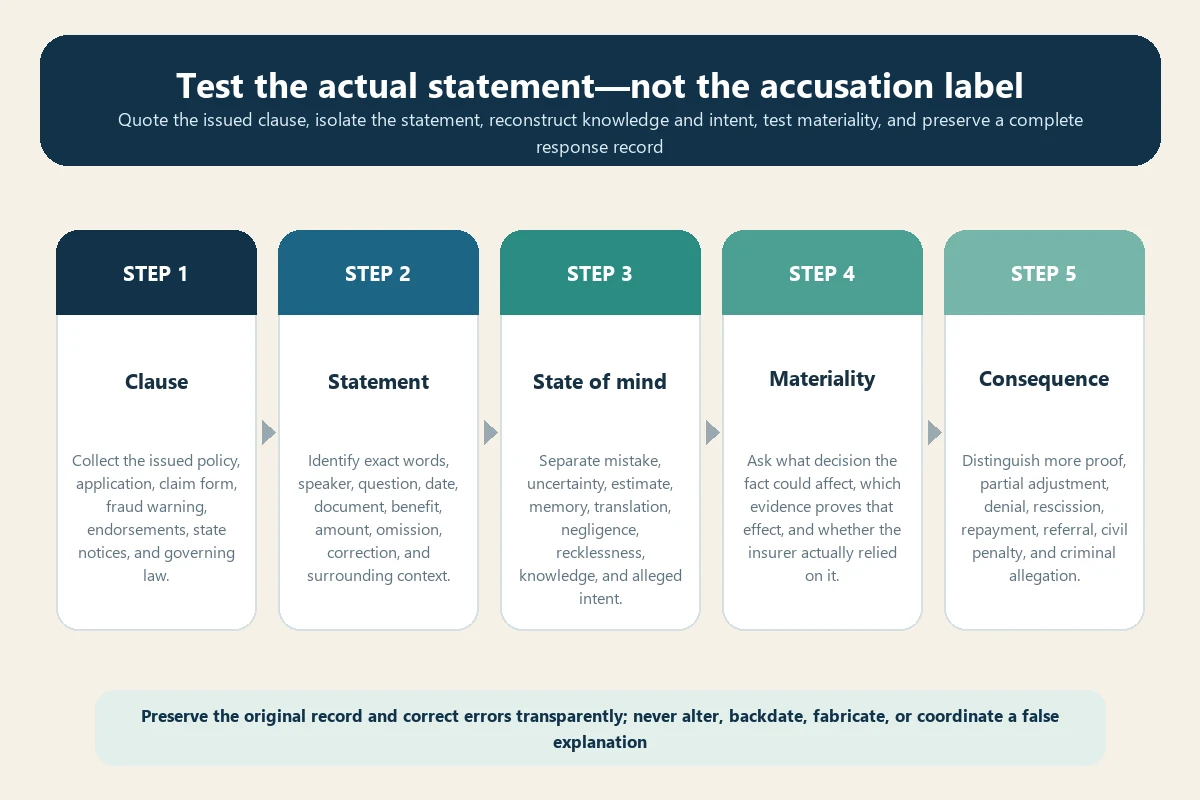
Start with the issued travel policy and exact statement. Separate purchase-stage representations from post-loss proof, mistake from intent, opinion from fact, missing evidence from concealment, and materiality from mere relevance.
Preserve originals, reconcile dates and money, correct errors transparently, and request the insurer’s complete position. Never alter evidence or manufacture certainty; serious allegations require prompt, qualified advice and a disciplined record.
A damaged-baggage claim needs an airport report, condition evidence, repair or replacement analysis, carrier outcome, policy valuation, and a clear record of who keeps the damaged property. Use this travel insurance damaged baggage claim guide to coordinate airline, TSA, card, and policy recovery without surrendering evidence or seeking duplicate payment.
An airline bankruptcy filing, flight cancellation, and insured financial default are different events. Use this travel insurance airline bankruptcy coverage guide to identify the correct supplier, policy trigger, refund route, and remaining insured loss.
