

A travel insurance arbitration award correction request asks for a limited fix after the award—not a second hearing on whether the claim should have been paid. The first task is to classify the problem accurately: ambiguity, clerical or computational error, an issue outside the submission, a defect of form, or actual disagreement with the arbitrator’s decision.
The arbitration agreement, provider rules, award, applicable federal or state law, and court procedure control. This U.S. consumer guide is general information, not legal advice. Deadlines can be short, remedies can overlap without sharing the same clock, and state arbitration statutes may differ from the Federal Arbitration Act.
Preserve the award exactly as delivered
Save the original email, portal notice, envelope, award file, attachments, and proof of transmission or delivery. Do not overwrite the original PDF with notes. Record the time zone and the date each party received access.
Use the arbitration award guide to inventory the parties, claims, defenses, findings, relief, interest, fees, performance dates, and allocation of arbitration costs. Correction starts with the issued text, not a recollection of what the arbitrator said.
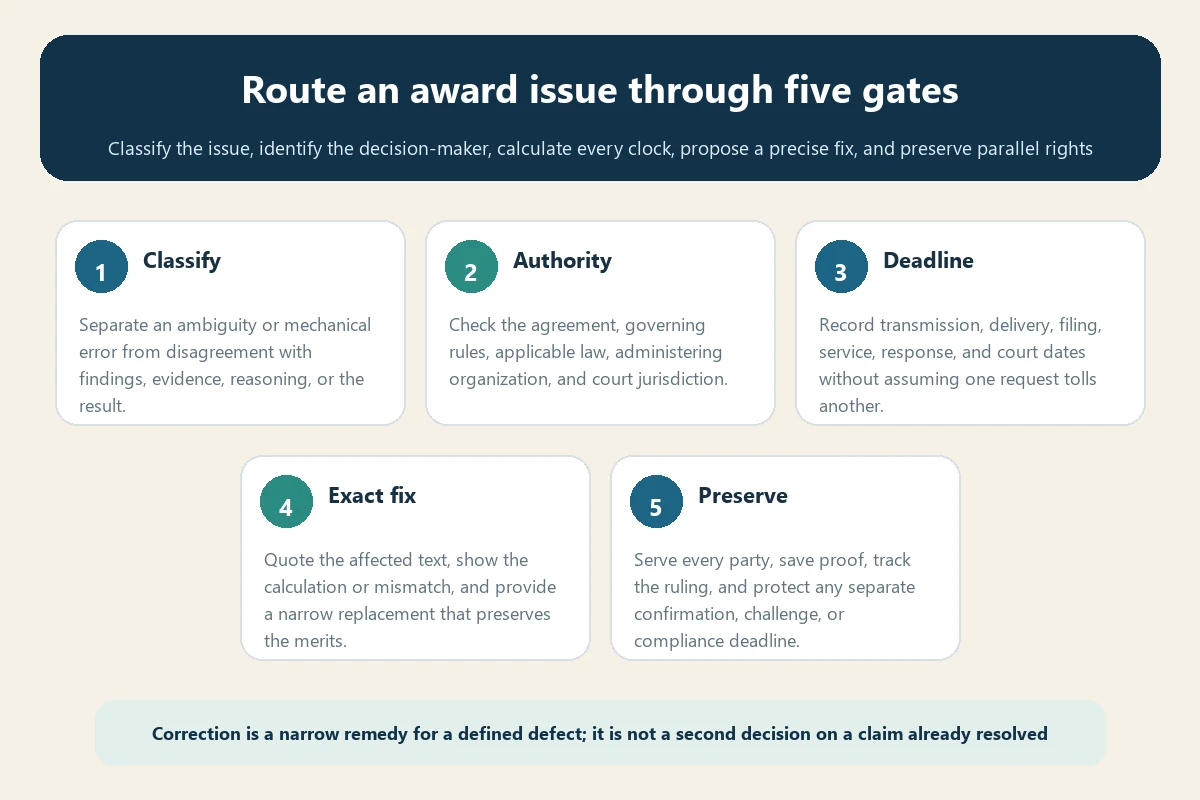
Classify the issue before choosing a remedy
Create a short issue log. For each suspected defect, quote the award page and sentence, identify the supporting record, describe the requested replacement, and state whether the requested change would alter a decided claim.
- Ambiguity: the award imposes a duty but the recipient, amount, date, or method cannot be applied reliably.
- Mechanical error: a name, date, total, arithmetic operation, or transcription does not match the stated components.
- Omission: the award appears not to address requested relief; whether it can be clarified or reconsidered depends on the governing authority.
- Merits disagreement: a party believes the arbitrator misunderstood evidence, interpreted coverage incorrectly, or awarded too much or too little.
- Court-level statutory issue: the requested modification falls within an applicable statute rather than the provider’s limited correction process.
Labeling a merits dispute “arithmetic” does not make it mechanical. If the request requires new credibility findings, different policy interpretation, new damages evidence, or reversal of a claim already decided, it likely exceeds a simple correction procedure.
Read the current provider rule
Current AAA Consumer Arbitration Rule R-49 provides a specific post-award route. Within 20 calendar days after transmission of an award, the arbitrator on their initiative, or a party with notice to the others, may request through the AAA that the arbitrator clarify the award or correct clerical, typographical, technical, or computational errors.
R-49 expressly says the arbitrator is not empowered through that process to re-determine the merits of a claim already decided. It gives opposing parties 10 calendar days to respond and directs the arbitrator to decide within 20 calendar days after the AAA transmits the request and responses. If applicable law supplies a different procedural period, the rule says that procedure is followed.
Verify the rule edition and the administrator named in the agreement. An AAA rule does not automatically govern an arbitration administered elsewhere.
Distinguish clarification from correction
A clarification request identifies wording that prevents practical implementation and asks what the existing decision requires. A correction request identifies a defined mechanical defect and supplies the accurate text or calculation. Both should preserve the decided merits.
For example, an award might list three reimbursable amounts correctly but add them incorrectly. A proposed sum derived from those stated components is narrow. Asking the arbitrator to add a fourth disputed expense that was rejected is a different request.
Do not reopen the evidentiary record by implication
Base the request on the existing award and record unless the governing procedure authorizes something else. Cite the admitted exhibit, stipulated figure, transcript page, or prior order that makes the error evident.
The hearing transcript guide, exhibit list guide, and post-hearing brief guide help locate a stable record citation. New evidence may create different procedural questions; it should not be slipped into a correction request without authority.
Calculate every deadline independently
Build a calendar with award transmission, actual receipt, provider-request deadline, response deadline, expected decision, payment or performance date, and any court deadline. Quote the rule or statute beside each date.
Do not assume a provider correction request pauses a judicial deadline, a payment duty, interest, or a confirmation proceeding. Obtain jurisdiction-specific advice promptly when parallel rights matter. The arbitration timeline guide provides a ledger format, but the controlling documents supply the dates.
Use the administrator’s required channel
When R-49 applies, submit the request through the AAA rather than contacting the arbitrator privately. Use the case number, exact case caption, award date, rule, requested correction, record citations, and proposed replacement language. Serve every party and preserve the submission receipt.
If formal motion practice is authorized, the arbitration motion practice guide helps separate requested relief, authority, facts, and exhibits. Follow any administrator direction about file type, page limit, redaction, and reply permission.
Draft a precise proposed correction
A useful request lets the decision-maker see the issue without reconstructing the entire case. Organize it as follows:
- Quote the exact award language and page.
- Name the type of correctable issue.
- Cite the governing rule or statute.
- Show the controlling record item or arithmetic.
- Provide exact replacement text.
- Explain why the fix does not re-determine the merits.
- State the transmission date, deadline, and service method.
For a calculation, show every operand and operation. For a description error, quote the correct legal name or property description from the record. Do not ask the arbitrator to “fix all errors”; identify each item separately.
Respond without enlarging the dispute
An opposing party should first address timeliness and authority, then agree or disagree item by item. If the proposed change alters the merits, explain exactly which finding, defense, damages category, or evidentiary judgment it would re-decide.
Offer narrower replacement wording when part of the request is valid. Preserve objections without turning the response into a complete appeal brief. Submit within the applicable response period and through the required channel.
Understand federal court modification
Section 11 of the Federal Arbitration Act describes limited grounds on which a federal court may modify or correct an award: an evident material miscalculation or material mistake in a description; an award on a matter not submitted, unless it does not affect the merits of matters submitted; or an imperfection in form that does not affect the merits.
The statutory court remedy is not the same as asking an arbitrator to clarify under R-49. Court jurisdiction, governing law, venue, service, filings, and remedies require separate analysis. Section 11 does not authorize general reconsideration simply because one party believes the award is wrong.
Calendar the federal service rule
Section 12 of the Federal Arbitration Act states that notice of a motion to vacate, modify, or correct an award must be served on the adverse party or attorney within three months after the award is filed or delivered. It also provides service rules that distinguish residents and nonresidents of the district.
Do not treat three months as a universal deadline. The FAA may not govern every issue, state statutes can differ, and court rules can add filing and service requirements. “Submitted to the administrator” is not proof of valid court service.
Separate correction from a challenge
A correction fixes a narrow qualifying defect. A challenge seeks vacatur or another judicial remedy on limited legal grounds. The award challenge guide explains the distinction and the need to preserve independent deadlines.
Do not expect a correction request to extend a challenge period unless controlling authority says it does. Conversely, do not ask a court to vacate an entire award when a qualifying form or arithmetic correction would address the issue.
Preserve confirmation and compliance decisions
An award may direct payment, document delivery, or another act by a date certain. Record whether a correction request affects that duty under the award, rule, agreement, or court order. Avoid unilateral assumptions.
The award enforcement guide covers confirmation and judgment concepts. If the parties settle implementation questions, document the resolution carefully using the arbitration settlement guide rather than silently editing the award.
Check interest, fees, offsets, and refunds
A corrected number may affect interest calculations, cost allocations, prior refunds, insurer payments, supplier credits, or a net award. Maintain a ledger showing the original figure, corrected figure, effective date, payment already made, and remaining balance.
Use the arbitration cost guide to distinguish claim damages, arbitration fees, attorney fees, costs, and interest. Do not net unrelated categories without authority.
Maintain one post-award control log
Keep the original award, request, exhibits, service proof, responses, administrator messages, corrected or clarified award, and court papers in chronological order. Name each version by date and status. Record who must act next and the controlling deadline.
If a corrected award issues, compare it line by line with the original. Identify every change, confirm whether the decision explains its authority, and preserve both versions. Update internal payment and compliance records without destroying the prior audit trail.
Avoid common correction mistakes
- Arguing the entire claim again under a correction label.
- Using the wrong administrator or obsolete rule edition.
- Counting from memory instead of documented transmission or delivery.
- Contacting the arbitrator outside the authorized channel.
- Failing to serve every party.
- Adding new evidence without procedural authority.
- Requesting a vague “clarification” without replacement wording.
- Assuming one request pauses every other deadline.
- Confusing an arbitrator correction with court modification.
- Discarding the original award after a corrected version issues.
Final award correction checklist
- Preserve the award and delivery evidence.
- Classify every suspected defect.
- Identify the controlling agreement, rule, and law.
- Calendar provider, response, court, and compliance dates separately.
- Quote the affected language and record citation.
- Propose an exact, narrow correction.
- Explain why the merits remain unchanged.
- Use the required channel and serve all parties.
- Preserve confirmation, challenge, and payment rights.
- Audit any corrected award against the original.
The strongest correction request is modest and exact. It identifies a specific defect, invokes the correct decision-maker and authority, meets every deadline, proposes language that can be adopted directly, and preserves separate rights without pretending that a limited correction process is an appeal.
