
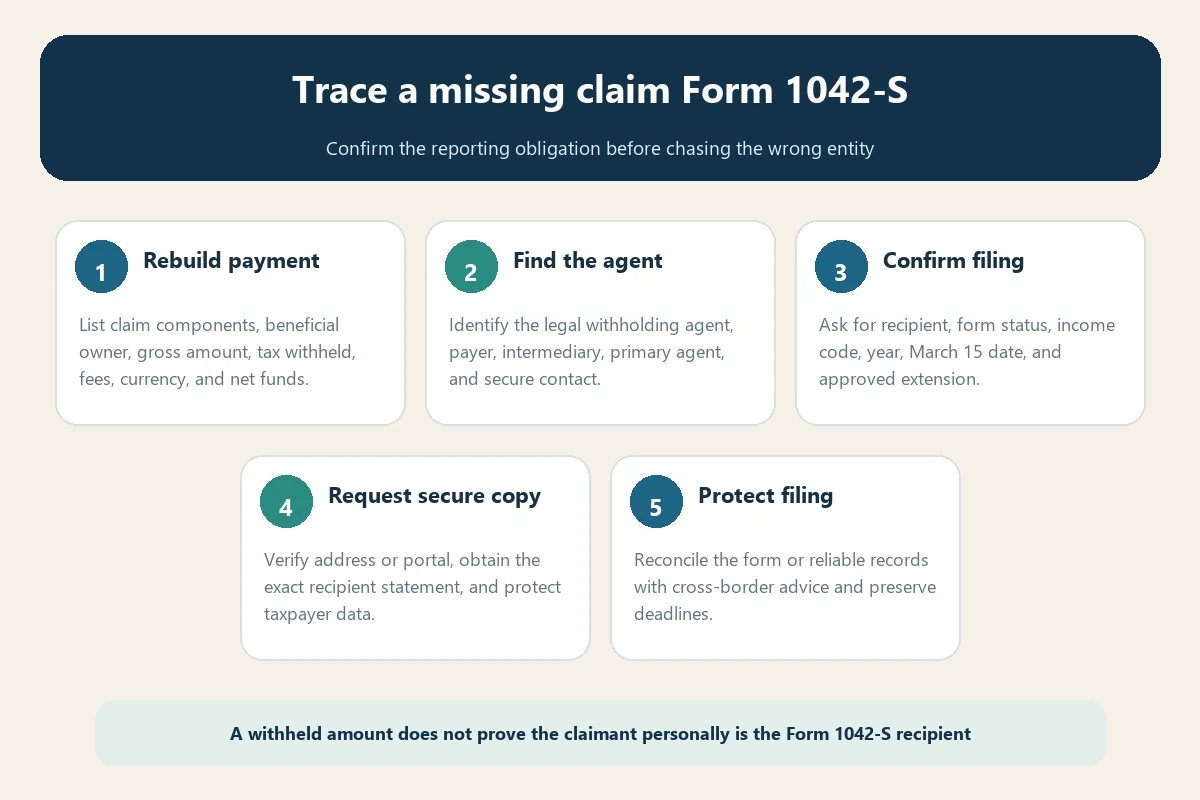
If a travel insurance claim Form 1042-S was not received, first confirm whether the legal withholding agent says a form was required and filed. Rebuild the gross payment and tax withheld, identify the beneficial owner and recipient, check the March 15 furnishing date or extension, and request a secure replacement statement.
Do not assume that every foreign claimant or overseas bank transfer produces Form 1042-S. The payment type, source, recipient status, W-8 documentation, withholding chapter, exemption, and intermediary structure can affect reporting. This guide is general information, not tax, legal, immigration, accounting, or insurance advice.
Rebuild the payment before searching for the form
Obtain the policy, claim decision, settlement agreement if any, payment advice, bank record, and tax-document correspondence. Separate each payment component and deduction.
| Question | Record | Why it matters |
|---|---|---|
| What was paid? | Benefit and settlement ledger | Different income types use separate forms |
| Who owned it? | Beneficial-owner documentation | Payee and recipient can differ |
| Who withheld? | Agent and primary-agent record | Identifies the form issuer |
| How much tax? | Gross, rate, tax, and net calculation | Supports return or refund analysis |
| When paid? | Availability and tax-year timeline | Identifies the expected form year |
| How delivered? | Portal, consent, address, and mail status | Separates missing copy from no filing |
Determine whether Form 1042-S is expected
Ask the payer whether it treated any component as reportable U.S.-source income paid to a foreign person or as another amount requiring Form 1042-S. Require the income code, withholding chapter, gross amount, recipient, and tax year.
The IRS page for Form 1042-S describes the form’s general purpose. The travel claim Form 1042-S guide explains how to connect those fields to an insurance payment.
Identify the legal withholding agent
The insurer’s brand, policy underwriter, administrator, settlement company, payment vendor, intermediary, attorney, and withholding agent may be different entities. General claims service may not control tax statements.
Ask for the legal withholding agent name, EIN ending, international tax-reporting department, secure portal, mailing address, and case contact. If another agent actually withheld, request its name and role.
Map primary agents and intermediaries
More than one entity can participate in a cross-border payment, but reporting responsibility and actual withholding should not be guessed from the wire description. Build a map showing who approved the claim, controlled the funds, withheld tax, deposited it, filed the form, and furnished the recipient copy.
The IRS withholding agent FAQ explains the reporting framework for Forms 1042, 1042-S, and 1042-T. Ask each entity to confirm its role in writing and identify any primary withholding agent whose tax appears on the expected statement.
Confirm the actual recipient
The claimant, traveler, policyholder, beneficiary, provider, attorney, estate, entity, intermediary, and bank-account owner can differ. A form may have been furnished to another legal recipient or issued for a component that person owned.
Compare the valid W-8 certificate and claim allocation. Do not request the other person’s private tax form; ask the payer to explain which amount was associated with the claimant’s documentation.
Joint owners may not receive identical forms
Form 1042-S lists one recipient, even when a payment involves joint owners. Ask how the withholding agent allocated the claim and which owner it reported.
Preserve policy rights, payment endorsements, owner certificates, and distribution records. Obtain cross-border advice before deciding that a missing second form is an error.
Match the expected tax year
The trip, loss, claim, approval, check issue, transfer, availability, return, reissue, and withholding can span calendar years. Ask which event and payment component drove the Form 1042-S year.
The claim tax-year guide helps build the chronology. Although it focuses on 1099 reporting, its payment-timeline method is useful; Form 1042-S rules require their own analysis.
Know the general March 15 deadline
The current IRS Instructions for Form 1042-S generally require the form to be filed with the IRS and furnished to the recipient by March 15 of the following calendar year, adjusted when the date falls on a weekend or applicable legal holiday.
Do not demand a form before the applicable due date merely because ordinary Forms 1099 often arrive earlier. Record the payment year, expected March deadline, and any payer notice.
Ask whether the payer obtained an extension
The IRS instructions describe a possible one-time 30-day extension for furnishing recipient copies through Form 15397 when timely requested and approved. An extension for the payer’s filing and an extension to furnish the recipient statement are not necessarily the same.
Ask the withholding agent whether an extension applies, which obligation it covers, the approved deadline, and when the claimant should receive the copy. Request written confirmation without demanding the payer’s confidential filing package.
Check electronic delivery and consent
Search the verified claims portal, tax-document center, secure message box, payment platform, and email notices. Navigate independently rather than clicking an unexpected tax-document link.
Ask whether the payer relied on electronic-delivery consent, when the statement became available, how long access lasts, and whether the document can be downloaded in a stable PDF.
Check paper delivery and returned mail
Confirm the exact recipient address, country, postal code, apartment or unit, transliteration, and effective date. Ask when the form was mailed and whether it was returned as undeliverable.
A foreign mailing delay can explain a late paper copy but does not prove the payer filed correct information. Request a secure duplicate while preserving the mailing history.
Request a recipient copy securely
Do not ask the payer to email an unprotected form containing TINs, address, birth date, account, gross income, and withholding. Use an authenticated portal, encrypted transfer, or verified postal process.
Request a delivery receipt and confirm that Copies B, C, or D correspond to the record filed with the IRS. A spreadsheet or claims letter is useful evidence but is not the recipient statement.
Reconcile gross amount and tax withheld
Calculate claim principal, interest or other reportable component, gross income, withholding rate and base, tax withheld, bank and currency fees, and net funds. Distinguish tax withheld by the current agent from tax withheld by another agent.
The claim tax withholding guide helps test the arithmetic. A missing form makes payment documentation more important, not less.
Check the W-8 documentation trail
Identify the exact W-8BEN, W-8BEN-E, W-8ECI, W-8EXP, or W-8IMY used for the payment. Record beneficial owner, status, country, TINs, treaty claim, signature, validity, changes in circumstances, and payer receipt.
The claim W-8BEN request guide covers authentication and secure submission. A missing or expired certificate can alter the payer’s recipient and withholding treatment.
Do not confuse a missing copy with a missing filing
The payer may have filed Form 1042-S but failed to deliver the recipient statement, or it may have furnished a draft before filing. Ask for the filing status, date, unique form identifier, and whether the payer later amended it.
Do not rely on an unsigned portal screenshot as proof of IRS filing. Conversely, the claimant generally cannot independently access the payer’s full Form 1042 filing.
Ask for a complete written status response
Request confirmation of:
- legal withholding and primary agents;
- beneficial owner and Form 1042-S recipient;
- payment component, income code, and gross amount;
- tax rate, actual withholding, and net disbursement;
- tax year and unique form identifier;
- IRS filing and recipient-furnishing dates;
- approved extension, if any;
- secure replacement delivery method; and
- correction contact and case number.
Review the copy immediately when it arrives
Compare every field with the W-8 record and payment ledger. Check withholding agent, recipient, country, address, TINs, income and status codes, exemption, gross income, rates, federal tax, account, year, and amended status.
If anything is wrong, use the incorrect claim Form 1042-S guide. An amended form should preserve the correct unique identifier and correction sequence.
Protect the return and refund deadline
Do not wait indefinitely for the statement. Give a cross-border tax professional the payment ledger, bank proof, W-8 documentation, payer correspondence, and best available withholding evidence.
Ask what filing, extension, TIN, attachment, refund or credit, and later amendment procedures apply. Do not estimate a tax credit casually; the recipient copy and payer filing can be critical to verification.
Watch for fake replacement-form messages
A scammer may offer a replacement or immediate withholding refund in exchange for passport data, bank login, remote access, gift cards, wire, or cryptocurrency. Verify the withholding agent through known channels.
The claim payment scam guide covers fake tax-release demands and changed instructions. A legitimate replacement should arrive through the payer’s controlled process.
Keep one missing-form file
Retain the policy, claim decision, payment and tax ledger, W-8 forms, delivery consent, address history, portal notices, replacement requests, extension confirmation, final or amended Form 1042-S, return, and professional workpapers.
The final file should show whether a form was required, who issued and received it, when it was filed and furnished, how tax reconciled, and how the claimant protected filing deadlines.
Bottom line
When Form 1042-S does not arrive after a travel insurance claim, verify the reporting obligation, withholding agent, beneficial owner, recipient, payment, tax, year, March 15 deadline, and extension. Request a secure recipient copy and protect cross-border filing and refund deadlines with complete records and qualified advice.
