

A travel insurance arbitration reasoned award gives the parties written insight into why the arbitrator reached the result. Under current AAA Consumer Rules, the operative term is a “brief written explanation,” not necessarily a court-style opinion with exhaustive findings, citations, and a line-by-line discussion of every exhibit.
The arbitration agreement, current provider rules, applicable law, procedural orders, party agreements, and submitted issues control the form. This U.S. consumer guide is general information, not legal advice. FINRA, employment, commercial, international, and state programs can use different terminology and requirements.
Identify the governing award rule
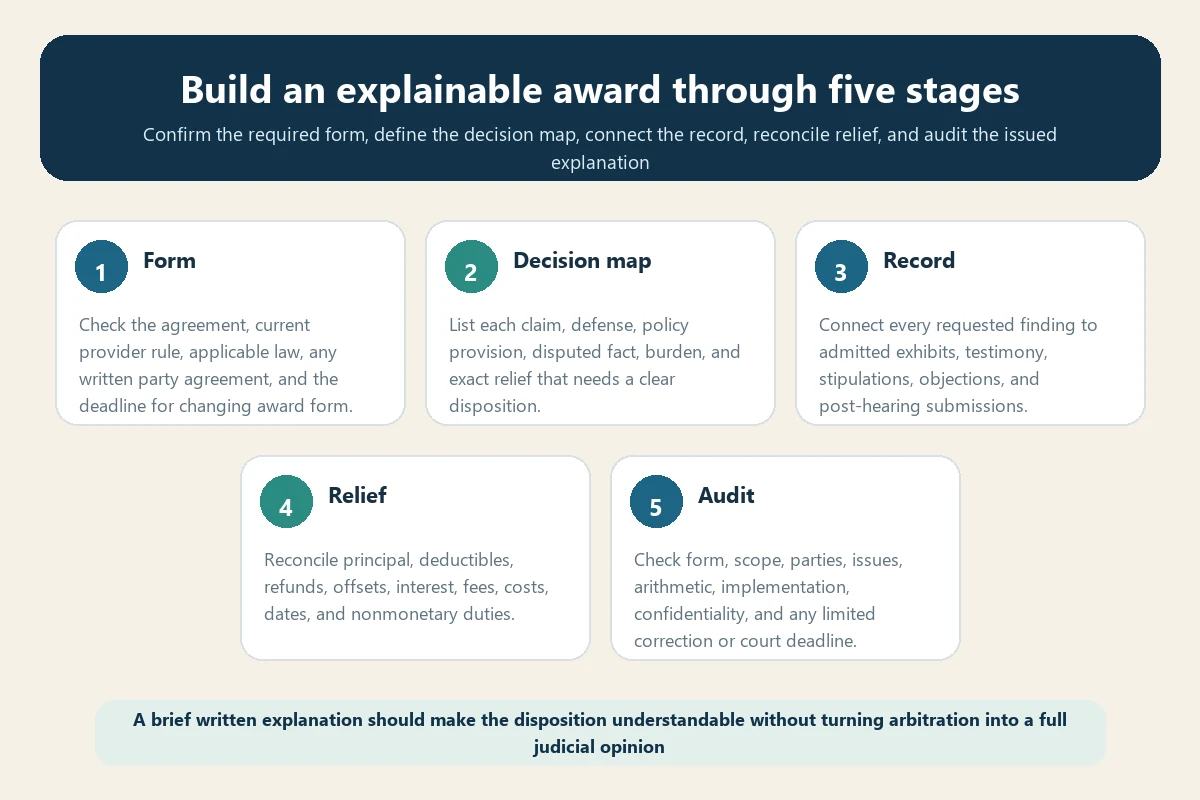
Start with the arbitration clause and the rule edition applicable to the case. Record the administrator, rule set, effective date, any contract language about findings or reasons, and any procedural order addressing the award form.
Current AAA Consumer Arbitration Rule R-45 requires a written award signed by a majority of the arbitrators and says the award shall provide a brief written explanation unless all parties agree otherwise. Any disagreement over form is decided by the arbitrator.
Use the current deadline for changing form
R-45 states that if the parties agree to a different form of award, they must do so in writing before the hearings close. Do not wait until an unfavorable award issues to request a longer or shorter explanation.
Record the closure date and submit any written agreement through the authorized channel. The reopening guide explains why post-closure procedure is limited and should not be treated as an informal extension of the hearing.
Distinguish a brief explanation from full findings
A brief explanation can state the central factual or contractual reason for granting or denying relief. Full findings of fact and conclusions of law usually imply a more detailed structure: numbered findings, legal conclusions, burden analysis, and application of law to facts.
Do not use “reasoned,” “explained,” “speaking,” “detailed,” and “findings” as if they are identical. Define the desired form in operational terms: issues covered, level of detail, treatment of damages, need for legal citations, and whether separate claims require separate dispositions.
Understand the 2025 consumer-rule change
AAA’s official comparison of revised Consumer Rules shows the updated award-form language, including the brief written explanation and the written pre-closure agreement requirement for a different form. This is useful when older articles or templates cite earlier rule numbers or language.
Always use the rule edition governing the actual case. A later rule change is not proof that it applies retroactively.
Decide whether a different form helps
A more detailed award may help the parties understand which policy provision controlled, which expense was accepted, how offsets were applied, and what must happen next. It may also require more drafting time, invite disputes over wording, disclose sensitive facts, or increase cost under some programs.
A shorter award can reduce unnecessary detail but may make implementation or review harder. The correct choice depends on the claims, agreement, law, privacy concerns, and intended use—not on an assumption that more pages always improve accuracy.
Create an issues-and-relief matrix
Before the preliminary hearing or another authorized deadline, create one row per issue. Include:
- claim or counterclaim;
- policy provision or other authority;
- disputed factual question;
- party bearing the burden;
- admitted evidence and testimony;
- requested finding or disposition;
- requested monetary or nonmonetary relief;
- offset, refund, deductible, interest, fee, or cost question.
AAA’s official article on an issues and relief statement explains how a clear roadmap can improve award drafting and post-hearing efficiency. The matrix is an advocacy and control tool; it does not dictate the outcome.
Use the preliminary hearing to define expectations
Raise award form, issue lists, briefing, hearing closure, confidentiality, and requested relief at the authorized case-management stage. Confirm decisions in a written order or administrator communication.
The preliminary hearing checklist helps organize these topics. Avoid one-sided contact with the arbitrator about how the award should be written.
Make the demand award-ready
The demand should identify each claim, controlling coverage provision, material facts, and requested relief. A vague request for “all damages” makes it harder to see whether the award resolved every submitted issue.
Use the arbitration demand guide to separate unpaid benefits, interest, fees, costs, and nonmonetary relief. Update claims through the authorized process when facts or amounts change.
Make the answer decision-ready
The response should admit or deny material allegations, identify defenses, state the insurer’s policy interpretation, and disclose offsets or prior payments. It should not force the arbitrator to infer the defense from scattered correspondence.
Use a structured answer method and match each defense to the claim it affects.
Connect every issue to the record
A written explanation is only as useful as the record beneath it. Maintain an exhibit index with admitted status, page citations, witness links, objections, and the issue each item supports. Distinguish filed material from admitted evidence.
The exhibit list guide helps build this map. Do not ask the award to rely on a document that was excluded, withdrawn, or never submitted.
Use stipulations to narrow the explanation
Parties can sometimes stipulate to the policy, insured trip cost, refund amount, chronology, authenticity, or mathematical inputs while disputing coverage or causation. Clearly identifying undisputed facts lets the explanation focus on the true decision points.
Write each stipulation precisely and submit it through the authorized channel. A shared timeline does not necessarily stipulate the legal effect of each event.
Preserve hearing citations
If a transcript or recording is authorized, index testimony by issue and page or timestamp. Correct the transcript through the approved procedure and preserve the final version.
The hearing transcript guide explains ordering, correction, citation, privacy, and cost. Do not quote an unofficial note as if it were the formal record.
Use post-hearing briefing strategically
A post-hearing brief should state the requested decision on each live issue, cite the admitted record, address the governing policy language, and provide a reconciled relief table. Avoid merely replaying the hearing chronologically.
The post-hearing brief guide helps organize the submission. Follow the page limit and do not attach unauthorized new evidence.
Reconcile monetary relief before closure
Provide a table showing gross claimed amount, covered amount sought, deductible, supplier refunds, chargebacks, prior insurer payment, other insurance, currency conversion, interest, fees, costs, and net requested award. Cite authority for each line.
Separate interest periods and rates. A reasoned award should not have to reverse-engineer an unexplained total.
Define nonmonetary relief precisely
If a party requests a declaration, document, correction of a claim record, or another act, identify who must do what, by when, in what format, and with what proof of completion. “Correct the claim” is too vague for reliable implementation.
Confirm that the requested remedy is within the agreement, applicable law, and submitted dispute. Separate a desired business accommodation from relief the arbitrator is authorized to award.
Protect privacy in the explanation
A written explanation can repeat medical details, account identifiers, travel records, family information, or settlement communications. Request appropriate redaction or protective measures before closure, consistent with the governing rules and law.
The arbitration confidentiality guide distinguishes administrator duties, party agreements, protective orders, and publication. Do not assume every award will remain private.
Use FINRA only as a comparison
FINRA’s official Decision & Award page defines an “explained decision” in its securities forum as a fact-based award stating general reasons, without requiring legal authorities or damages calculations. FINRA uses its own joint-request procedure and timing.
That FINRA procedure does not govern an AAA consumer travel insurance arbitration. It is a useful comparison showing why the exact forum terminology, consent rule, deadline, and expected detail must be confirmed rather than assumed.
Audit the issued explanation
When the award arrives, first verify form: writing, signatures, parties, case number, date, and delivery. Then compare the explanation with the issues-and-relief matrix. Mark each claim granted, denied, dismissed, reserved, or apparently unaddressed.
Recalculate every total and verify payee, currency, interest, offsets, due dates, fees, and nonmonetary duties. Use the award payment guide to convert the operative obligations into a controlled payoff and satisfaction process.
Do not confuse a brief explanation with appeal rights
An explanation can make the result understandable, but it does not create a general merits appeal. The agreement and applicable federal or state law govern any limited correction, modification, vacatur, confirmation, or enforcement process.
The award challenge guide explains why disagreement with reasoning is not by itself a statutory ground. Calendar every deadline independently.
Use correction only for an authorized defect
If the explanation contains an ambiguity, clerical issue, or computational error, identify the precise text and governing correction authority. Do not use correction to obtain a second merits decision.
The award correction guide covers the current AAA R-49 route and separate court concepts. Preserve the original award and all versions.
Avoid common reasoned-award mistakes
- Using an old rule edition or wrong forum terminology.
- Waiting until after closure to define the desired form.
- Assuming “brief explanation” means full judicial findings.
- Failing to list every claim and defense.
- Requesting a total without a relief calculation.
- Citing filed but unadmitted material.
- Ignoring privacy in the written explanation.
- Importing FINRA’s procedure into an AAA case.
- Treating weak reasoning as automatic appeal authority.
- Seeking a merits rewrite through correction.
Final reasoned award checklist
- Confirm the agreement, forum, rule edition, and applicable law.
- Identify the default award form.
- Document any different written agreement before closure.
- Build an issues-and-relief matrix.
- Connect each decision point to admitted evidence.
- Reconcile monetary and nonmonetary relief.
- Protect sensitive information.
- Audit the issued explanation against every submitted issue.
- Calendar correction, challenge, payment, and enforcement dates.
- Preserve the complete record and every award version.
A useful reasoned award begins long before issuance. The parties define the expected form, narrow the issues, build a reliable record, reconcile relief, and protect privacy. The resulting explanation can then make the decision understandable without turning the arbitration into a full appellate opinion.
