
Travel insurance arbitration successor liability becomes important when an insurer, booking platform, claims administrator, or assistance company changes after a policy is sold. A merger, acquisition, reorganization, name change, or portfolio transfer may affect who can enforce an arbitration clause—and who can be required to arbitrate.
This U.S. consumer guide provides an evidence-first framework for analyzing the transaction, assumed rights and duties, governing law, contract scope, and defenses. It is not legal advice.
Start with the exact legal entities
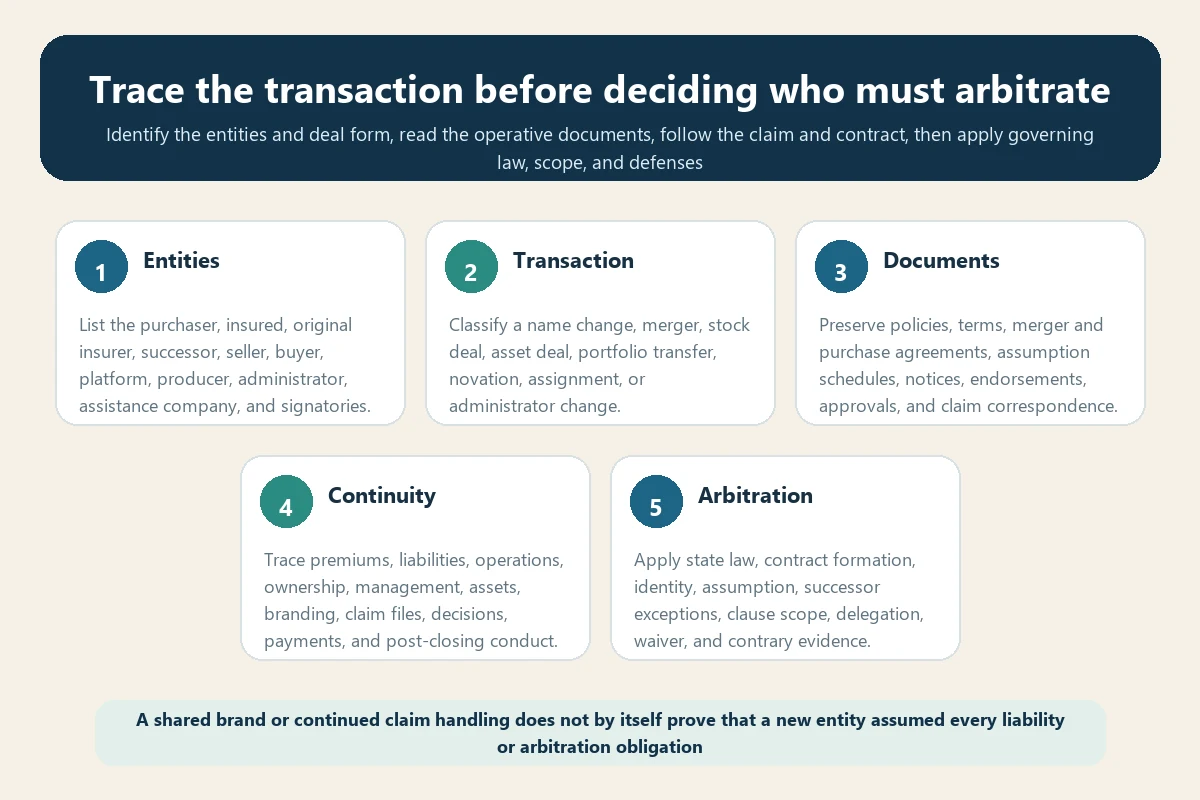
List the purchaser, insured travelers, original insurer, alleged successor, seller, buyer, producer, platform, claims administrator, assistance provider, and every contract signatory by full legal name. Record trade names separately.
A familiar logo is not a legal identity. Confirm names through the policy, certificate, state insurance records, corporate filings, invoices, and correspondence.
Build a dated transaction timeline
Record policy purchase, trip dates, covered event, claim, denial, appeal, corporate announcement, signing, closing, regulatory approval, transfer notice, and arbitration demand. A transaction completed after a denial may raise different issues from one completed before the policy was sold.
Use primary records rather than a current website footer. Save dated copies and note where each fact came from.
Classify what actually changed
Do not call every corporate event a merger. Determine whether the event was a legal name change, statutory conversion, merger, stock purchase, asset purchase, policy portfolio transfer, assignment, novation, or replacement of a service provider.
The form matters. In a stock purchase, the operating company may remain the same legal entity with new owners. In an asset purchase, a different entity may acquire selected assets and liabilities. A name change may leave the contracting entity unchanged.
Separate liability from arbitration
Ask two distinct questions: did the alleged successor become responsible for the underlying claim, and did it obtain or assume a right or duty under the arbitration agreement? A conclusion about one does not automatically answer the other.
Identify who is trying to compel whom, which claim is asserted, and what contractual language allegedly connects that claim and party to arbitration.
Identify the operative written agreement
Preserve the policy, certificate, booking terms, producer disclosures, claim-administration terms, endorsements, amendments, and incorporated arbitration rules. Record the exact version, purchase screen, notice, assent, parties, covered claims, named affiliates, governing law, forum, and delegation language.
Use the incorporation-by-reference guide when the clause depends on another document or linked rules.
Use the Federal Arbitration Act carefully
Section 2 of the Federal Arbitration Act generally makes a written arbitration provision involving commerce enforceable on the same footing as other contracts. It does not create one nationwide successor-liability rule.
Formation, party identity, assumption, and successor doctrines generally require the relevant state contract or corporate law. Choice-of-law analysis can therefore be outcome-sensitive.
Read Arthur Andersen as a framework, not a shortcut
In Arthur Andersen LLP v. Carlisle, the U.S. Supreme Court held that a nonsignatory may invoke an FAA stay when applicable state contract law permits enforcement. The Court identified assumption and other traditional principles as possible routes.
The decision removes a categorical nonsignatory bar. It does not establish that a buyer, affiliate, or replacement administrator is a successor in a particular dispute.
Review GE Energy when an international contract is involved
In GE Energy Power Conversion France SAS v. Outokumpu Stainless USA, LLC, the Supreme Court held that the New York Convention does not categorically conflict with domestic-law equitable-estoppel enforcement by nonsignatories.
The Court did not decide whether enforcement was available on the facts or which law controlled. International travel arrangements still require a transaction-specific analysis.
Read the transaction documents
Obtain the merger agreement, asset purchase agreement, assumption agreement, disclosure schedules, bills of sale, transition-services agreement, regulatory orders, policy-transfer documents, and customer notices where lawfully available.
Search for definitions of assumed liabilities, excluded liabilities, contracts, claims, disputes, proceedings, insurance obligations, refunds, customer liabilities, and successors and assigns. Read exceptions and schedules, not just recitals.
Distinguish express assumption from implied assumption
An express-assumption theory relies on transaction language accepting defined obligations. An implied-assumption theory relies on conduct and circumstances recognized by the governing jurisdiction. Keep the theories separate and state the required elements and burden for each.
The related arbitration assumption guide provides a focused checklist for words and conduct said to show acceptance.
Analyze an asset purchase cautiously
Many jurisdictions begin with a rule that an asset buyer does not automatically inherit every seller liability, subject to jurisdiction-specific exceptions. Common labels may include express or implied assumption, de facto merger, mere continuation, or a transaction designed to evade liabilities.
Labels are not proof. Identify the controlling state’s exact elements, current authority, burden, and whether the doctrine applies in the asserted direction to arbitration rights or duties.
Do not confuse stock ownership with succession
If only the shares changed hands, the insurer or platform may remain the same contracting legal entity. New ownership alone does not replace that entity or rewrite its contracts.
If a parent or affiliate is the proposed arbitration party, analyze its own contractual or state-law basis. The alter-ego guide explains why common ownership and branding alone are not enough to disregard separateness.
Separate assignment from successor liability
An assignment may transfer identified contractual rights without transferring all liabilities. An assumption or novation may address duties, consent, or party substitution. A corporate succession theory may operate differently under state law.
Use the travel insurance arbitration assignment guide to trace assignor, assignee, transferred rights, delegated duties, consent, and notice.
Audit insurance-specific transfers
Determine whether policies or claim obligations moved under an assumption reinsurance arrangement, novation, statutory transfer, rehabilitation order, merger approval, or another insurance-law mechanism. Preserve regulator approvals and policyholder notices.
Reinsurance behind the issuing carrier ordinarily should not be treated as an automatic substitution of the policyholder’s counterparty. Verify the legal effect under the applicable policy and insurance law.
Do not mistake a new administrator for a new insurer
A third-party administrator may receive claim files and communicate decisions while the issuing insurer remains the contractual risk bearer. Preserve the administration agreement if available, letters, signatures, email domains, payment records, and authority descriptions.
If an administrator invokes arbitration, analyze the clause’s covered-party text and the relevant agency theory separately from successor liability.
Trace post-closing conduct
Record which entity accepted premiums, serviced policies, received the claim, requested documents, signed the denial, handled appeals, issued refunds, paid settlements, maintained the portal, or represented that it would honor prior obligations.
Conduct may support or contradict an assumption theory, but continued customer service or branding alone may also reflect a limited transition-services contract.
Test continuity factors without collapsing entities
Depending on governing law, potentially relevant facts may include continuity of ownership, management, personnel, physical location, assets, business operations, customers, products, and dissolution of the seller.
Record both supporting and contrary evidence. A fair analysis includes separate books, different owners, excluded liabilities, independent management, limited service agreements, and continued seller operations.
Analyze clause scope after party status
Even if a successor relationship is established, ask whether the clause covers the particular denial, refund, statutory claim, misrepresentation, or post-closing conduct. Review temporal limits, carve-outs, forum rules, and remedy terms.
Do not use broad dispute language as a substitute for proving that the proposed party may invoke or be bound by the agreement.
Address delegation separately
If a party argues that an arbitrator must decide successor status, identify the exact delegation language and any incorporated rule. Courts generally treat consent to arbitrate as foundational; the allocation of a specific gateway issue requires careful authority.
Preserve challenges directed specifically to delegation as well as challenges to the broader arbitration clause.
Check waiver and inconsistent conduct
Build a chronology of litigation, discovery, motions, settlement activity, claim handling, and delay before arbitration was demanded. Apply current law to the conduct of the actual party asserting arbitration.
A predecessor’s conduct and a successor’s conduct may raise attribution questions. Do not combine them without a legal and factual basis.
Create an evidence matrix
For every proposition, record the source, date, custodian, entity, transaction stage, supporting inference, contrary inference, and authenticity status. Include policy documents, corporate filings, regulator orders, agreements, schedules, notices, correspondence, portal captures, and payment records.
Maintain an issue column for formation, identity, transaction type, assumption, successor exception, scope, delegation, waiver, and remedy. This prevents one fact from doing work it cannot support.
Preserve reasonable defenses
Potential defenses may include wrong entity, no valid agreement, excluded liability, no consent, no recognized exception, lack of continuity, seller survival, clause outside the transferred contract, claim outside scope, invalid delegation, waiver, or jurisdiction-specific statutory limits.
Conversely, a party asserting succession should address exclusions, schedules, corporate separateness, limited service arrangements, and conflicting public records rather than omitting them.
Use a disciplined decision sequence
- Identify every legal entity and trade name.
- Prove the operative arbitration agreement and its formation.
- Classify the corporate or insurance transaction.
- Determine governing contract, corporate, and insurance law.
- Trace express terms, conduct, continuity, and contrary evidence.
- Decide party status before clause scope and delegation.
- Analyze waiver, remedies, and procedural posture separately.
Bottom line
Travel insurance arbitration successor liability is not established by a new logo, a corporate announcement, or continued claim handling. The reliable method is to identify the entities, classify the transaction, preserve the written agreements and schedules, trace what rights and duties moved, apply the controlling state law, and then test arbitration scope and defenses.
That sequence keeps a merger, stock deal, asset purchase, assignment, policy transfer, and administrator replacement from being treated as though they were the same event.