
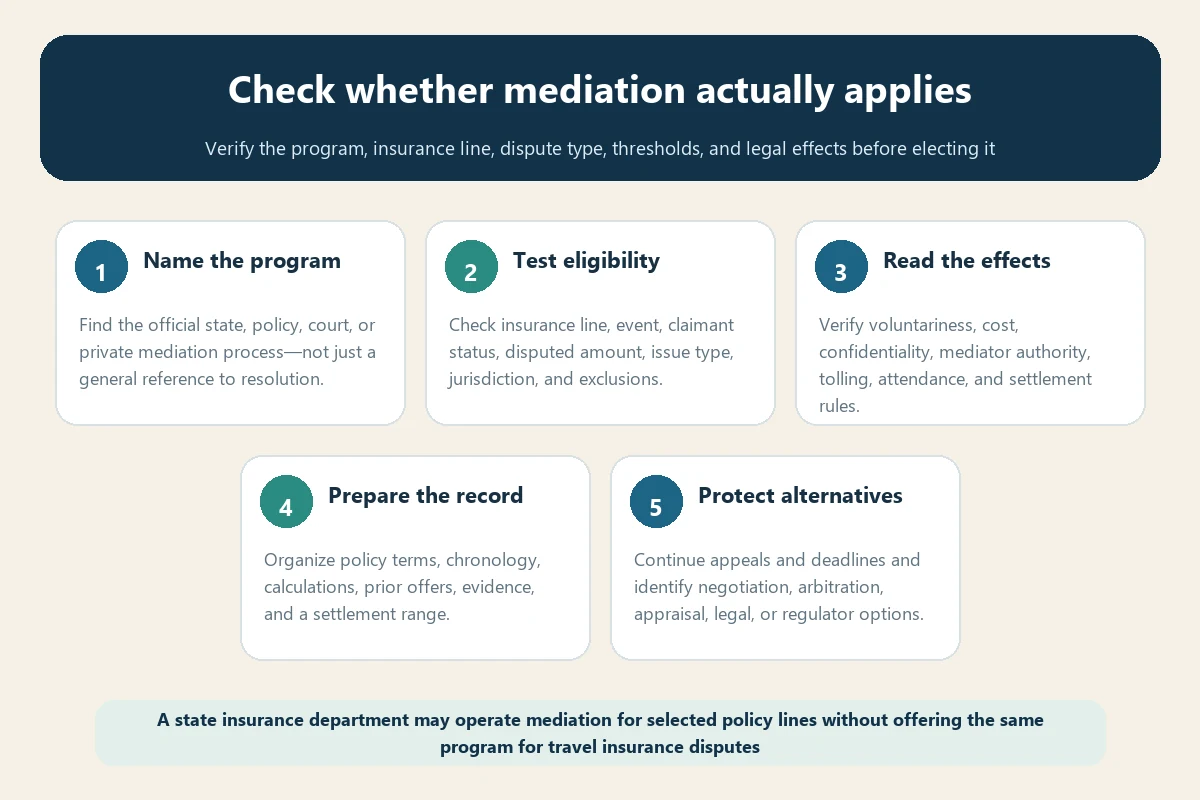
Travel insurance complaint mediation is not a universal service offered by every state insurance department. Some departments operate mediation programs only for named lines such as residential property, earthquake, or automobile physical damage, sometimes after a declared disaster. Verify the exact program before assuming a travel policy dispute qualifies.
Mediation, informal complaint assistance, negotiation, appraisal, arbitration, external review, and a hearing are different processes. Each has its own eligibility, authority, confidentiality, cost, deadline, and settlement effect. This guide is general information, not legal advice.
Start by naming the process
Ask the department whether it offers a formally named mediation program for the insurance line and dispute. Request the program page, statute or rule, application, eligibility criteria, and consumer notice. Do not rely on a staff member’s use of “mediate” to describe ordinary efforts to communicate with the company.
The NAIC explains that state insurance departments can receive complaints, obtain insurer responses, review handling, and require correction when authorized. That ordinary complaint role does not itself create a neutral mediation conference.
Why travel insurance may fall outside state programs
A legislature or regulator may design mediation for high-volume or catastrophe-related disputes with defined valuation issues. Travel insurance can involve different benefits, policy forms, administrators, assistance services, medical records, trip suppliers, and jurisdiction questions.
The existence of an insurance mediation page on a state website therefore proves only that some disputes may qualify. Read the covered policy lines and exclusions.
California illustrates narrow statutory eligibility
California Insurance Code Chapter 8.9 establishes a mediation program for specified claims: certain homeowners fire losses tied to a declared emergency, certain residential earthquake claims tied to a declared emergency, and automobile collision or physical-damage disputes. It also identifies exclusions and monetary thresholds.
The official California insurance mediation statutes do not list ordinary travel insurance disputes in that program. A California travel complaint should not be presented as eligible merely because the department operates mediation elsewhere.
Event-specific programs are also limited
New Jersey’s Storm Sandy Insurance Mediation Program was created for qualifying Sandy-related homeowners, automobile, and commercial insurance claims, subject to its conditions. The page describes a disputed-amount threshold, excludes certain matters, and addresses costs and nonbinding participation.
The official New Jersey Storm Sandy mediation page demonstrates why a disaster program cannot be generalized to unrelated travel insurance claims.
Use an eligibility matrix
For any proposed program, verify:
- State and policy jurisdiction.
- Insurance line and policy type.
- Named event or declared emergency requirement.
- First-party, third-party, insured, or claimant status.
- Minimum claim and disputed amounts.
- Coverage, valuation, damage, legal-interpretation, fraud, or bad-faith exclusions.
- Required complaint or insurer appeal first.
- Open litigation, representation, or prior settlement restrictions.
- Application and election deadline.
One failed condition can make the program unavailable even when the dispute feels suitable for mediation.
Distinguish coverage disputes from valuation disputes
Mediation programs may favor disputes about amount, scope, repair method, or valuation while excluding pure legal interpretation or the absence of coverage. A travel claim denial often turns on a covered reason, exclusion, pre-existing-condition definition, documentation requirement, or timing clause.
Ask whether the mediator may address coverage, only settlement amount, or both. Do not prepare for a valuation conference when the threshold question is whether the policy covers the event at all.
Mediation is generally facilitative, not adjudicative
A mediator usually helps parties communicate and explore agreement but does not impose a decision. California’s official automobile mediation guide says the mediator has no power to impose an agreement and only the parties decide whether to settle.
Review the California Automobile Claims Mediation Program as an example of a defined, nonbinding program. Its rules apply to eligible automobile physical-damage disputes, not travel insurance.
Confirm whether participation is voluntary
Ask whether the consumer and insurer may decline, whether a regulator can compel participation, and what happens after refusal. Do not assume “voluntary” means there are no consequences for failing to appear after election.
Read attendance requirements, cancellation fees, rescheduling, representative authority, and required decision-makers. A company representative without settlement authority can undermine the session unless program rules address it.
Identify who pays
Costs can include mediator fees, administration, attorney fees, expert fees, travel, translation, and document preparation. A state program may require the insurer to pay mediator costs while leaving each party responsible for counsel and experts.
New Jersey’s Sandy page says the insurer pays mediator and administration costs, subject to a policyholder no-show rule. California’s statutes similarly allocate specified program costs. Neither rule establishes who pays in a private travel insurance mediation.
Read confidentiality rules before speaking
Determine whether mediation communications, offers, admissions, documents, and caucus discussions are confidential or inadmissible; who may receive them; what exceptions apply; and whether the regulator keeps a separate complaint record.
Do not assume everything brought to mediation disappears from the regulatory file. Documents previously submitted to the department may remain governed by its retention and public-record rules. The complaint privacy guide covers that separate record.
Never assume mediation tolls a deadline
A statute or agreement may toll a specified limitation for a defined period, but ordinary negotiation may do nothing. California’s Chapter 8.9 contains a tolling provision tied to that particular program and specified dates. It is not a national rule.
Calendar claim appeals, proof-of-loss duties, contractual limitations, statutes of limitation, arbitration, administrative review, and court deadlines independently. Obtain legal advice when a time bar may expire.
Check settlement and rescission rules
A formal program may define when a settlement becomes binding, whether counsel’s signature changes the result, which issues a release can cover, and whether a cooling-off period applies. Private mediation may use different terms.
Do not assume a three-day cancellation right. The settlement during a state complaint guide explains how to review payment, release, withdrawal, confidentiality, performance, and outside deadlines.
Prepare a mediation statement
If the dispute qualifies, organize a concise statement with:
- Parties, policy, claim, and jurisdiction.
- Agreed and disputed facts.
- Relevant policy language.
- Chronology and decisive exhibits.
- Claim calculation and other recoveries.
- Prior offers and responses.
- Requested resolution and negotiable components.
- Nonfinancial terms such as claim status or corrected records.
Follow page limits and exchange rules. Do not overload the mediator with an unsorted claim archive.
Set a settlement range before the session
Calculate the supported claim value, litigation or arbitration costs, timing, uncertainty, release scope, tax or lien issues, and noncash terms. Decide what authority a representative has and which terms require advice.
A mediation range is a decision tool, not a promise to accept. Revisit it when new evidence or terms appear.
Ask what happens to the state complaint
If mediation is connected to a regulator complaint, ask whether the complaint remains open, is administratively paused, closes on settlement, or receives a disposition. Ask what the department learns about offers and outcomes.
A private settlement may resolve consumer relief while the department retains data or independent regulatory authority. The complaint status codes guide explains closure and disposition.
If no state mediation program covers travel insurance
Ask about other available routes:
- Focused negotiation through the complaint examiner.
- The insurer’s internal appeal or reconsideration.
- Contractual arbitration or another dispute-resolution clause.
- Voluntary private mediation agreed by both parties.
- Legal advice and court remedies.
- Another regulator or agency with jurisdiction.
Do not describe private mediation as department-sponsored unless the agency confirms it.
If the insurer has not completed its own reconsideration process, preserve that route with the denied travel insurance claim appeal guide rather than waiting for an uncertain mediation referral.
Review the policy’s dispute clause
Find governing law, venue, arbitration, appraisal, limitation, notice, and service provisions. Travel policies may use different dispute terms depending on the underwriter and state-issued certificate.
Mediation does not automatically replace mandatory arbitration or preserve a lawsuit. Have qualified counsel assess conflicts and enforceability where material.
Use the complaint process accurately
The official NAIC complaint guidance explains the ordinary state complaint workflow and helps locate the correct department. The state travel insurance complaint filing guide helps identify the licensed insurer, jurisdiction, evidence, and requested review.
In your complaint, you may ask whether mediation exists, but do not assert entitlement to a program that excludes the policy line.
Frequently asked questions
Does every insurance department offer mediation?
No. Programs vary, and many cover only specific policy lines, claim types, or disasters.
Can a travel claim use an automobile or homeowners mediation program?
Generally the program’s defined policy line controls. A travel policy does not become eligible merely because the loss involved a car, home, fire, or storm.
Can the mediator force the insurer to pay?
Usually mediation is nonbinding and the mediator facilitates agreement rather than orders payment. Verify the particular program.
Is mediation confidential?
It depends on the governing statute, rule, and agreement. Complaint records and preexisting documents may follow separate disclosure rules.
What if mediation fails?
Use the remaining insurer appeal, arbitration, legal, or regulatory options and deadlines. Ask whether any program-specific tolling ends immediately.
The correct first question is not whether mediation sounds useful, but whether a named program covers the policy and dispute. Verify eligibility, costs, confidentiality, authority, tolling, and settlement effects. If travel insurance is excluded, choose an accurate alternative without sacrificing deadlines.
