
Travel insurance arbitration waiver asks whether a party lost or relinquished the right to insist on arbitration through delay, litigation activity, inconsistent positions, or other conduct. It is not the same as a consumer’s jury-trial waiver, class-action waiver, policy waiver, or contractual opt-out.
Waiver standards depend on the forum and governing law. A court examines a developed record, not a checklist alone. This U.S. consumer guide helps organize that record and distinguish waiver from agreement formation, arbitrability, default, estoppel, forfeiture, and the insurance claim merits. It is general information, not legal advice.
Begin with the exact waiver question
Write the issue precisely: “Did the insurer waive its contractual right to compel arbitration by litigating this dispute in court?” differs from “Did the traveler opt out of the arbitration clause?” It also differs from an argument that the arbitration agreement was never formed or is unenforceable.
Name the party said to have waived the right, the right involved, the conduct relied upon, the dates, the forum, and the requested ruling. Avoid using “waiver” as a label for every objection to arbitration.
Read Morgan v. Sundance carefully
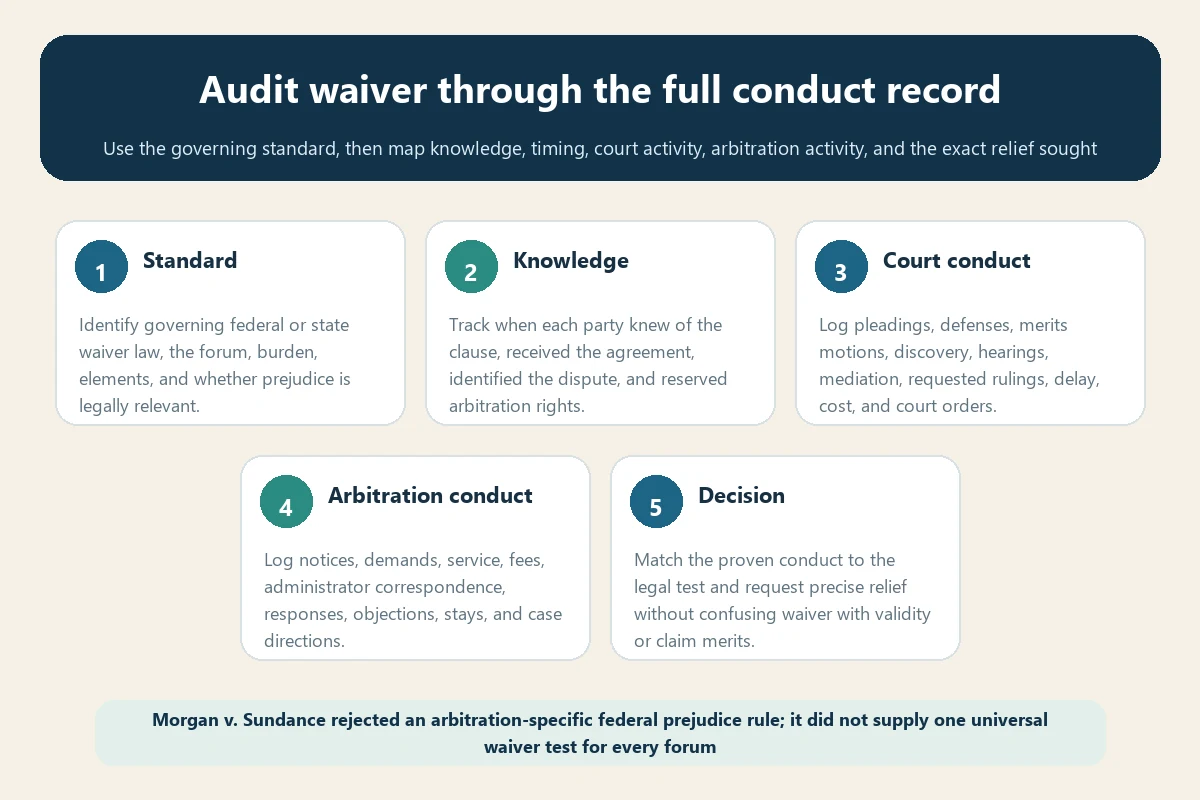
In its official Morgan v. Sundance opinion, the U.S. Supreme Court held that federal courts may not create an arbitration-specific waiver rule requiring a showing of prejudice. The Federal Arbitration Act places arbitration agreements on equal footing with other contracts; it does not authorize special rules favoring arbitration.
Morgan did not decide every waiver question or announce one nationwide factual test for all courts. The opinion returned the case for application of an ordinary waiver rule. Identify the post-Morgan law controlling the actual court and dispute.
Check the Federal Arbitration Act language
FAA Section 3 addresses a stay of litigation for an issue referable to arbitration, provided the applicant is not “in default in proceeding with such arbitration.” FAA Section 4 addresses a petition to compel arbitration and the court’s determination of agreement-related issues.
Use the statutory text as a starting point, not a substitute for the governing cases and procedural rules. “Default,” “waiver,” “forfeiture,” and “estoppel” can carry different meanings.
Separate six concepts that are often combined
- Waiver by conduct: relinquishment of a known arbitration right through inconsistent action.
- Forfeiture: loss of a right through failure to assert it timely, sometimes without intentional relinquishment.
- Default: statutory or contractual nonperformance relevant to a stay or order compelling arbitration.
- Estoppel: a bar based on a position or conduct and justified reliance under applicable law.
- Opt-out: timely exercise of a contractual right not to accept the arbitration provision.
- Validity or scope: whether an enforceable agreement exists and covers the dispute.
The arbitrability guide helps separate formation, delegation, scope, procedure, and merits. Keep the waiver analysis in its own section.
Identify the controlling forum and law
Record the court, jurisdictional basis, governing contract law, choice-of-law provision, applicable arbitration statute, and procedural rules. Determine whether the issue is decided by a court or was validly delegated under the relevant agreement and law.
Do not copy a waiver test from another federal circuit or state without checking whether it controls. Morgan removed an arbitration-specific prejudice requirement in federal waiver doctrine; it did not erase all forum-specific contract principles.
Build one master chronology
Start with plan purchase and delivery of the clause. Add the loss, notice, claim, document requests, denial, internal appeal, complaint, service, answer, amendments, motions, discovery, conferences, mediation, demand for arbitration, motion to compel, stay request, and every ruling.
For each event, record actor, date, forum, document, position, relief sought, arbitration reservation, response, cost, and result. The arbitration timeline guide provides a control ledger.
Establish knowledge of the arbitration right
Preserve when the party received or possessed the policy, certificate, booking terms, claim file, and clause. Note when counsel appeared, when the dispute became identifiable, and when arbitration was first mentioned.
Knowledge should be supported by documents, not assumed merely from company size or sophistication. Also record any genuine uncertainty about the operative contract, party identity, or claim scope.
Audit pleadings and affirmative defenses
Compare the complaint, answer, counterclaims, amendments, removal papers, and case-management statements. Did a party invoke arbitration, reserve it, omit it, deny the contract, or request relief inconsistent with arbitration?
An omitted defense can matter, but its effect depends on governing law and the later record. Preserve the original filing and amendments with docket timestamps.
Classify every court motion
Distinguish jurisdictional, venue, service, preservation, and scheduling motions from motions asking the court to decide the claim merits. Identify whether the party sought dismissal on substantive grounds, summary judgment, an injunction, discovery enforcement, or other affirmative relief.
The arbitration motion guide helps map the requested order and supporting record. The label on a motion matters less than what it asked the court to decide.
Measure delay with context
Calculate time from service, knowledge of the clause, answer, first merits activity, and first arbitration request. Then explain the interval: contract investigation, party identification, settlement, court-ordered schedule, jurisdictional dispute, or unexplained strategic delay.
There is no safe universal number of days. A short period with substantial merits activity may be more significant than a longer period involving only preliminary steps.
Audit discovery and use of court machinery
List document requests, interrogatories, depositions, subpoenas, expert disclosures, admissions, third-party discovery, protective orders, and motions to compel. Identify who initiated each step and whether it concerned gateway or merits issues.
Use the document exchange checklist to compare the information sought in court with what was later sought in arbitration. Avoid assuming that any exchange automatically proves waiver.
Record mediation and settlement conduct accurately
Mediation does not automatically equal litigation on the merits. Record whether it was voluntary or court-ordered, whether arbitration rights were reserved, what scheduling positions were taken, and which nonconfidential procedural facts can lawfully be used.
Protect confidential settlement communications. The arbitration settlement guide helps preserve deadlines and separate negotiation from the adjudicative record.
Compare parallel arbitration conduct
Preserve informal notices, demands, administrator intake, clause registration, fees, service, answers, jurisdiction objections, arbitrator appointment, preliminary orders, and any stay. A party may act in court and arbitration at the same time for legitimate or inconsistent reasons.
The arbitration demand guide identifies the filing and service evidence needed to establish when arbitration was actually invoked.
Do not treat prejudice as the federal special rule
Morgan rejected a federal rule requiring the opponent of arbitration to prove prejudice solely because the contract involved arbitration. That does not make cost, delay, disclosure of strategy, duplicate work, or changed position irrelevant in every legal framework.
Document concrete effects in a separate table without presenting prejudice as a universal element. Identify the authority explaining how the controlling test treats those facts.
Document duplicate work without overstating it
Create a neutral ledger of court fees, attorney work, document production, depositions, expert activity, travel, missed deadlines, and tasks that would need to be repeated in arbitration. Mark which work remains usable and which was caused by the allegedly inconsistent conduct.
This ledger can explain the practical sequence even when prejudice is not a required element. Use invoices, docket entries, production logs, and declarations where appropriate; avoid unsupported estimates or disclosing privileged legal advice.
Preserve rights early and consistently
A party seeking arbitration should identify the clause promptly, assert the right in pleadings where required, request an orderly decision, avoid unnecessary merits litigation, and explain any steps taken before the motion. It should not assume a generic reservation cures all inconsistent conduct.
A party opposing arbitration should object on time, preserve the docket record, identify specific inconsistency, and request precise relief. The preliminary hearing checklist helps organize any parallel case schedule.
Request a precise waiver ruling
State whether the requested ruling applies to all claims, specified claims, all parties, or only one party’s ability to compel. Address what happens next: litigation continues, arbitration is stayed, a motion is denied, or limited proceedings resolve a disputed fact.
Do not ask a waiver ruling to decide travel insurance coverage. Preserve the policy, exclusions, proof, causation, valuation, and damages for the merits forum.
Avoid common waiver-analysis mistakes
- Confusing litigation-conduct waiver with a jury or class waiver.
- Treating Morgan as a universal factual test.
- Using another jurisdiction’s law without checking control.
- Counting months without describing what occurred.
- Ignoring pleadings, reservations, and docketed relief.
- Calling all discovery merits discovery.
- Disclosing protected mediation communications.
- Assuming prejudice is always required or always irrelevant.
- Failing to compare court and arbitration conduct.
- Using waiver to replace the coverage merits analysis.
Final travel insurance arbitration waiver checklist
- Define the exact right and party allegedly waiving it.
- Identify the controlling forum, law, and decision-maker.
- Preserve the agreement and evidence of knowledge.
- Build a dated court-and-arbitration chronology.
- Audit pleadings, motions, discovery, mediation, and requested relief.
- Explain delay rather than relying on elapsed time alone.
- Separate waiver, forfeiture, default, estoppel, and opt-out.
- Document concrete effects under the governing test.
- Request a claim- and party-specific ruling.
- Keep the insurance merits record separate and ready.
A sound waiver analysis is conduct-first and law-specific. It reconstructs what each party knew, said, requested, and did in every forum, then applies the controlling ordinary contract and procedural rules without giving arbitration agreements either favored or disfavored treatment.
