
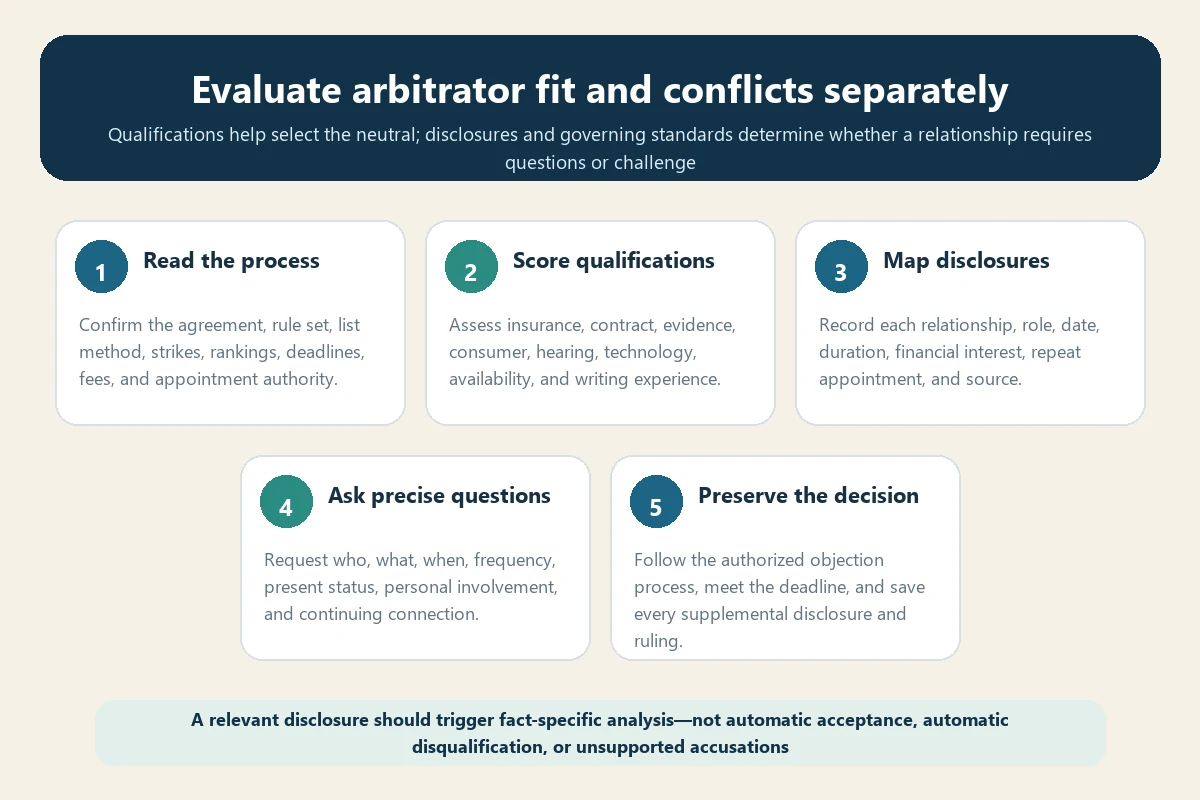
Travel insurance arbitrator selection requires two separate reviews: whether a candidate has the qualifications and availability to manage the dispute, and whether disclosed relationships or interests raise a concern under the governing rules, agreement, ethics standards, or law.
Do not equate familiarity with automatic bias, and do not ignore a relationship because it was disclosed. Use the administrator’s list, ranking, appointment, supplemental-question, and challenge procedures exactly. This guide provides general information, not legal advice.
Start with the appointment clause
Read the complete arbitration provision for number of arbitrators, qualifications, party appointment, neutrality, administrator, list method, ranking, strikes, fallback procedure, venue, fees, and who resolves appointment disputes. Check incorporated rules and their effective date.
A clause may call for one neutral, three neutrals, party-appointed arbitrators, a specialized panel, or administrator appointment. Do not apply a generic ranking process when the agreement provides another method.
Compare the accepted clause copy with the travel insurance arbitration demand guide to confirm that the administrator and appointment terms came from the controlling policy rather than a summary.
Read the governing consumer rules
If AAA administers the case, use the current AAA Consumer Arbitration Rules for appointment, disclosure, disqualification, communication, fees, and arbitrator authority. Other providers and state programs can use different procedures.
Record whether the administrator, parties, another neutral, or a court has the stated appointment role. An unauthorized direct approach to a candidate can create an ex parte communication problem.
Build a candidate comparison matrix
Use the same fields and evidence for every candidate:
- Current role, location, licenses, and professional history.
- Insurance coverage and claim-handling experience.
- Consumer contract and arbitration experience.
- Experience with the disputed benefit or technical issue.
- Hearing, evidence, motion, and case-management experience.
- Written-reasoned-award experience.
- Virtual, in-person, accessibility, and technology capability.
- Hourly or daily rate and estimated availability.
- Disclosures, relationships, and repeat appointments.
- Potential scheduling or geographic constraints.
Do not score identity, reputation, or outcome anecdotes as a substitute for verified qualifications.
Match expertise to the actual dispute
A trip cancellation claim may turn on contract wording, supplier refunds, timing, and causation. A medical claim may involve clinical records, pre-existing-condition definitions, emergency assistance, and currency calculations. A baggage claim can require valuation and possession evidence.
Choose the expertise necessary to understand and manage the issues, not someone who appears likely to favor one side. The arbitration answer guide can help identify which defenses and counterclaims require specialized knowledge.
Evaluate procedural management
Consider whether the candidate can control proportionate information exchange, privilege disputes, protective orders, motions, witnesses, experts, subpoenas, virtual technology, and hearing time. A technically knowledgeable person may still be a poor fit if availability or case-management needs do not align.
Use the preliminary hearing checklist to define the management tasks the neutral will face.
Compare cost using a case estimate
Record rate, minimum increments, study time, conference time, travel, cancellation, hearing days, post-hearing work, award preparation, and administrator allocation. Ask only through the permitted channel.
A lower hourly rate can cost more if the candidate has less relevant experience or needs longer to resolve procedural disputes. A higher rate is not proof of quality.
Check availability against the case calendar
Identify dates for appointment, preliminary conference, document exchange, motions, expert reports, final hearing, and award. Ask about known conflicts and estimated decision time where the process allows.
Do not rank a preferred candidate first if the disclosed availability makes the required hearing schedule impossible.
Understand the purpose of disclosures
Disclosures let parties evaluate relationships and interests before or during the case. AAA’s official arbitrator disclosure guide says doubts should be resolved in favor of disclosure and emphasizes details about who, what, when, where, and how.
The guide also explains that the duty continues throughout the proceeding as new counsel, witnesses, experts, or other participants appear. Treat appointment disclosures as the beginning of the review, not the end.
Read the ethics code in context
The AAA-ABA Code of Ethics for Arbitrators in Commercial Disputes establishes a presumption of neutrality for arbitrators, including party-appointed arbitrators, unless the agreement, rules, or applicable law provide otherwise. It requires disclosure of facts that might affect neutrality, independence, or impartiality.
The code is an ethics source, not a universal statute or automatic disqualification formula. Compare it with the case rules and jurisdiction-specific law.
Create a disclosure map
For each disclosed contact or interest, record:
- Person or entity involved.
- Nature of relationship or service.
- Arbitrator’s personal involvement.
- Start, end, frequency, and most recent date.
- Financial or professional significance if known.
- Whether the matter is pending or concluded.
- Connection to a party, affiliate, counsel, witness, expert, or insurer.
- Source and date of the disclosure.
- Supplemental question and response.
- Objection deadline and decision.
This separates actual facts from assumptions about influence.
Review repeat appointments carefully
Ask about prior or current appointments involving the insurer, administrator, counsel, firm, expert, or related entity when the rules permit. Record number, time period, role, appointing source, and whether information is limited by confidentiality.
Repeat service is not automatically disqualifying. Its significance depends on governing standards and facts such as frequency, recency, financial importance, continuity, and relationship.
Check affiliate and trade-name relationships
Travel protection can involve an underwriter, insurer, claims administrator, assistance company, booking platform, seller, and parent or affiliate. Provide accurate legal names so the conflicts check reaches the relevant entities.
If an affiliate emerges later, notify the administrator through the authorized process and request a supplemental conflicts check.
Include lawyers, witnesses, and experts
An arbitrator may have a relationship with counsel, law firm, witness, medical expert, vendor, or co-arbitrator even if no direct relationship with the named insurer appears. Update the participant list promptly.
AAA’s disclosure guidance emphasizes ongoing checks when new participants are added. Late witness identification can create avoidable delay if it triggers a new disclosure.
Ask fact-specific supplemental questions
A useful question seeks missing facts without argument: Was the representation direct? Is it ongoing? When did it end? How many matters occurred within a defined period? Was the arbitrator personally involved? Did the relationship involve this insurer or an affiliate? Is compensation continuing?
Do not demand confidential details of another arbitration that the candidate cannot disclose. Ask for enough nonconfidential information to evaluate the relationship.
Distinguish disclosure from disqualification
A disclosure may show diligence rather than partiality. Conversely, disclosure does not automatically cure a relationship that meets a disqualification standard. Apply the rule and facts, not a blanket reaction.
AAA’s published Arbitrator Challenge Review Procedures describe factors including whether a conflict is direct, continuing, substantial, and recent, considered together under the stated review framework. Confirm whether those procedures govern the particular case.
Use the authorized objection process
Record who receives the objection, deadline, required form, service, evidence, confidentiality, response opportunity, decision-maker, and effect on the schedule. Submit verified facts, source documents, governing standard, and requested relief.
Do not contact the arbitrator privately or campaign publicly. Use the administrator or case procedure.
Protect the objection deadline
Calendar the initial disclosure date, supplemental disclosure date, participant additions, objection deadline, and time zone. If information is incomplete, request clarification promptly without assuming the request extends the deadline.
Preserve portal notices, emails, attachments, delivery receipts, questions, answers, objection, responses, and ruling.
Avoid unsupported bias accusations
Describe the relationship and governing concern neutrally. Statements such as “the candidate’s former firm currently represents the insurer” are testable; statements such as “the arbitrator is corrupt” require evidence and can undermine credibility.
Focus on impartiality, independence, appearance, disclosure sufficiency, and the exact standard used by the forum or law.
Recognize jurisdiction-specific consequences
State law can impose disclosure duties or vacatur standards beyond provider rules. The Wisconsin Supreme Court’s official decision in Borst v. Allstate addressed evident partiality in a specific insurance arbitration involving an arbitrator who served as ongoing counsel for the insurer.
That decision is not a universal rule for every state or travel policy. It illustrates why active legal relationships and the intended neutrality of the panel require jurisdiction-specific analysis.
Review the final appointment notice
Confirm the selected arbitrator’s legal name, contact restrictions, rate, appointment date, disclosure package, acceptance, availability, case number, and next event. Check whether all parties and entities used in the conflict search are listed correctly.
Do not begin substantive communication until the administrator authorizes it and all parties receive notice.
Maintain an ongoing disclosure log
Add every new party, affiliate, lawyer, witness, expert, vendor, and significant contact. Record when the administrator was notified, whether a supplemental disclosure issued, questions asked, response, objection deadline, and resolution.
Link the log to the arbitration document exchange index so late-produced materials identifying new participants trigger review.
Handle replacement without losing the schedule
If a candidate declines, is removed, becomes unavailable, or withdraws, read the replacement rule. Determine whether prior orders remain effective, the new neutral may revisit them, deadlines are stayed, fees are adjusted, or a new conference is needed.
Ask for a written updated schedule. Do not assume replacement resets every deadline.
Coordinate confidentiality
Disclosures may be limited by confidentiality duties owed in other matters. The arbitration confidentiality guide explains why the need for enough conflict detail must be balanced with protected information from unrelated cases.
Common mistakes
- Ignoring the appointment method in the agreement.
- Choosing only by insurance experience or perceived outcomes.
- Failing to compare cost and availability.
- Equating every disclosure with disqualification.
- Assuming disclosure cures every conflict.
- Using trade names instead of complete legal entities.
- Omitting counsel, witnesses, experts, or affiliates from checks.
- Asking vague or accusatory supplemental questions.
- Missing the objection deadline while investigating.
- Contacting the arbitrator outside the authorized process.
Final selection checklist
- Agreement, rules, and appointment method confirmed.
- Candidate matrix uses consistent evidence and criteria.
- Expertise matches the actual disputed issues.
- Cost and availability fit the case plan.
- All parties, affiliates, counsel, witnesses, and experts identified.
- Disclosures mapped by relationship, date, duration, and significance.
- Supplemental questions are precise and timely.
- Challenge standard and procedure verified.
- Appointment, objection, and ruling records preserved.
- Ongoing disclosure log ready for new participants.
Bottom line
Travel insurance arbitrator selection should be evidence-based. Choose for relevant competence, fair case management, availability, and cost while separately testing disclosures under the governing rules, ethics standards, agreement, and law.
Ask precise questions, avoid unsupported accusations, preserve challenge deadlines, and continue conflict checks throughout the case. Obtain qualified advice when a relationship, non-neutral appointment clause, removal request, or possible award challenge could materially affect the proceeding.
