
Travel insurance appraisal clause arbitration disputes arise when a traveler and insurer disagree about the value or amount of a loss and one side invokes a valuation procedure. Appraisal and arbitration are not automatically the same. The issued clause, governing state law, and disputed issue control.
This U.S. guide explains how to separate coverage from amount, identify prerequisites, select qualified appraisers, preserve valuation evidence, review an award, and keep broader arbitration questions distinct. It is educational, not legal advice.
Confirm that the travel policy has an appraisal clause
Collect the exact issued clause, endorsements, schedule, claim conditions, legal-action provision, arbitration clause, and state amendments. Search for appraisal, valuation, amount of loss, appraiser, umpire, competent, impartial, and award.
Do not rely on a generic online article or another insurance product. Many travel policies may not provide appraisal at all.
Distinguish appraisal from arbitration
Appraisal commonly determines value, price, or amount of loss through appraisers and an umpire. Arbitration can decide a contractual controversy through a more adjudicative process, depending on the agreement.
Some jurisdictions treat appraisal as a narrow arbitration form; others distinguish them. Apply the governing rule instead of assuming terminology decides procedure.
Separate coverage from amount
Coverage asks whether the policy responds to the event, property, person, territory, date, cause, and claimed benefit. Amount asks the covered loss’s value after limits, depreciation, deductibles, salvage, and other valuation rules.
A dispute about whether baggage was actually stolen is different from disagreement over the stolen item’s covered value.
Inventory the disputed property
Create one row for each bag, device, camera, instrument, jewelry item, mobility aid, document, rental item, or other property. Record description, owner, purchase date, original price, condition, proof, claimed amount, insurer amount, limit, and exclusion.
Use the travel-insurance claim-filing guide to organize receipts, photos, carrier reports, and proof before invoking a valuation mechanism.
Quote the policy valuation standard
Identify actual cash value, replacement cost, repair cost, depreciated value, market value, scheduled value, original purchase price, or another measure. Record age, condition, useful life, and maximum benefit.
An appraiser cannot choose a more favorable valuation standard that the contract does not provide.
Apply sublimits before debating totals
Check per-item, per-category, aggregate, high-value, electronics, jewelry, sports equipment, and unattended-property limits. Separate limit interpretation from arithmetic.
If the policy caps the category below both valuations, appraisal may not change payment unless the cap itself is disputed.
Account for other recoveries
Record airline or carrier payment, credit-card benefits, homeowners or renters insurance, merchant refund, warranty, repair reimbursement, salvage, and recovered property.
Apply other-insurance and subrogation terms accurately. Do not seek duplicate payment for the same economic loss.
Identify prerequisites to appraisal
The clause may require a written demand, itemized disagreement, completed proof of loss, production, inspection, examination under oath, or meaningful exchange of valuation information.
The condition-precedent arbitration guide helps classify these post-loss duties and possible consequences.
Establish an actual disagreement
Preserve the traveler’s itemized amount, insurer estimate, depreciation, methodology, requests for clarification, and written response. A demand may be premature before both sides can form a valuation position.
Identify every agreed item so the neutral process addresses only the real difference.
Resolve the claim record before escalating valuation
Confirm that the insurer has the receipts, ownership evidence, carrier report, photographs, serial numbers, repair estimate, and explanations needed to state its position. Use the cooperation-clause arbitration guide to distinguish a missing material record from a valuation disagreement.
If an examination under oath was requested, document whether it is a contractual prerequisite and what amount-related questions remain. If the claim was denied entirely, first compare the stated grounds with the claim-denial guide. Appraisal should not be used to bypass an unresolved coverage decision or manufacture agreement that a loss is covered.
Use appraisal precedents cautiously
An official Eleventh Circuit insurance decision discusses appraisal as narrowly restricted to actual cash value and amount, meaningful information exchange, and post-loss obligations under Florida law.
It concerns property insurance, not a standard travel policy. Use the analytical distinction only after confirming the travel contract and governing state law.
Keep coverage questions outside a narrow appraisal
An official 2025 Eleventh Circuit decision quotes a policy limiting appraisal to amount of loss and excluding coverage questions.
A travel insurer should not use a valuation award to silently decide an excluded cause, ownership, eligibility, or another coverage issue outside the clause.
Select a competent appraiser
Match expertise to the property: consumer electronics, cameras, jewelry, luggage, assistive equipment, instruments, antiques, or repair. Preserve qualifications, licenses if relevant, methods, fees, availability, and conflicts.
An appraiser should understand the policy valuation measure, not merely the retail market.
Test impartiality and independence
Disclose relationships with the traveler, insurer, adjuster, attorney, vendor, and prior matters. Record compensation and whether any fee depends on outcome.
Competent and impartial are separate requirements. Follow the exact clause and governing law.
Select or appoint the umpire correctly
Preserve each side’s proposed candidates, disclosures, selection efforts, deadline, appointment mechanism, and court application if the clause permits one.
Do not involve the umpire before the appraisers actually disagree unless the procedure allows it.
Define the submission
List the specific property and amount questions submitted. State the valuation date, policy measure, deductible treatment, taxes, repair, depreciation, salvage, and limits that are agreed or reserved.
A written scope reduces the risk that an award decides coverage or another issue the parties did not submit.
Build a valuation evidence file
Include receipts, credit-card statements, photographs, serial numbers, model information, condition evidence, repair estimates, comparable sales, replacement quotes, expert reports, and depreciation schedules.
Explain missing receipts with alternative proof rather than fabricating precision.
Document methodology
For each item, state data source, comparable selection, adjustments, depreciation rate, condition, remaining useful life, taxes, shipping, repair feasibility, and confidence range.
The final number should be reproducible from the evidence and policy standard.
Separate causation from measurement
A repair estimate can reveal damaged components and cost, but whether the covered event caused that damage may be a coverage question. Identify which factual findings are necessary only to measure amount.
Reserve disputed causation in writing when the appraisal clause excludes it.
Preserve hearings and inspections
Record inspection date, attendees, property condition, tests, photographs, evidence exchanged, questions, presentations, and whether a formal hearing occurred.
Appraisal can be less formal than arbitration. Do not assume full discovery or evidentiary rules unless the agreement or law supplies them.
Review the award’s form
Confirm signatures, itemization, agreement by the required participants, valuation date, amount, reservations, and delivery. Check whether the award exceeds the written submission.
An amount award does not necessarily equal immediate payment; coverage, limits, deductible, and other policy terms may remain.
Understand appraisal-award review
Grounds and procedures for confirming, vacating, or modifying appraisal vary by state and by whether appraisal is treated like arbitration. Calendar contractual and statutory deadlines immediately.
An unfavorable valuation is not itself proof of bias, misconduct, or excess of authority.
Do not confuse appraisal waiver with arbitration waiver
Delay, litigation conduct, payment, denial, or inconsistent action may allegedly waive appraisal. The governing test may differ from arbitration waiver.
Preserve demand dates, pleadings, discovery, reservation letters, payments, and prejudice allegations.
Analyze a separate arbitration clause
If the policy also contains arbitration, determine whether it covers coverage disputes, appraisal enforcement, award challenges, bad-faith claims, statutory claims, or other controversies.
Do not allow two dispute clauses to overwrite each other. Reconcile their text, hierarchy, and specific-versus-general scope.
Test formation and delegation
Preserve offer, assent, delivery, parties, incorporation, authority, and version. Identify any delegation of arbitrability and whether appraisal questions are included.
A formed appraisal clause does not automatically prove formation of a broader arbitration agreement.
Apply the FAA carefully
9 U.S.C. §2 addresses written arbitration provisions involving commerce. Whether a state-law appraisal is arbitration for FAA purposes requires specific analysis.
Do not cite the FAA merely because the word award appears.
Use Fifth Circuit valuation authority carefully
An official Fifth Circuit decision discusses a property-loss appraisal award, appraisers, an umpire, and review under Texas law.
It provides procedural context, not travel-insurance coverage advice. Confirm the issued travel clause before borrowing any rule.
Create an appraisal matrix
Use columns for item, ownership, coverage status, policy valuation measure, claimed value, insurer value, evidence, depreciation, limit, deductible, other recovery, appraiser, disputed issue, award, and remaining coverage question.
Mark amount and coverage disputes in different colors or fields.
Questions for qualified counsel
- Does the issued travel policy actually authorize appraisal?
- Is the dispute about coverage, amount, or both?
- Which post-loss prerequisites remain?
- How are appraisers and the umpire selected and challenged?
- What issues and remedies can the award decide?
- How do appraisal, arbitration, and court review interact?
Practical takeaway
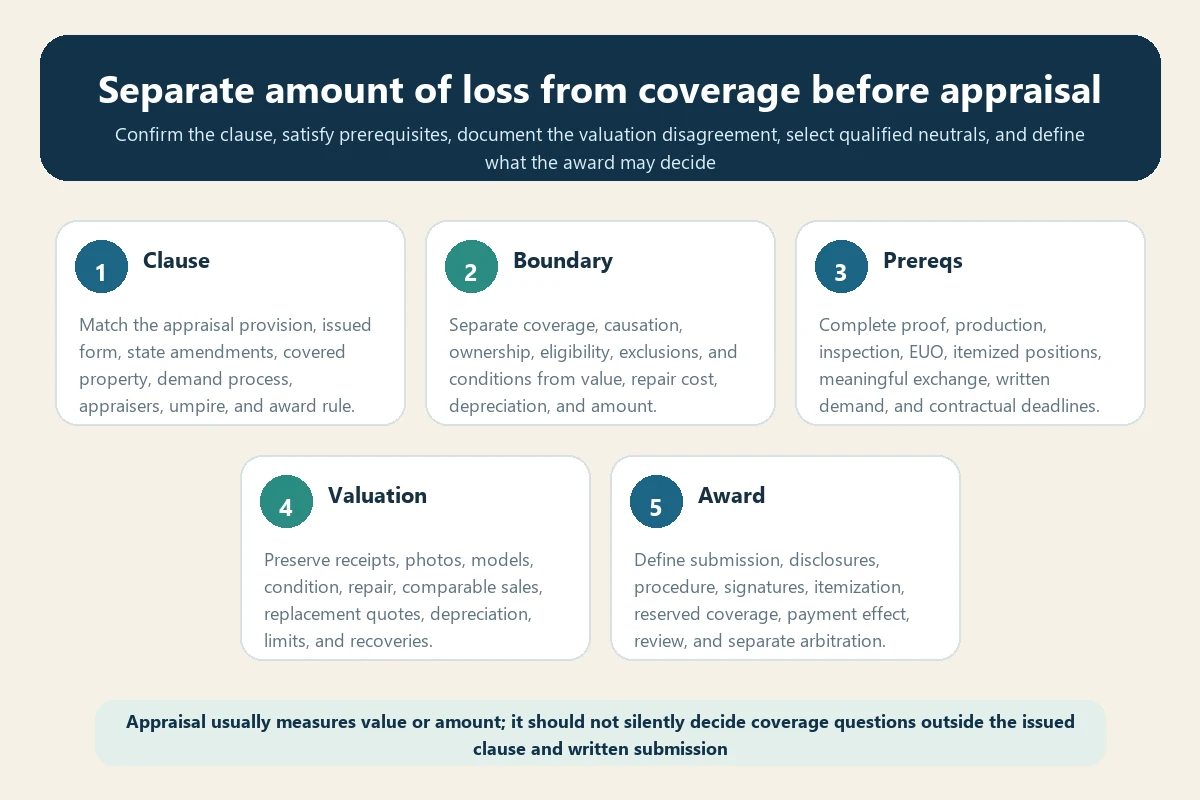
Use appraisal only when the travel policy and governing law support it. Separate coverage from amount, satisfy post-loss duties, document a real disagreement, select qualified and impartial participants, define the submission, and preserve reproducible valuation evidence.
Then analyze any broader arbitration clause separately. Appraisal, arbitrability, award review, coverage, payment, and remedies do not necessarily share one procedure or decision-maker.
Choice of law identifies the substantive rules proposed for a dispute; it does not automatically choose the court, create jurisdiction, or erase mandatory insurance protections. Use this travel insurance choice of law clause guide to preserve the issued policy, map state contacts, distinguish forum language, and calendar every potentially applicable deadline.
A suit limitation clause sets a potential filing deadline, but notice, proof of loss, appeal, arbitration, and court filing can each have a different clock. Use this travel insurance suit limitation clause guide to identify the trigger, compare state rules, preserve tolling and waiver evidence, and protect the earliest plausible deadline.
