
If you received a travel insurance claim incorrect 1099, compare the tax form with the claim decision and actual payment before using it on a return. Identify the exact form, payer, recipient, tax year, box, gross amount, withholding, and account reference, then ask the issuer—not the claims claimant—to correct its filed record.
A Form 1099 is an information return, not a complete tax analysis. Whether an insurance payment is taxable or reportable can depend on what it replaces, who owns it, prior deductions, business use, settlement terms, interest, and other facts. This U.S.-focused guide is general information, not tax, legal, accounting, or insurance advice. Use a qualified tax professional for your return.
Identify exactly what is wrong on the 1099
Do not report only that “the 1099 is wrong.” Create a field-by-field comparison. Record the form type, payer legal name and taxpayer ID, recipient legal name and masked TIN, recipient address, account number, tax year, every populated box, federal and state withholding, and whether the copy says corrected.
| Possible error | Compare with | Correction evidence |
|---|---|---|
| Wrong gross amount | Claim approval and payment advice | Line-item payment ledger |
| Wrong recipient | Policy, release, payee instruction | Legal payee record |
| Wrong name or TIN | Verified taxpayer record | Secure W-9 or proper W-8 route |
| Wrong form or box | Payer’s stated payment category | Written classification explanation |
| Wrong tax year | Payment and constructive-receipt facts | Dated disbursement records |
| Wrong withholding | Gross-to-net calculation | Withholding and deposit statement |
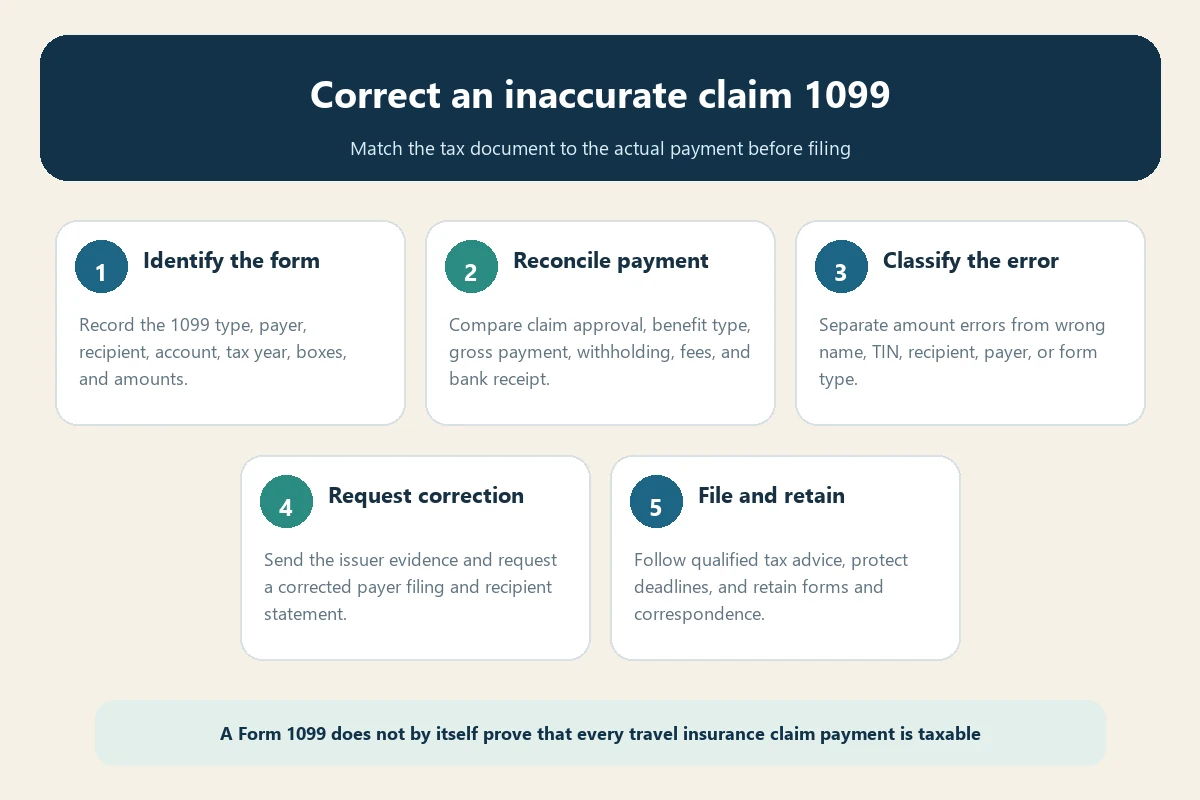
Reconcile the form with the travel claim
Build a claim ledger showing the amount requested, approved benefits, deductible, policy limits, offsets, prior payments, interest, fees, tax withholding, and net funds received. A 1099 amount may not equal the check or deposit if it reports a gross component, but the payer should be able to explain the difference.
Use the claim payment fee guide to separate bank or processing charges from tax reporting. If the insurer says tax was withheld, compare the form with the claim tax withholding checklist.
Determine which entity actually issued the form
The brand that handled the claim may not be the legal payer shown on Form 1099. An insurer, claims administrator, payment vendor, bank, settlement administrator, attorney, employer, or another entity may appear. Use the issuer name and contact information printed on the form, then independently verify the phone number or secure portal.
The IRS guidance for an incorrect Form 1099-K tells recipients to contact the filer and keep correspondence. That form-specific page should not be used to assume every 1099 has the same return treatment, but its issuer-first principle is useful. See the official IRS Form 1099-K FAQ.
Do not assume the form proves taxability
Travel insurance payments can represent reimbursement of trip cost, medical expense, baggage loss, delay benefit, accidental death coverage, provider payment, interest, settlement proceeds, or another item. A payer’s information-return decision does not eliminate the need to determine the correct federal and state tax treatment.
Ask the payer to state what the reported amount represents and why it selected that form and box. Do not ask a claims representative to prepare your tax return. A tax professional can analyze whether the form aligns with the underlying transaction and how an unresolved error should be handled accurately.
Separate an amount error from an identity error
The current IRS General Instructions for Certain Information Returns use different correction procedures for common dollar errors and for errors involving a payee name, TIN, or wrong return type. The payer or filer performs those information-return corrections; the recipient should supply accurate evidence and obtain the corrected statement.
A wrong amount may require a new return marked corrected. A wrong name, TIN, or form type can require a more involved sequence that identifies and reverses the incorrect record before reporting the correct one. Do not alter the PDF, cover the wrong field, or create your own “corrected” copy.
Verify name and TIN through a secure route
If the issue is a misspelled name, maiden name, entity name, estate, trust, joint payee, or TIN mismatch, identify the legal recipient first. The claimant, traveler, policyholder, bank-account owner, and taxable payee are not necessarily the same person.
The travel claim W-9 request guide explains how to verify a requester before transmitting taxpayer data. Never email an unmasked Social Security number to an unfamiliar address, and never change a TIN merely to match a claims portal.
Joint payees and alternate recipients need allocation
A claim payment may include two travelers, a medical provider, an attorney, an estate, or a business. Ask the issuer which recipient and TIN it reported, which portion it attributed to that recipient, and why. A bank’s endorsement requirements do not decide federal tax ownership.
For a two-name disbursement, use the two-payee claim check guide for payment handling, but obtain tax guidance for allocation. If more than one 1099 reports the same payment, list every payer, account number, amount, and form rather than requesting a vague duplicate deletion.
Check the tax year against the payment record
The travel date, loss date, claim filing date, approval date, check date, deposit date, and reporting year can differ. Ask the issuer which payment event placed the amount in the stated tax year. Preserve check images, ACH advice, card activation history, reissued-payment records, and bank statements.
If a payment was voided, returned, reissued, never received, or paid after year-end, state those facts precisely. The expired claim check reissue guide helps document stale checks without assuming the tax result.
Match gross amount, withholding, and net receipt
Recalculate the form using a transparent equation: gross amount reportedly paid, less federal withholding, less state withholding, less separately disclosed non-tax charges, equals expected net receipt. Then compare the result with every actual deposit.
If the payer recouped an overpayment, do not simply net two years or two forms together. Use the claim overpayment repayment guide to document the original payment, recovery demand, repayment, waiver, and revised ledger, then ask a tax professional about the reporting years.
Send a complete written correction request
Address the request to the filer’s tax-reporting or information-returns team. Include the claim number and masked account reference, but transmit a full TIN only through a verified secure channel. State each disputed field, the value shown, the value you believe is correct, and the source record supporting it.
Request written confirmation of:
- the legal payer and form type;
- the payment category and gross amount reported;
- the recipient name, masked TIN, and account used;
- the tax year and reason for that year;
- federal and state withholding amounts;
- whether the payer will file a correction with the IRS;
- when a corrected recipient statement will be issued; and
- the case number and responsible department.
Attach the claim decision, line-item payment advice, relevant bank proof, and earlier tax document. Send copies rather than irreplaceable originals and retain delivery confirmation.
Understand the corrected statement
When the replacement arrives, compare every field again. A corrected amount should reconcile with the claim ledger, while a name, TIN, or form-type correction may produce more than one information-return entry. Do not discard the original because it explains the correction trail.
Confirm that the issuer corrected both its filing and the recipient statement when required. A revised claim letter alone may not update information already submitted to the IRS. Conversely, a portal label saying “corrected” is not enough if no downloadable statement or confirmation exists.
Use a wage and income transcript as a cross-check
An IRS wage and income transcript shows information-return data reported to the IRS, including Form 1099 series data, although timing and available fields have limits. The official IRS Topic 159 explains online and Form 4506-T transcript access.
A transcript is a cross-check, not proof that the payer’s entry is substantively correct. It may also lag a correction. Compare the transcript with the original form, corrected form, issuer confirmation, and actual payment records.
Protect the tax filing deadline
Ask for a correction promptly, but do not ignore a filing deadline while correspondence remains open. The IRS advises taxpayers missing or awaiting corrected documents to contact the payer or issuing agency. See its current guidance on missing and corrected tax documents.
Different 1099 types and transaction facts can require different return treatment. A qualified tax professional can advise whether to file with available accurate records, seek an extension, attach an explanation where appropriate, or amend a previously filed return. Do not copy the special 1099-K “zero out” procedure onto another form without confirming that it applies.
Escalate an unresolved issuer error carefully
Escalate from claims service to the payer’s tax-reporting, compliance, legal, or executive-resolution channel. Provide the original request, evidence, delivery proof, response, and a short field-by-field correction table. Keep the insurance-benefit dispute separate from the information-return dispute.
If the underlying claim handling remains disputed, the NAIC state insurance department directory links to official state regulators. A state insurance regulator generally does not prepare federal tax returns or directly edit IRS information-return records.
Watch for identity theft and correction scams
An unknown payer, unknown claim, unfamiliar account, or form bearing your TIN can indicate identity misuse. Verify the issuer independently, protect the form, monitor tax records, and follow official IRS identity-theft guidance. Do not pay a “release tax” or correction fee by cryptocurrency, gift card, wire, or remote-access session.
Use the travel claim payment scam guide when a caller changes payment instructions or demands money to fix the form. A legitimate correction request should not require sharing online banking credentials or one-time codes.
Keep one permanent correction file
Retain the policy, claim decision, payment calculation, bank proof, original 1099, correction request, secure taxpayer form receipt, correspondence, corrected 1099, transcript, and tax-professional advice. Maintain a timeline of form receipt, payer contact, promised correction date, filing deadline, and final resolution.
The final file should let another reviewer trace the reported gross amount to the actual travel claim, identify the legal recipient, explain every withholding entry, and confirm how the payer corrected its records.
Bottom line
For an incorrect 1099 after a travel insurance claim, identify the exact error, reconcile it with the gross payment and legal payee, and send the issuer a documented correction request. Obtain the corrected statement, cross-check IRS records when appropriate, protect the filing deadline, and use qualified tax advice rather than assuming the form itself proves taxability.
