

Travel insurance arbitration accord and satisfaction disputes arise when an insurer, platform, or traveler argues that a payment or accepted performance resolved a contested claim. The issue may involve a “payment in full” check, partial reimbursement, refund, credit, settlement draft, release, or electronic transfer.
This U.S. consumer guide explains how to audit the disputed amount, tender, notice, acceptance, statutory rules, discharge scope, arbitration clause, and defenses. It is not legal advice.
Start with the exact claim ledger
List every amount demanded, admitted, denied, paid, refunded, credited, recovered from a supplier, or still disputed. Separate trip cancellation, interruption, delay, medical, baggage, rental, assistance, interest, fees, and extra-contractual claims.
A payment may concern only one benefit or expense. Do not treat it as settlement of the entire trip without supporting text and law.
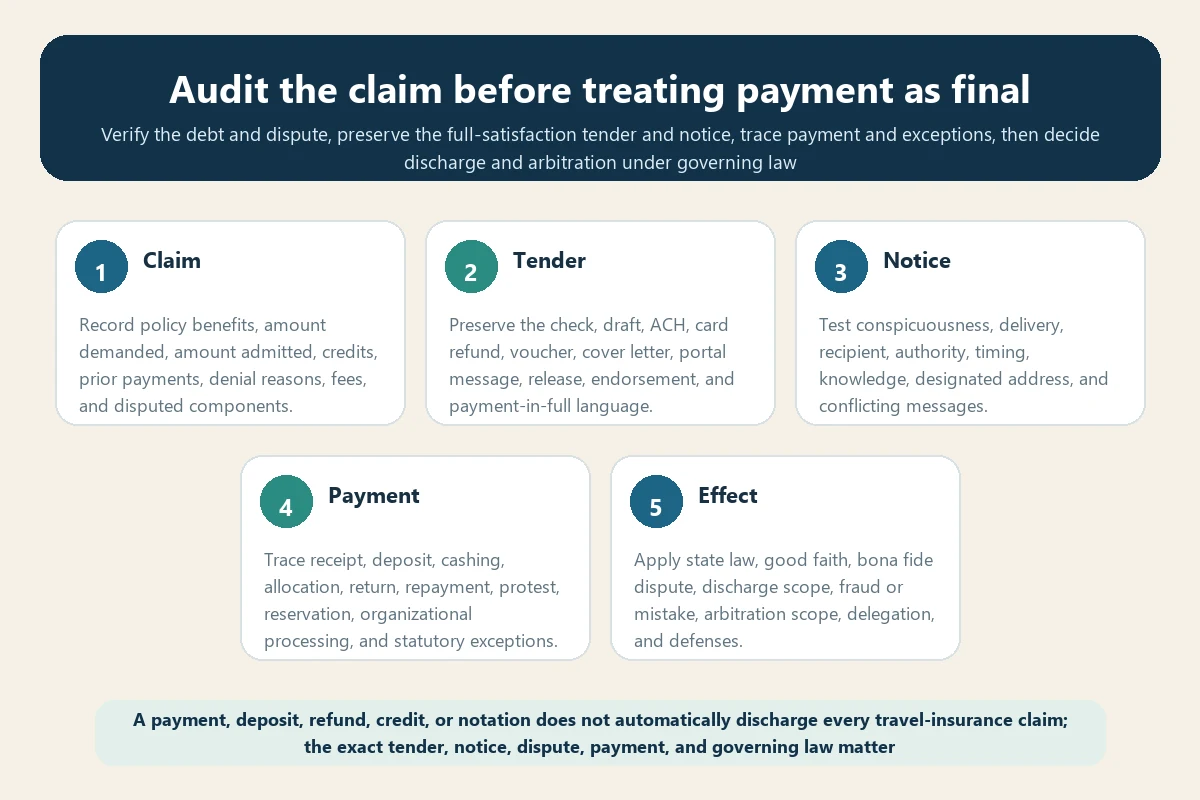
Define accord and satisfaction carefully
An accord is an agreement to accept stated performance in resolution of an existing claim; satisfaction is performance of that accord. Exact elements, statutes, common-law rules, and burdens differ by state.
Do not use the phrase as a synonym for any payment, release, settlement negotiation, or claim closure.
Identify governing law first
Review policy and settlement choice-of-law clauses, state of residence, place of contracting, payment location, forum rules, and controlling authority. Determine whether a negotiable-instrument statute, insurance-specific statute, common law, or more than one rule applies.
A check governed by one state’s Uniform Commercial Code enactment may be analyzed differently from an ACH transfer, card refund, or travel voucher.
Use the Federal Arbitration Act correctly
Section 2 of the Federal Arbitration Act generally makes written arbitration provisions involving commerce enforceable on ordinary contract footing. It does not create a federal accord-and-satisfaction rule.
State law ordinarily governs whether a claim was discharged. The arbitration analysis separately asks who decides that defense and whether the clause reaches it.
Understand the UCC payment-in-full pattern
As one official state example, Florida Statutes section 673.3111 addresses accord and satisfaction by instrument. Its framework includes good-faith tender, an unliquidated or bona fide disputed claim, payment obtained, and a conspicuous full-satisfaction statement, subject to exceptions.
Do not assume Florida law applies or that every state has identical text, interpretation, notice routes, organizational exceptions, or repayment periods.
Identify a bona fide dispute
Preserve the proof of loss, itemized expenses, benefit calculation, denial, appeal, policy limits, supplier refunds, deductible, depreciation, and correspondence showing why the amount was contested.
A debtor cannot necessarily manufacture a genuine dispute by simply offering less than an undisputed fixed amount. Apply the controlling jurisdiction’s standard.
Determine whether the amount was liquidated
Record whether the amount was fixed, readily calculable, dependent on disputed facts, or subject to competing policy interpretations. Separate an admitted minimum from an additional contested balance.
Payment of an undisputed amount may have a different effect from a compromise of an uncertain total.
Audit good faith
Examine how the amount was calculated, why the tender was labeled final, whether material facts were disclosed, and whether the timing or process was designed to surprise the recipient.
Preserve internal and external communications lawfully available, plus the claimant’s prior demands and the payer’s contemporaneous explanation.
Preserve the exact tender
Keep front and back images of a check, remittance data, envelope, endorsement, deposit record, ACH description, card statement, voucher terms, cover letter, email, portal screen, release, and settlement agreement.
Record sender, recipient, date, amount, payment method, account, reference number, and all accompanying communications.
Test whether the statement was conspicuous
Identify the precise words allegedly communicating full satisfaction, where they appeared, font and placement, what document they referenced, and whether conflicting language limited the tender to one expense or benefit.
A small memo-line notation, separate portal message, and signed release may not carry the same evidentiary weight.
Identify who received the notice
Record whether the tender reached the traveler, attorney, public adjuster, provider, travel agent, family member, corporate lockbox, bank processor, or designated dispute office. Analyze authority to receive and accept the proposed resolution.
Automated processing by an organization can raise different statutory issues from a claimant personally endorsing a check.
Check designated-address rules
Some UCC enactments include an organizational exception when a claimant previously sent a conspicuous statement directing communications about disputed debts to a designated person, office, or place, and the tender did not reach it.
Preserve the designation, delivery proof, effective dates, tender route, and actual recipient. Apply the exact state text.
Trace whether payment was obtained
Determine whether a check was deposited, cashed, rejected, stopped, returned, or reversed. For electronic payments, identify authorization, settlement, reversal rights, and whether the recipient took any affirmative acceptance step.
Receipt alone may differ from obtaining payment under the governing rule.
Do not rely on a protest alone
A claimant may write “under protest,” cross out “payment in full,” or send a reservation letter. The legal effect can depend on the applicable accord-and-satisfaction statute rather than general reservation-of-rights principles.
Preserve the protest, timing, delivery, altered instrument, deposit, and any response. Do not promise that unilateral wording defeats discharge.
Check statutory repayment options
Some state UCC provisions may allow a claimant to avoid discharge by tendering repayment within a specified period, subject to organizational exceptions and other conditions. Verify the current statute and case law immediately.
Record the payment date, discovery date, repayment deadline, method, amount, recipient, and delivery proof.
Separate a check from a signed release
A signed settlement and release may create an express contract with its own definitions, claims, parties, consideration, conditions, revocation rights, confidentiality, and dispute-resolution terms. Analyze it independently.
The travel insurance claim release guide helps audit scope, unknown claims, parties, payment, authority, and reservations.
Separate accord and satisfaction from novation
Accord and satisfaction addresses resolution and discharge of a claim through agreed substitute performance. Novation concerns replacement of an obligation or party with intent to extinguish the old obligation.
Use the arbitration novation guide when the dispute centers on a new contract replacing the old one.
Separate it from waiver and ratification
Waiver concerns intentional relinquishment of a known right; ratification concerns later affirmation of an unauthorized act. A deposit or accepted benefit may be argued under multiple theories, but each has distinct elements. Use the arbitration waiver guide when inconsistent litigation conduct is the actual issue.
The ratification guide provides a separate knowledge, authority, intent, conduct, and objection analysis.
Map refunds, credits, and vouchers separately
A supplier refund may reduce the insured loss without settling a dispute with the insurer. A platform credit may resolve a booking obligation but not a policy claim. A benefit payment may be an admitted partial amount.
Identify payer, recipient, underlying contract, consideration, restrictions, expiration, and any full-resolution language for each transaction.
Check allocation language
Determine whether the payment was allocated to one invoice, one traveler, one coverage, principal, interest, costs, or the entire claim. Compare the remittance advice, claim ledger, release, and accounting entries.
Unilateral internal allocation does not necessarily establish the agreement required under governing law.
Analyze fraud, mistake, and duress claims
Preserve alleged misrepresentations, missing pages, erroneous calculations, duplicate deposits, emergency pressure, language access, capacity concerns, and corrective communications.
Apply the jurisdiction’s standards and remedies. Do not assume every mistake invalidates a discharge or every financial need proves duress.
Decide which agreement contains arbitration
The policy, booking terms, settlement, release, payment portal, or incorporated rules may contain different dispute provisions. Identify which party invokes which clause and how it was formed.
Use the incorporation-by-reference guide if the asserted clause appears in a linked or separate document.
Separate formation from scope
In Granite Rock Co. v. International Brotherhood of Teamsters, the U.S. Supreme Court emphasized that courts apply arbitration agreements according to ordinary contract formation and consent principles.
First identify a valid agreement between the relevant parties. Then ask whether its language covers a later payment, discharge, settlement, or release dispute.
Address delegation separately
If a party says an arbitrator must decide accord and satisfaction, identify the exact delegation clause and incorporated rules. Determine whether the challenge concerns formation, the delegation itself, or the merits of a discharge defense.
Preserve objections specifically directed to delegation and the proposed decision-maker.
Build an evidence matrix
Create rows for claim amount, admitted amount, bona fide dispute, governing law, good faith, tender, instrument, full-satisfaction statement, conspicuousness, designated address, recipient, authority, payment, repayment, release, allocation, scope, delegation, and defenses.
For each row, cite supporting and contrary evidence, date, source, custodian, and authenticity. This prevents a memo line from being treated as the entire agreement.
Preserve reasonable defenses
Potential defenses include no genuine dispute, liquidated debt, lack of good faith, no conspicuous final-payment notice, wrong recipient, designated-address exception, no payment obtained, timely repayment, fraud, mistake, duress, wrong party, partial allocation, claim outside discharge, no valid arbitration agreement, invalid delegation, or waiver.
A party asserting discharge should address every conflicting letter, ledger entry, payment explanation, reservation, and statutory exception rather than relying only on the instrument.
Use a disciplined decision sequence
- Reconcile the full claim and payment ledger.
- Identify governing state, UCC, insurance, and contract law.
- Prove a genuine dispute and the exact tender.
- Audit final-payment notice, recipient, authority, and payment.
- Test designated-address and repayment exceptions.
- Define the exact scope of any discharge or release.
- Analyze arbitration formation, scope, delegation, and defenses.
Bottom line
Travel insurance arbitration accord and satisfaction cannot be resolved by spotting a payment, deposited check, refund, credit, or “payment in full” notation. The reliable method is to reconstruct the disputed claim, tender, notice, recipient, payment, statutory exceptions, and intended discharge under governing law.
Only after that should anyone decide whether the asserted claim remains live and whether a valid arbitration clause assigns the dispute to a court or arbitrator.
