
Travel insurance contra proferentem arbitration disputes ask whether genuinely ambiguous policy language should be read against its drafter and how that rule interacts with an agreement to arbitrate. The answer is not automatic: governing state law, the complete contract, the identity of the drafter, and the exact issue all matter.
This U.S. consumer guide provides a document-first method for separating coverage interpretation from arbitration formation, scope, delegation, procedure, and remedies. It is educational, not legal advice.
Understand the rule before invoking it
Contra proferentem is a rule that may construe unresolved ambiguity against the party responsible for the language. Insurance law often applies a related protective principle because standard policy wording is commonly prepared by the insurer.
The rule does not mean every difficult clause loses, every exclusion disappears, or every disagreement is resolved for the policyholder. Its trigger and position in the interpretive sequence vary by jurisdiction.
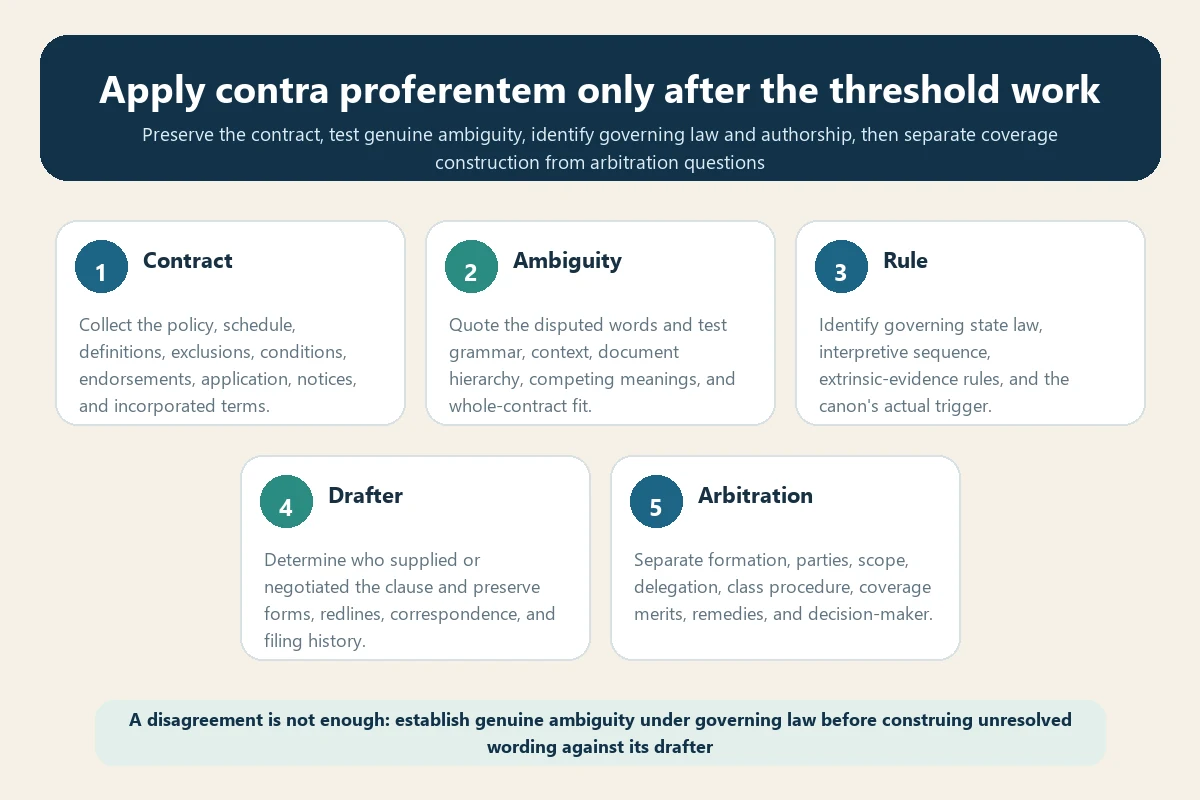
Preserve every contract document
Collect the policy, certificate, declarations or schedule, benefits, definitions, exclusions, conditions, endorsements, amendments, application, purchase confirmation, notices, and incorporated materials. Record form numbers, revision dates, state, plan, travelers, effective dates, and delivery method.
A quoted sentence cannot be evaluated reliably if an endorsement changes it or a definition elsewhere supplies its meaning. The incorporation-by-reference guide explains how to audit external terms without assuming they became part of the bargain.
Quote the disputed language exactly
Copy the words, punctuation, capitalization, headings, numbering, cross-references, exceptions, and provisos. Identify each proposed interpretation and state the practical result: payment, exclusion, limitation, arbitration, court litigation, delegation, or another consequence.
Do not rewrite the clause into a cleaner version. The actual syntax and placement may determine whether a proposed meaning is reasonable.
Test for genuine ambiguity first
A policy is not ambiguous merely because two parties offer conflicting readings. Read the text in context, give provisions operative effect, and reject meanings that depend on omitted words, broken grammar, or an isolated fragment.
The policy-ambiguity arbitration guide provides the broader threshold analysis. Contra proferentem generally matters only after that threshold has been met under governing law.
Identify governing law before selecting a rule
Review choice-of-law wording, state of residence, policy situs, place of contracting, forum rules, and insurance statutes. A state may apply contra proferentem immediately to a facial insurance ambiguity, only after considering extrinsic evidence, or differently in negotiated agreements.
Preserve the conflicts analysis instead of citing a favorable rule from an unrelated state. Also distinguish substantive contract law from procedural rules of the court or arbitral forum.
Read the contract as a whole
Compare the insuring agreement, definitions, benefit schedule, exclusions, exceptions, conditions, claims provisions, endorsements, and arbitration clause. Test whether either interpretation creates surplusage, internal conflict, an absurd result, or a missing coverage requirement.
An insurer-prepared phrase should not be construed against the insurer until the governing sequence has been applied. Whole-contract reading can eliminate apparent ambiguity before any tie-breaking canon is reached.
Check the document hierarchy
Determine whether a manuscript endorsement controls a printed form, a schedule supplies a variable term, or a later amendment supersedes earlier language. Record the hierarchy rule stated in the contract and the rule supplied by applicable law.
Conflicting documents may create ambiguity, but they may instead be reconciled through a clear precedence clause.
Identify who drafted the disputed words
Do not assume authorship from the logo alone. A clause may come from an insurer, administrator, broker, policyholder, association, vendor, mandated state form, negotiated manuscript endorsement, or arbitral institution.
Request drafting history, redlines, proposals, form filings, correspondence, and evidence of negotiation when relevant and available. The identity of the drafter can differ for the coverage clause and the arbitration clause.
Separate standardized from negotiated wording
Courts may apply the canon differently when sophisticated parties jointly negotiated a provision. Record who proposed the text, who could revise it, what alternatives were exchanged, and whether counsel participated.
A consumer clicking a standard plan is not factually equivalent to two commercial parties revising a manuscript endorsement. Avoid conclusions based only on labels such as adhesion contract or sophisticated insured.
Determine whether extrinsic evidence comes first
Some jurisdictions examine course of dealing, communications, industry usage, or other evidence before construing language against the drafter. Others may resolve a facial insurance ambiguity through the canon without that intermediate step.
Preserve admissibility objections, completeness, dates, authors, and context. Marketing language cannot silently replace the issued contract, but it may matter under a specific legal theory.
Distinguish coverage from arbitration consent
A coverage ambiguity asks what risk or benefit the policy addresses. Arbitration formation asks whether the relevant parties agreed to arbitrate. These are separate questions even when both appear in one document.
The Federal Arbitration Act states in 9 U.S.C. §2 that written arbitration provisions involving commerce are enforceable, subject to generally applicable contract grounds and the statute’s other terms. It does not supply a universal insurance-interpretation rule.
Ask who decides formation
Before reaching policy meaning, identify the parties, assent evidence, delivery, incorporation, signatures or clicks, authority, and applicable formation law. A person cannot be sent to arbitration solely because a disputed clause would be read broadly after consent is assumed.
Agency and non-signatory issues require their own evidence. Use the arbitration agency guide when authority rather than wording is the central dispute.
Analyze scope without presuming the answer
If an agreement was formed, quote its covered claims, parties, carve-outs, exclusions, survival wording, and relationship to the policy. Compare the pleaded claims and requested remedies with that text.
Contra proferentem may or may not apply to scope under the chosen law and facts. Do not convert a general policy-coverage canon into an automatic anti-arbitration presumption.
Keep delegation separate
A delegation provision assigns certain gateway disputes to an arbitrator. Identify its exact wording, incorporation, applicable arbitral rules, formation evidence, and the challenge directed specifically to delegation.
The decision-maker for coverage merits can differ from the decision-maker for formation, scope, or delegation. Map each issue separately rather than calling the entire dispute arbitrable or non-arbitrable.
Do not use silence to manufacture class consent
Class or collective arbitration changes procedure substantially. In Lamps Plus v. Varela, the Supreme Court addressed ambiguity and class arbitration, explaining that an ambiguous agreement did not provide the contractual basis required for class arbitration under the FAA.
That decision should not be reduced to a rule for every travel-insurance ambiguity. It highlights why the disputed consequence and governing arbitration doctrine must be identified precisely.
Use insurance decisions for the correct proposition
A published 2023 Eleventh Circuit insurance decision explains Florida’s whole-policy approach and treatment of facial ambiguity under contra proferentem. It is useful evidence of a jurisdiction-specific sequence, not a nationwide travel-insurance holding.
A separate 2024 Eleventh Circuit decision applying New Jersey law emphasizes that conflicting interpretations do not themselves establish genuine ambiguity. Confirm current law, posture, and governing jurisdiction before relying on either decision.
Distinguish reformation from interpretation
Contra proferentem chooses between permissible meanings of issued text. Reformation asks whether a writing should be corrected to reflect a proven prior agreement. The elements, evidence, defenses, and remedies differ.
Use the policy-reformation arbitration guide if a party seeks replacement wording rather than interpretation of the existing words.
Address rescission independently
An insurer may argue the policy should be rescinded because of an application representation. That does not automatically resolve which meaning applies if the policy remains operative, nor does it automatically decide arbitration-clause formation or survival.
The policy-rescission arbitration guide separates application proof, materiality, statutory elements, premium restoration, severability, and forum questions.
Build a clause-by-clause evidence table
Create columns for document, version, clause, location, author, proposed reading, textual support, contextual support, governing rule, extrinsic evidence, decision-maker, consequence, and unresolved fact. Link every assertion to a source.
This table prevents one favorable interpretation from being copied across unrelated exclusions, benefits, and arbitration provisions.
Preserve the claim chronology
Record purchase, delivery, deposit, departure, loss, notice, claim, document requests, decision, appeal, demand, arbitration filing, and court proceedings. Save complete communications with metadata and attachments.
Timing may affect waiver, amendment, notice, limitation, reliance, and which policy version applies. A chronology also reveals whether a new rationale appeared only after a dispute began.
Challenge hidden assumptions
Ask whether each side assumes the policyholder drafted nothing, the insurer authored everything, arbitration covers all parties, the same state law controls every issue, or a canon overrides clear wording. Mark each assumption as proven, disputed, or unknown.
Legal labels should follow evidence. They should not replace it.
Connect the rule to the requested remedy
Specify whether the requested result is coverage, payment, a declaration, an order compelling arbitration, a stay, severance, a particular forum, individual procedure, fees, interest, or another remedy.
A favorable construction of one phrase may not establish causation, amount, compliance with conditions, arbitrability of every claim, or entitlement to every requested remedy.
Prepare a concise issue map
For each disputed clause, state the exact text, two proposed meanings, why each is or is not reasonable, the governing interpretive sequence, authorship evidence, and the resulting consequence. Then identify who decides that issue.
Keep disputed facts separate from legal propositions. Note adverse authority and missing evidence rather than presenting certainty that the record cannot support.
Questions for qualified counsel
- Which state’s law governs policy construction and arbitration formation?
- Is the wording genuinely ambiguous after whole-contract review?
- Must extrinsic evidence be considered before contra proferentem?
- Who drafted or negotiated each disputed clause?
- Who decides formation, scope, delegation, coverage, and procedure?
- What deadlines, preservation duties, and remedies apply?
Practical takeaway
Use contra proferentem as a jurisdiction-specific interpretive step, not as a slogan. Preserve the complete travel policy, establish genuine ambiguity, identify the drafter, apply the governing sequence, and connect the result to a defined remedy.
Most importantly, keep coverage construction separate from arbitration formation, scope, delegation, and class procedure. That disciplined separation produces a clearer record for the traveler, insurer, counsel, court, or arbitrator.
Reasonable expectations are jurisdiction-specific and must be supported by the policy, delivery record, representations, and transaction—not hindsight alone. Use this travel insurance reasonable expectations arbitration guide to audit coverage expectations while separately testing arbitration formation, scope, delegation, procedure, and remedies.
Narrow or conditional travel insurance is not automatically illusory; the central question is whether the promised benefit can ever produce payment for an insured under governing law. Use this travel insurance illusory coverage arbitration guide to test benefits, exclusions, attachment of risk, premium treatment, and the separate arbitration issues.