
Travel insurance policy ambiguity arbitration disputes arise when policy or arbitration language is reasonably claimed to support more than one meaning. The critical questions are whether the ambiguity is genuine, which interpretive sequence governs, and whether the disputed words concern coverage, consent, scope, delegation, or procedure.
This U.S. consumer guide explains how to preserve the contract, test competing readings, apply context, use contra proferentem carefully, and identify the correct decision-maker. It is not legal advice.
Start with the complete contract
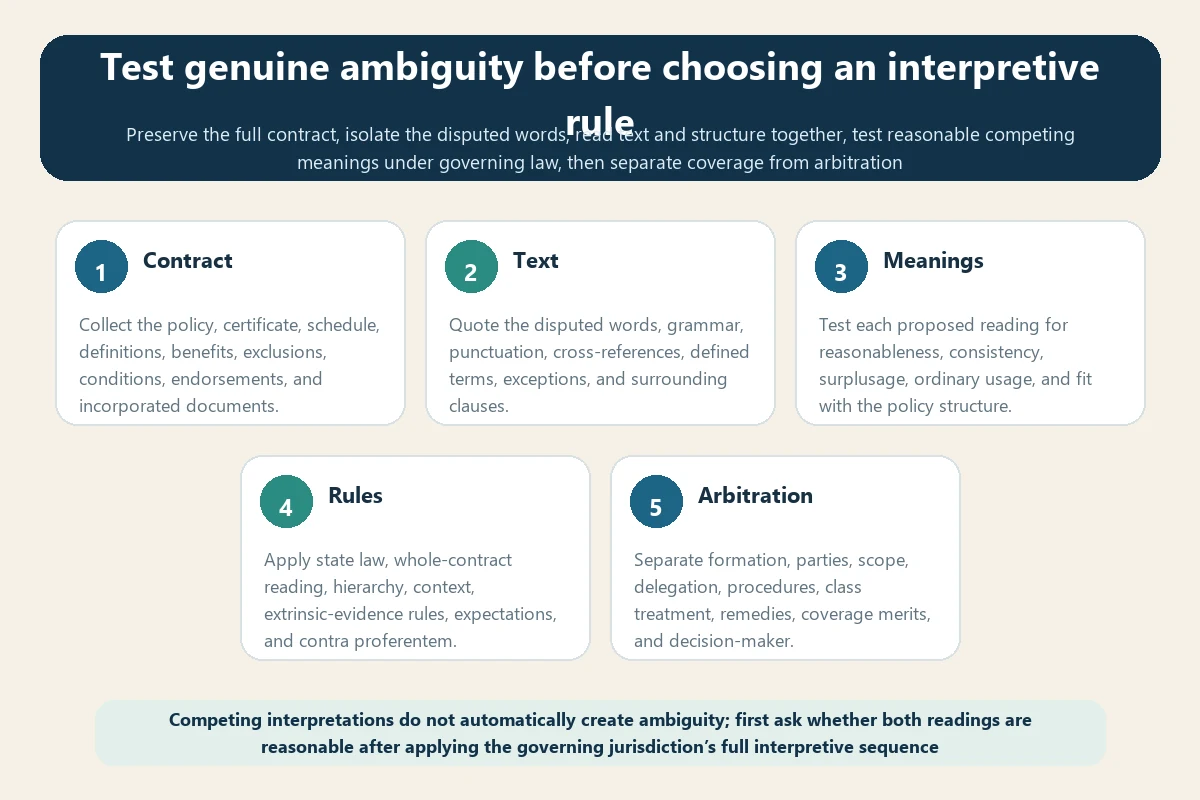
Collect the policy, certificate, declarations or schedule, benefits, definitions, exclusions, conditions, endorsements, amendments, application, confirmation, and every document incorporated by reference.
Record the exact version, issue date, effective date, state, insured travelers, plan, and source. A sentence detached from its endorsement set is not the full contract.
Quote the disputed words exactly
Identify the precise phrase, sentence, definition, cross-reference, exception, exclusion, arbitration term, or delegation clause. Preserve punctuation, capitalization, numbering, and layout.
State what each side says the words mean and what practical outcome follows from each reading.
Do not infer ambiguity from disagreement alone
Two parties can disagree even when only one interpretation is reasonable after reading the policy as a whole. Apply the governing state’s standard rather than counting proposed meanings.
A strained, grammatically impossible, or context-free interpretation generally should not create ambiguity merely because it benefits one side.
Determine governing law first
Review choice-of-law terms, state of residence, policy situs, place of contracting, forum rules, and insurance statutes. States differ on ambiguity, extrinsic evidence, reasonable expectations, contra proferentem, and special treatment of insurance forms.
Do not import one jurisdiction’s interpretation sequence into another without conflicts analysis.
Apply ordinary meaning in context
Begin with the words an average policyholder would reasonably understand in context unless the policy supplies a definition or technical meaning. Use dictionaries cautiously and check the relevant time period.
Ordinary meaning is not chosen in isolation from the sentence, section, benefit, and contract structure.
Read the policy as a whole
Compare definitions, insuring clauses, benefit schedules, exclusions, conditions, exceptions, claims procedures, endorsements, and arbitration terms. Seek a reading that gives operative effect to all provisions where governing law directs.
An interpretation that makes a definition, exception, or endorsement meaningless may be less reasonable.
Use the hierarchy of documents
Determine whether an endorsement controls conflicting printed policy language, whether a schedule fills a variable field, and whether special terms override general terms under applicable law.
Check amendment and order-of-precedence clauses rather than assuming the newest-looking page controls.
Audit missing or conflicting endorsements
Preserve issued packages, delivery records, policy-management logs, references to endorsement numbers, state filings, and customer copies. Determine whether the dispute is missing text, conflicting text, or interpretation of existing text.
A missing endorsement may raise formation or reformation issues. The policy reformation arbitration guide explains how to prove a prior agreement before changing the writing.
Check definitions recursively
Map every defined term inside the disputed clause and every definition incorporated into another definition. Identify circular definitions, undefined capitalized terms, inconsistent singular and plural forms, and cross-reference errors.
Build a dependency chain so no definition is silently skipped.
Analyze grammar and punctuation
Test modifiers, lists, conjunctions, series qualifiers, provisos, exceptions, commas, semicolons, headings, and sentence boundaries. Compare how each reading applies the grammar consistently.
Grammar informs meaning but should be evaluated with contract structure and governing interpretive rules.
Test for surplusage
Ask whether a proposed reading makes words redundant, deletes a condition, duplicates another benefit, or collapses an exclusion and exception. Record the effect provision by provision.
Some overlap may be intentional; the goal is to apply the jurisdiction’s rule, not enforce a mechanical anti-redundancy formula.
Test practical and absurd results
Apply each interpretation to representative facts: one traveler versus a family, single-trip versus annual coverage, predeparture versus postdeparture loss, refund versus credit, and domestic versus international travel.
A result can be unfavorable without being absurd. Use the governing legal threshold.
Separate ambiguity from factual uncertainty
The policy language may be clear while facts remain disputed, such as when symptoms began, whether a storm caused closure, or when a supplier issued a refund. Conversely, facts may be agreed while text remains uncertain.
Create separate columns for textual interpretation and fact application. The claim denial reasons guide helps organize the distinct factual and clause-based grounds.
Separate ambiguity from missing evidence
An incomplete claim file, unreadable receipt, missing medical record, or absent policy version does not necessarily make the contract ambiguous. It may create a proof or authenticity issue.
Identify the missing evidence and why it matters before converting it into a text argument.
Use an official insurance interpretation example
In a published Eleventh Circuit insurance decision, the court described Florida’s approach: read the policy as a whole, give provisions meaning, and apply contra proferentem to facial ambiguity under the state’s insurance rules.
The decision also discusses Florida’s treatment of extrinsic evidence. Other states may use a different sequence.
Require genuine ambiguity
Another published Eleventh Circuit insurance decision explains that contra proferentem does not apply where the policy is not genuinely ambiguous after textual and contextual analysis.
This is a useful discipline: complete ordinary interpretation before invoking a tie-breaker.
Apply contra proferentem at the correct stage
Contra proferentem generally construes unresolved ambiguity against the drafter under applicable law. Identify who drafted the term, whether it was negotiated, and whether the jurisdiction applies special insurance rules.
Do not start with the canon before determining that ambiguity remains after the required interpretive steps.
Evaluate extrinsic evidence under governing law
Potential evidence includes applications, quotes, negotiations, course of performance, trade usage, forms, filings, delivery records, and contemporaneous explanations. Jurisdictions differ on whether and when such evidence may resolve ambiguity.
Preserve both supporting and contrary evidence rather than selecting only post-dispute statements.
Use reasonable expectations cautiously
Some jurisdictions recognize a reasonable-expectations doctrine in defined circumstances; others rely primarily on text or apply the doctrine narrowly. Identify the actual state rule and required facts.
A claimant’s subjective expectation alone is not necessarily the legal standard.
Separate interpretation from reformation
Interpretation chooses the meaning of words already in the contract. Reformation changes the writing to reflect a proven prior agreement. Do not use ambiguity doctrine to add text that was never issued.
Likewise, do not seek reformation merely because an existing term has two reasonable readings.
Apply the Federal Arbitration Act carefully
Section 2 of the Federal Arbitration Act generally places written arbitration provisions involving commerce on ordinary contract footing.
The FAA does not provide a federal insurance-policy ambiguity code, and relevant state insurance law may remain important.
Separate coverage ambiguity from arbitration ambiguity
An ambiguous covered-reason definition concerns claim merits. Ambiguous language identifying parties, covered disputes, forum, rules, or procedures concerns arbitration. Different decision-makers or presumptions may apply.
Label the disputed clause and issue before applying any canon.
Use Lamps Plus for a narrow warning
In Lamps Plus, Inc. v. Varela, the U.S. Supreme Court held that ambiguity could not provide the necessary contractual basis to compel class arbitration.
The case concerns class procedures and fundamental arbitration attributes. It should not be generalized into a rule that all insurance or arbitration ambiguity is resolved the same way.
Analyze who is bound
Read definitions of company, insurer, plan administrator, affiliate, agent, traveler, insured, claimant, and beneficiary. Determine whether an ambiguity concerns identity or only claim scope.
If a linked document supplies party definitions, use the incorporation-by-reference guide to test identification, availability, and assent.
Analyze arbitration scope
Compare “arising under,” “arising out of,” “relating to,” statutory claims, tort claims, refunds, claim handling, application statements, and post-policy conduct. Read exclusions and survival clauses.
Broad wording does not replace proof of a formed agreement between the relevant parties.
Address delegation separately
If a party says an arbitrator decides interpretation, identify the exact delegation language and incorporated rules. Determine whether the dispute targets delegation, formation, scope, or coverage merits.
The arbitrability guide helps map the correct decision-maker.
Keep severability distinct
Contractual severability addresses the effect of invalid terms; arbitration separability treats the arbitration clause distinctly for certain validity challenges. Neither is the same as construing ambiguous words.
Use the arbitration severability guide to separate these doctrines.
Build an interpretation matrix
Create rows for disputed text, defined terms, context, document hierarchy, each proposed meaning, grammar, cross-references, surplusage, practical results, governing rule, extrinsic evidence, drafter, coverage effect, arbitration formation, scope, delegation, and defenses.
For each row, cite supporting and contrary evidence, source, version, date, and authenticity.
Preserve reasonable defenses
Potential defenses include plain meaning, unreasonable competing reading, missing rather than ambiguous text, factual dispute, wrong policy version, controlling endorsement, defined term, special-versus-general rule, negotiated language, improper extrinsic evidence, no genuine ambiguity, no clause formation, invalid delegation, or claim outside scope.
A party asserting ambiguity should address the whole contract and the strongest competing textual explanation.
Use a disciplined decision sequence
- Preserve the complete operative contract and endorsements.
- Quote the exact disputed words and proposed meanings.
- Determine governing law and document hierarchy.
- Apply ordinary meaning, grammar, context, and whole-contract rules.
- Decide whether more than one reasonable meaning remains.
- Apply extrinsic evidence or tie-breakers in the correct order.
- Separate coverage, formation, scope, delegation, and procedure.
Bottom line
Travel insurance policy ambiguity arbitration requires more than competing arguments. The reliable method is to preserve the full contract, isolate the disputed words, test each reading against grammar and structure, and apply the governing jurisdiction’s interpretation sequence.
Only then should anyone invoke contra proferentem or decide whether the ambiguity concerns insurance coverage, arbitration consent, scope, delegation, or a special procedure such as class arbitration.
Contra proferentem is usually a later interpretive rule, not a shortcut whenever a traveler and insurer disagree. Use this travel insurance contra proferentem arbitration guide to test genuine ambiguity, identify the drafter and governing law, and separate coverage construction from arbitration consent and procedure.
Reasonable expectations are jurisdiction-specific and must be supported by the policy, delivery record, representations, and transaction—not hindsight alone. Use this travel insurance reasonable expectations arbitration guide to audit coverage expectations while separately testing arbitration formation, scope, delegation, procedure, and remedies.
