
Travel insurance arbitration novation disputes ask whether a valid new agreement or party substitution extinguished an earlier contract and replaced it with a new obligation. The answer can determine whether an old arbitration clause survived, a new clause controls, or no asserted clause reaches the claim.
This U.S. consumer guide explains how to compare agreements, parties, assent, consideration, intent, performance, claim timing, scope, and defenses. It is not legal advice.
Start with a document pair
Place the alleged old contract and new contract side by side. Preserve the travel policy, certificate, booking terms, endorsements, settlement, transfer agreement, replacement policy, administrator notice, and every incorporated document.
Record the exact version, date, source, parties, signatures or online assent, governing law, effective date, covered obligations, arbitration language, and survival terms.
Define novation narrowly
Novation generally describes a new valid contractual obligation accepted in place of an existing one, with intent to extinguish the earlier obligation. Exact elements and proof standards differ by state.
Do not use the label merely because terms changed, a company was acquired, or another administrator handled the file.
Identify the proposed substitution
State precisely what was allegedly replaced: one party, one duty, the entire policy, a booking contract, a settlement obligation, a claim-administration role, or only an arbitration provision.
Also identify the enforcement direction. A new entity seeking to compel arbitration presents a different record from a traveler arguing that a later agreement extinguished an older clause.
Prove the earlier valid obligation
A novation theory ordinarily begins with a valid existing obligation. Reconstruct policy purchase, notice, assent, purchaser identity, terms version, premium, delivery, and any right-to-cancel period.
If formation of the original online terms is disputed, use the clickwrap agreement guide to preserve screen and acceptance evidence.
Prove the new agreement independently
Identify offer, acceptance, consideration, definite terms, authority, and required formalities for the alleged replacement agreement. A proposal, customer-service email, unsigned draft, or unilateral announcement may not establish mutual assent.
Preserve the complete exchange rather than quoting one sentence that appears to substitute a party or obligation. If the new document adopts linked terms or rules, apply the incorporation-by-reference checklist.
Apply the Federal Arbitration Act correctly
Section 2 of the Federal Arbitration Act generally makes written arbitration provisions involving commerce enforceable on ordinary contract footing. It does not supply a single federal novation test.
Relevant state law ordinarily determines contract formation, substitution, extinguishment, and who is bound. Identify the choice-of-law clause and forum conflicts rules before listing elements.
Use Arthur Andersen as a boundary
In Arthur Andersen LLP v. Carlisle, the U.S. Supreme Court explained that state contract law governs whether arbitration agreements may be enforced by or against nonparties under traditional principles.
The decision means nonsignatory status is not the end of the analysis. It does not prove a novation, substitution, or release in any travel-insurance transaction.
Distinguish bilateral agreement from unilateral update
In an official Ninth Circuit memorandum involving updated Google terms, the court distinguished a bilateral acceptance of new terms from unilateral changes under the earlier contract’s modification mechanism.
The case is a useful evidence lesson: determine how the later terms were presented and accepted. Do not assume that posting a new version and obtaining affirmative agreement are legally identical.
Find objective replacement intent
Search for words such as replace, substitute, supersede, extinguish, discharge, release, terminate, novate, assume, assign, amend, survive, and remain in effect. Read definitions, recitals, operative clauses, schedules, and signature blocks together.
Intent may also be inferred from conduct under governing law, but ambiguous conduct should not be converted into a complete contractual replacement without the required proof.
Check consent by every required party
A party-substitution novation may require consent from the departing party, incoming party, and remaining counterparty. Identify who consented, how, when, and with what authority.
Silence, continued travel, claim submission, or use of a portal may carry different legal weight depending on the documents, disclosures, state law, and circumstances.
Test consideration and new obligations
Record what each participant promised or delivered under the alleged new agreement. Examples may include assumption of policy duties, release of the former obligor, payment, extended benefits, settlement, or acceptance of a replacement policy.
Do not assume the same premium or continued service automatically supplies every element of novation.
Distinguish novation from amendment
An amendment changes an existing agreement while leaving it in force as modified. A novation is asserted to extinguish and replace an obligation. Determine which characterization the text and governing law support.
Check integration, supersession, amendment, survival, and no-waiver clauses. A later document can modify only selected provisions while preserving the earlier arbitration clause.
Distinguish novation from assignment
An assignment may transfer specified rights, while delegation or assumption addresses duties. Novation may substitute an obligor or agreement and discharge the original obligation if its elements are satisfied.
The arbitration assignment guide helps trace assignor, assignee, rights, duties, restrictions, notice, and consent without presuming full replacement.
Distinguish novation from assumption
A party may assume a defined duty without extinguishing the original obligor’s liability. Conversely, a complete substitution may discharge the earlier party if the agreement and governing law say so.
Use the assumption theory guide to evaluate specific agreement language, knowledge, performance, benefits, and objections.
Do not infer novation from a corporate transaction alone
A name change may leave the same entity in place. A stock purchase may change ownership without replacing the contracting company. An asset sale may transfer selected obligations while excluding others.
The successor liability guide separates these transaction forms and their jurisdiction-specific consequences.
Audit insurance-specific approvals
Determine whether the event involved a policy assumption, statutory transfer, merger approval, rehabilitation order, replacement coverage, reinsurance, or only administrative servicing. Preserve regulator orders, notices, endorsements, certificates, and policyholder consent records.
Insurance law may impose requirements or legal effects beyond ordinary commercial contract language. Verify the relevant state’s current rules and the regulator’s actual order.
Do not confuse an administrator change with party substitution
A new third-party administrator may process a claim while the original insurer remains responsible under the policy. Identify who bears risk, who decides claims, who pays, and what authority the administrator holds.
Continued claim handling can be evidence of performance, but it does not alone establish release of the insurer or replacement of the policy.
Map claim timing
Record when the covered event, claim, denial, appeal, new agreement, release, and arbitration demand occurred. Then determine whether the later agreement applies prospectively, retrospectively, or only to listed disputes.
A later arbitration clause may expressly cover earlier claims; an earlier clause may survive termination. Neither result should be presumed without text and governing authority.
Test the effect on the arbitration clause
Ask whether the later agreement contains its own clause, expressly preserves the old clause, supersedes the entire prior agreement, releases claims, or remains silent. Read the dispute definition, covered parties, temporal reach, exclusions, forum, rules, and remedies.
Even if a contract was novated, the asserted clause must still cover the particular denial, refund, statutory claim, or alleged post-substitution conduct.
Analyze delegation separately
If a party says an arbitrator must decide novation, identify the exact delegation language and incorporated rules. Determine whether the challenge targets the delegation clause specifically, the whole arbitration provision, or formation of the replacement agreement.
Do not let a scope argument silently replace the threshold question of whether the parties formed the asserted agreement.
Preserve performance evidence
Collect premium records, refunds, benefit payments, claim letters, portal logs, account changes, signatures, notices, endorsements, correspondence, and statements about which entity would perform. Date each item.
Record contrary evidence too: reservations of rights, rejected substitutions, excluded liabilities, limited service agreements, preserved claims, and documents showing the old party remained liable.
Check authority and capacity
Verify whether the person accepting the alleged novation had authority for the traveler, insurer, platform, administrator, or corporate party. Examine powers of attorney, agency agreements, corporate approvals, and policyholder identity.
A family member purchasing coverage or submitting a claim may not necessarily hold authority to release or substitute every insured’s contractual rights.
Evaluate releases and settlements carefully
A settlement may resolve specified claims, replace earlier duties, preserve enforcement provisions, or create a new dispute. Read release scope, effective date, conditions, payment obligations, integration language, and dispute-resolution terms.
Do not assume a settlement extinguishes an arbitration clause merely because it concerns the same underlying trip.
Build an element-by-element matrix
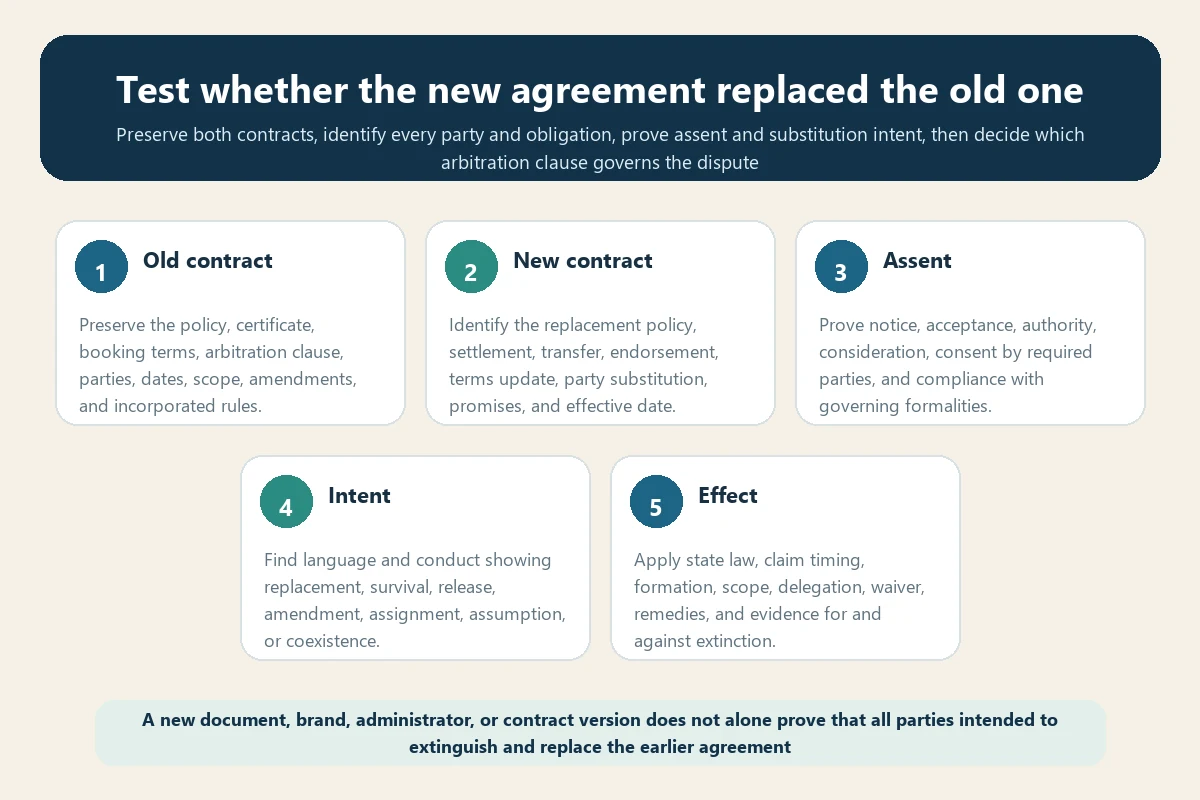
Create rows for the prior valid obligation, new valid agreement, parties, consent, authority, consideration, substitution intent, extinguishment, effective date, claim timing, arbitration scope, delegation, and defenses.
For each row, cite supporting and contrary documents. This exposes missing proof and prevents one ambiguous email from carrying an entire novation theory.
Preserve reasonable defenses
Potential defenses include no valid old contract, no valid new contract, missing consent, lack of authority, no consideration, amendment rather than replacement, assignment rather than novation, no intent to extinguish, statutory restrictions, wrong party, claim outside scope, invalid delegation, or waiver.
A party asserting the old clause should also address supersession, release, replacement-policy language, and post-agreement conduct rather than relying only on the earlier document.
Use a disciplined decision sequence
- Identify every legal entity, traveler, and contract.
- Prove the original obligation and arbitration provision.
- Prove the later agreement and its formation.
- Determine governing law and required novation elements.
- Test consent, authority, consideration, and replacement intent.
- Decide what was extinguished, preserved, or modified.
- Analyze claim timing, arbitration scope, delegation, and defenses.
Bottom line
Travel insurance arbitration novation requires more than a new document, new logo, new administrator, or revised terms. The reliable approach is to prove both agreements, identify every party and obligation, apply the controlling state’s elements, and find objective evidence of mutual assent and intended replacement.
Only after that analysis should anyone decide whether an earlier arbitration clause survived, a later clause controls, or the asserted dispute falls outside both.
