
A travel insurance medical records authorization claim HIPAA request can feel broader than the emergency being claimed. The insurer may need records to verify diagnosis, treatment, medical necessity, onset, stability, pre-existing-condition provisions, or a physician’s advice. The traveler still should understand what the form authorizes, which providers it covers, how long it lasts, who receives the information, and how the records will be protected.
HIPAA applies to covered U.S. entities and creates patient rights and privacy standards; it does not automatically govern every travel insurer, assistance company, foreign hospital, or overseas transfer. State law, foreign law, the policy, and the authorization itself can also matter. This guide offers a practical review framework, not legal advice.
Key takeaways
- Ask why the requested records are relevant to the specific policy issue.
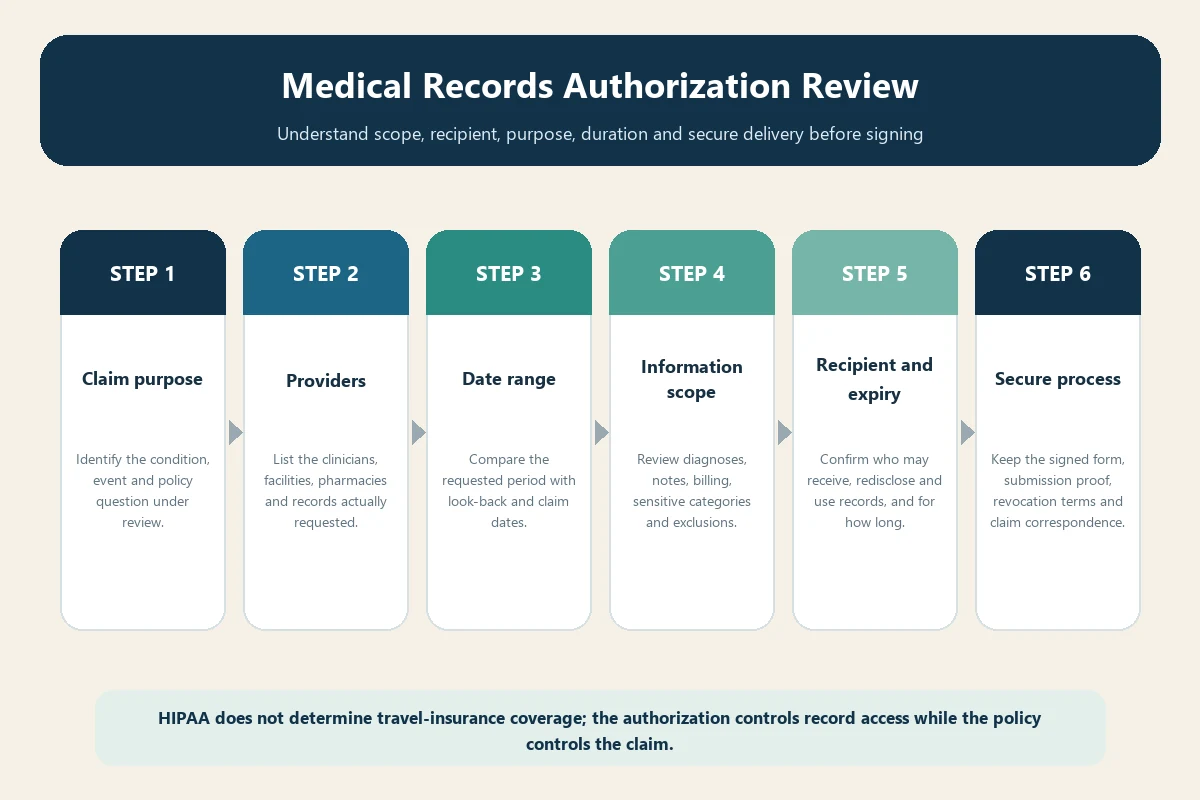
- Read the scope, provider list, date range, recipients, purpose, expiration, and revocation language.
- Your HIPAA right of access is different from authorizing a provider to send records to an insurer.
- Foreign providers may use local consent, identity, translation, and privacy procedures.
- Refusing or narrowing a request can affect claim proof; resolve concerns in writing before deadlines.
Why a travel insurer requests medical records
Medical records can establish that an illness or injury occurred during the covered trip, treatment was medically necessary, a physician advised cancellation or interruption, evacuation met the policy standard, or a condition was stable before purchase. Billing records alone rarely answer all those questions.
The administrator may also need records from before the trip when the policy contains a look-back period or pre-existing-condition exclusion. That does not make every lifetime record relevant. Ask the adjuster to identify the policy provision and disputed medical question.
Authorization versus the patient’s right of access
Under HIPAA, an individual generally has a right to inspect or obtain copies of designated records from covered U.S. providers and health plans, subject to exceptions and procedures. The traveler can request records personally and then submit selected claim evidence.
A HIPAA authorization is a different route: it permits a covered entity to disclose described protected health information to identified recipients for the stated purpose. An insurer’s form may allow it or its vendor to request records directly. Compare both workflows for timing, cost, completeness, and privacy.
Core fields to review
A valid HIPAA authorization has required elements under federal rules. In practical terms, verify:
- Information: the records or categories described.
- Sources: the providers or persons allowed to disclose.
- Recipients: the insurer, administrator, vendor, reinsurer, or other persons authorized to receive.
- Purpose: claim evaluation, administration, appeal, or another stated use.
- Expiration: a date or event tied to the authorization.
- Signature: the patient or authorized personal representative, with authority described.
- Required statements: revocation rights and other notices required by the rule.
Read additional clauses about redisclosure, electronic records, substance-use treatment, psychotherapy notes, genetic information, communicable disease, mental health, and state-specific protections. Special categories can require separate treatment.
Scope should match the claim question
A claim for a fractured wrist during a trip may require emergency and follow-up records plus limited prior information if a policy issue exists. A cancellation involving a chronic condition may legitimately require records around the applicable look-back period. The necessary scope depends on facts and wording.
If a form appears unlimited in provider, subject, or time, ask why. Propose a date range or categories tied to the issue, but do not assume the insurer must accept the change. Obtain written agreement and avoid modifying a signed form without clear instructions.
Pre-existing-condition review
Travel policies can define a look-back period and evaluate treatment, symptoms, diagnoses, medication changes, or medical advice before coverage. A waiver may apply only when purchase and eligibility conditions are satisfied. The claims reviewer may therefore request primary-care, specialist, pharmacy, or hospital records from a defined period.
Build a date map using the issued certificate. Identify the look-back start and end, relevant providers, prescription changes, and the condition connected to the loss. Do not characterize a condition as “pre-existing” or “not pre-existing” in place of the contractual analysis; provide accurate medical facts.
Physician statements are not always enough
A short physician form can establish dates, diagnosis, and advice, but the insurer may request underlying notes when the form is incomplete, internally inconsistent, or does not address the policy standard. Conversely, a massive chart dump can obscure the relevant evidence.
Ask for a precise missing-information list. A focused office note, medication history, diagnostic result, or discharge summary may resolve the question faster than hundreds of unrelated pages.
Foreign hospitals and HIPAA limits
A hospital outside the United States is not automatically subject to HIPAA merely because the patient is American or the records will support a U.S. insurance claim. The facility may follow national privacy law, local medical-record rules, its own release form, identity verification, notarization, apostille, translation, or fee process.
Contact the foreign provider early. Ask how the patient or authorized representative can request records, whether an English copy is available, how delivery is secured, and whether the insurer’s form is accepted. Keep the original-language files and follow our foreign medical bill and translation guide.
Spouses, adult children, and caregivers
A spouse or adult child does not automatically control another competent adult’s medical records or claim. The provider, insurer, and jurisdiction may require the patient’s authorization, a recognized personal-representative document, guardianship order, power of attorney, or other proof.
HIPAA generally treats a qualifying personal representative as the individual for relevant rights, but the authority depends on the legal document and applicable law. Carry copies of appropriate documents when a senior traveler needs a caregiver to manage care and claims. Avoid sending an entire estate-planning file when a specific proof page will suffice.
Incapacity and emergencies
Emergency treatment should not be delayed to complete insurance records paperwork. A companion can call the assistance company, identify the patient, describe incapacity, and ask how to preserve the claim. The provider and insurer will apply their rules for information sharing and representation.
Document incapacity, attempts to obtain consent, representative authority, and assistance case numbers. After stabilization, complete required forms promptly and confirm which benefits were opened.
Revocation and expiration
HIPAA authorizations generally must explain the right to revoke in writing and any limits on revocation, such as action already taken in reliance. Expiration can be a date or event. Review the form rather than assuming authorization ends when the claim is paid.
If revocation is considered, understand how it may affect the insurer’s ability to verify the claim and what disclosures have already occurred. Send any revocation through the required channel and retain delivery evidence. For a disputed broad request, obtain qualified advice when stakes are substantial.
Redisclosure and vendors
Once records leave a HIPAA-covered provider, the recipient’s legal status and privacy obligations can differ. The claim administrator may use medical reviewers, translators, assistance companies, technology vendors, or reinsurers. Read the privacy notice and authorization language, and ask who will receive the information.
Do not upload records to an unverified link or send them to an address obtained only from an unsolicited message. Confirm the claim number and channel using the certificate or official insurer website.
Secure document handling
- Use an authenticated claim portal or approved encrypted transfer when available.
- Verify the domain, recipient, and claim number.
- Keep an index of every file and page transmitted.
- Redact only unrelated information when permitted; never alter clinical content.
- Store originals separately from working copies and translations.
- Record upload confirmations, hashes or filenames, dates, and follow-up.
Our claim documentation guide provides the broader packet structure.
When records go directly to the insurer
Ask the provider for a copy of what it sends, when legally available, so the traveler can verify dates and completeness. Direct transmission can omit billing ledgers, imaging, outside-provider reports, or records held in a separate system. Confirm receipt with the adjuster.
If the insurer says records are missing, obtain the provider’s release log or confirmation and compare the requested categories. Do not assume “complete chart” means the same thing to every department.
Medical records, bills, and EOBs are different
Clinical records explain care. An itemized bill lists charges. Proof of payment shows money moved. An EOB records another payer’s decision. A complete medical claim may require all of them. Use our EOB guide for coordination.
If Medicare or Medicare Advantage is involved, follow the separate sequence in our Medicare coordination guide. An authorization to collect records does not automatically authorize every insurer to pay or exchange claim information.
Protect deadlines while reviewing the form
Do not ignore an authorization request. Respond before the stated date, ask questions promptly, and submit undisputed records or a protective appeal where appropriate. The claim deadline guide explains why a records dispute does not necessarily pause proof or appeal clocks.
If the claim is denied for failure to provide records, use the travel insurance appeal workflow. Address relevance, scope, efforts to obtain records, alternative evidence, and any written agreement about supplementation.
Questions to ask before signing
- Which policy provision and medical issue require these records?
- Which providers, dates, and categories are requested?
- Who can receive and redisclose the information?
- When does the authorization expire, and how can it be revoked?
- Can I obtain and submit the records myself?
- How are foreign records, translations, and special categories handled?
- What happens to the claim if a provider cannot produce a record?
- Which secure channel should be used?
FAQ
Does HIPAA prevent a travel insurer from asking for records?
No. HIPAA regulates covered entities and disclosures; a claim can require relevant medical evidence. The authorization and recipient’s status matter.
Can I narrow a broad authorization?
You can ask, but the insurer may explain why broader records are necessary. Resolve any modification in writing and consider advice for a material dispute.
Does my spouse need authorization?
Often yes, unless the spouse has recognized representative authority or another rule applies. Check the provider and insurer requirements.
Can a foreign hospital use the insurer’s HIPAA form?
It may accept it, require its own form, or apply local law. Contact the facility directly.
Bottom line
A medical-record authorization is part evidence tool and part privacy decision. Tie the scope to the policy question, review providers, dates, recipients, purpose, expiration, and revocation, and use secure delivery. Treat U.S. HIPAA rights, foreign provider rules, bills, clinical records, and payer decisions as connected but distinct processes.
Sources
- HHS — Your Medical Records Rights
- eCFR — 45 CFR 164.508 Authorizations
- eCFR — 45 CFR 164.524 Access
- HHS — Personal Representatives
- U.S. Department of State — Insurance Coverage Overseas
- NAIC — What to Know About Travel Insurance
Reviewed August 16, 2026. This article is general educational information, not legal, medical, or privacy advice. Requirements depend on the policy, provider, law, authorization, and claim.
