
A travel insurance family claim with multiple travelers and shared expenses needs more than one household total. A hotel room can be shared, airfare is usually passenger-specific, a cruise cabin can combine occupancy pricing, a package can hide component values, and one parent can pay for everyone. The insurer still must apply coverage, limits, deductibles, and refunds to the correct insured and benefit.
Build a family allocation ledger. Identify every traveler, policy, booking, payer, expense, beneficiary, refund, credit, and amount requested. Explain shared-cost methods instead of dividing everything equally by default.
Key takeaways
- One booking does not mean every traveler has identical coverage or cost.
- Allocate passenger-specific costs directly and explain shared-cost methods.
- Track who paid separately from who was insured or received the service.
- Apply refunds and credits to the booking lines they actually affect.
- Confirm whether the insurer wants one family file or separate claims.
Start with a traveler roster
List full name, date of birth, relationship, policy and certificate, coverage dates, trip dates, insured trip cost, premium status, and claim number. Mark which people traveled, canceled, interrupted, received care, or incurred expenses.
Do not assume a child, companion, friend, or adult relative is insured merely because the person appears on the itinerary. Verify enrollment and dependent definitions.
One policy or several policies
A family can share one plan, hold separate plans, use credit-card benefits, or have different health coverage. Benefits and limits can vary by person even on a shared certificate. Ask whether the administrator wants one event submission, one claim per insured, or linked claim numbers.
Cross-reference related cases without duplicating every expense. A shared hotel receipt can appear in each file’s index while the reconciliation claims it only once.
Who paid is not who is insured
One spouse, parent, grandparent, friend, or group organizer can pay for several travelers. Record the cardholder or account payer and the traveler to whom each cost belongs. Include reimbursement expectations between travelers when relevant.
Do not move an expense to the payer’s claim solely because the receipt bears that person’s card. The policy can require the insured’s covered loss and determine the proper payee separately.
Passenger-specific costs
Assign airline tickets, rail fares, visas, individual medical bills, baggage items, excursions, and named fees directly to the traveler shown on the supplier record. Keep ticket numbers and coupon status. Identify child, senior, or loyalty pricing.
If a supplier issues one total, request the passenger breakdown. Do not divide a $4,000 airfare total equally when fare classes or taxes differ.
Shared hotel rooms
A room can be one indivisible booking used by two or more people. Explain who occupied it, why it was needed, nights, room rate, taxes, fees, and payer. The policy or adjuster can allocate by room, traveler, insured share, or another method.
Do not claim the full room under every traveler. If one person stayed alone after another was hospitalized, record the occupancy change and date.
Vacation rentals
A rental can include base rent, cleaning, tax, platform fee, damage deposit, optional services, and extra-guest charges. Identify which components were used, refunded, or retained. A refundable deposit is not a loss.
When friends outside the insured family shared the property, document their contributions and the insured travelers’ net share. Do not claim unpaid contributions as though the policyholder paid them.
Cruise cabin pricing
Cruise fares can use first-and-second passenger pricing, lower third-and-fourth occupancy, single supplements, taxes, port charges, packages, gratuities, and excursions. Request the passenger-level invoice and final ledger.
An equal split can misstate a child’s or third traveler’s cost. For interruption, separate used cruise days, unused value, early disembarkation, and new transportation.
Package tours
A package can combine airfare, lodging, meals, guides, transfers, and activities. Ask the tour operator for traveler allocation, component values when available, used services, cancellation penalty, and refunds. If wholesale rates are confidential, request an official net nonrefundable amount per traveler.
Do not invent component values. Mark unallocated amounts and ask the insurer which reasonable method it uses.
Meals and delay expenses
Itemized receipts can cover several travelers. Identify each person, covered delay period, eligible items, alcohol or unrelated purchases, tax, tip, and per-person or daily limits. Explain whether a child meal or shared entrée changes the allocation.
A card total without itemization is weak. Use the alternative proof guide if the receipt is missing.
Rental cars and ground transportation
A rental vehicle or taxi can serve the entire group. Identify driver, passengers, route, necessity, dates, base charge, fuel, tolls, taxes, insurance, upgrade, and unused original transport. Do not multiply the vehicle cost by the number of travelers.
If one traveler took separate transport for medical reasons, record that line independently.
Medical claims
Medical bills belong to the patient, even when another family member paid. Keep each provider, EOB, deductible, and health plan separate. A family health-plan deductible does not automatically equal the travel policy deductible.
Use our EOB guide. For a child, follow the authority and payee rules in our minor claim guide.
Shared interruption costs
When one traveler is hospitalized, others can incur hotel, meals, new tickets, or companion expenses. Coverage depends on relationship, traveling-companion definitions, necessity, limits, and assistance coordination. Separate the patient’s medical benefit from each companion’s interruption expense.
Our trip interruption guide explains unused prepaid cost versus new transportation.
Loyalty points and mixed payments
A family booking can combine cash, points, certificates, companion fares, statement credits, and taxes. Record each funding source and traveler allocation. The policy determines whether redeposit fees, lost points, taxes, or cash portions are insurable trip cost.
Do not convert points to a cash value without the insurer’s method. Obtain the loyalty account statement showing redemption, cancellation, redeposit, fee, and remaining loss. A card statement credit can be a recovery even when the supplier did not issue cash.
Different cancellation decisions
One family member can cancel while others travel, or some can interrupt while others continue. Rebuild the roster and itinerary from the change date. Identify which bookings were used, transferred, canceled, or re-priced because occupancy changed.
A single supplement, room repricing, or replacement traveler can create new costs and refunds. Do not assume the nontraveling person’s share equals the original allocation. Request the supplier’s final recalculation.
Separated households and friends
Traveling companions do not need to share finances or residence. Each adult should document personal trip cost, payment, coverage, and authority. A group organizer can coordinate supplier records without controlling every claim or payment.
When one person fronted the group deposit, show contribution transfers and the supplier allocation. If a traveler never repaid the organizer, explain the actual financial arrangement rather than creating a receipt. Privacy-sensitive medical evidence should be submitted to the insurer through the affected traveler’s file, not circulated across the group.
Refunds and credits
Apply a refund to the supplier, booking, traveler, and component it concerns. An airline refund for one child’s ticket should not reduce another adult’s nonrefundable tour. A package credit can require a documented allocation.
Use our supplier refund statement guide and disclose later recoveries. A family voucher can have named-user restrictions.
Currency conversion
Different family members can pay on different cards and dates, producing different dollar conversions. Keep original currency and actual postings for each transaction. Do not apply one rate to the entire trip unless the policy or adjuster accepts it.
Follow our currency claim guide.
Deductibles and limits
Verify whether each deductible or maximum is per insured, family, trip, incident, day, item, room, or policy. The wording matters. A partial payment can result from applying a per-person cap to shared expenses or a family limit to individual claims.
Audit the decision using our partial payment guide. Ask how shared lines were allocated before the limit was applied.
Family allocation ledger
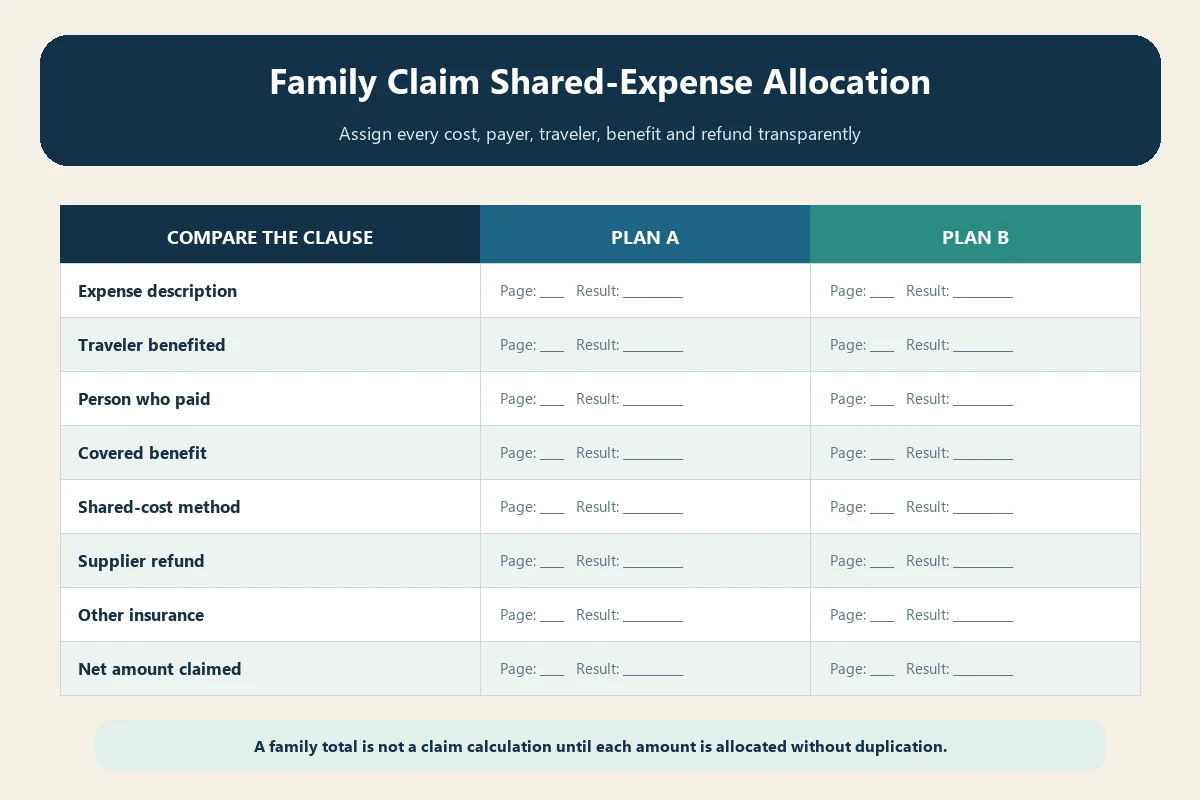
Use columns for expense ID, supplier, description, date, original currency, total, payer, travelers served, allocation method, amount per traveler, benefit, refund, other insurance, deductible, limit, and amount requested. Link the source document.
Add a family summary showing each traveler’s claimed subtotal and the group total. The sum of individual allocations must equal the shared expense once—not more or less.
Allocation methods
- Direct assignment: ticket or medical bill names one traveler.
- Supplier allocation: invoice provides passenger shares.
- Occupancy allocation: shared lodging divided by documented room use.
- Contribution allocation: travelers paid agreed shares.
- Benefit allocation: insurer applies its contract method.
- Reasonable estimate: used only when disclosed and supported.
State the method and why it fits. Do not change methods across similar expenses to maximize payment.
Separate signatures and authorizations
Each adult insured can need a signature, medical authorization, or payment form. Minors and incapacitated travelers require accepted representatives. Do not have one family member sign for all adults without authority.
Use secure portal access and do not share passwords. Link representatives to the appropriate insured.
One cover letter, multiple exhibits
A coordinated cover letter can describe the event and linked claims. Then provide traveler-specific schedules and shared-cost exhibits. Use stable filenames and one master manifest.
Follow our claim documentation guide. Ask the carrier whether shared records should be uploaded once or to each linked case.
FAQ
Should we divide every family expense equally?
No. Use passenger-specific invoices or a documented method that matches actual use, price, and policy.
Can one parent file for everyone?
Administrative coordination is possible, but each adult can need separate authority, signature, and payment instructions.
Who claims a hotel room?
Document who used and paid for it, then follow the insurer’s allocation method without duplicating the room.
What if one traveler gets a later refund?
Apply it to that traveler and booking line, disclose it, and revise the family reconciliation.
Bottom line
A family claim needs a traveler-level ledger, not one household total. Assign direct costs, explain shared-cost methods, separate payer from insured, apply refunds to the correct lines, and verify per-person or family limits. Every allocated subtotal should reconcile to the supplier records exactly once.
Sources
- NAIC — What to Know About Travel Insurance
- NAIC — Travel Insurance Model Act
- New York DFS — Travel Insurance
- California Department of Insurance — Travel Insurance Guide
- U.S. DOT — Airline Refunds
- CFPB — Card Charge Disputes
Reviewed August 17, 2026. This article is general educational information, not legal, tax, accounting, family, or coverage advice.
