
A travel insurance claim with no written decision letter is difficult to audit. A portal may say paid, denied, partially approved, or closed while omitting the expense-level calculation, policy basis, payment details, or appeal deadline. A phone call or bank deposit may reveal an outcome but still leave important questions unanswered.
This U.S.-focused guide explains how to identify the missing record, request a complete decision packet, preserve deadlines, and escalate through the correct state and policy channels without assuming one nationwide rule.
Distinguish five different records
| Record | What it should answer | What it does not prove alone |
|---|---|---|
| Portal status | Current workflow label | Full policy or calculation basis |
| Decision letter | Approved, denied, or partial outcome and reasons | That payment reached the correct payee |
| Calculation or EOB | Claimed, allowed, reduced, deductible, and paid lines | Every appeal deadline unless stated |
| Payment record | Amount, payee, method, issue date, trace | Why another line was unpaid |
| Appeal notice | Review channel, address, deadline, required content | That an informal call preserves the deadline |
Confirm whether a decision actually exists
Ask the claims administrator whether the claim is still under review or a formal determination has been made. Record the exact status, decision date, deciding organization, examiner, delivery method, address used, and document title.
Check the authenticated portal’s correspondence, documents, messages, payment, and closed-claim areas. Search email spam and postal mail. Confirm the correct mailing and email address, especially after a move or name correction.
Use the claim status follow-up guide to ask for the last completed action, present dependency, owner, and next date rather than relying on a vague “closed” label.
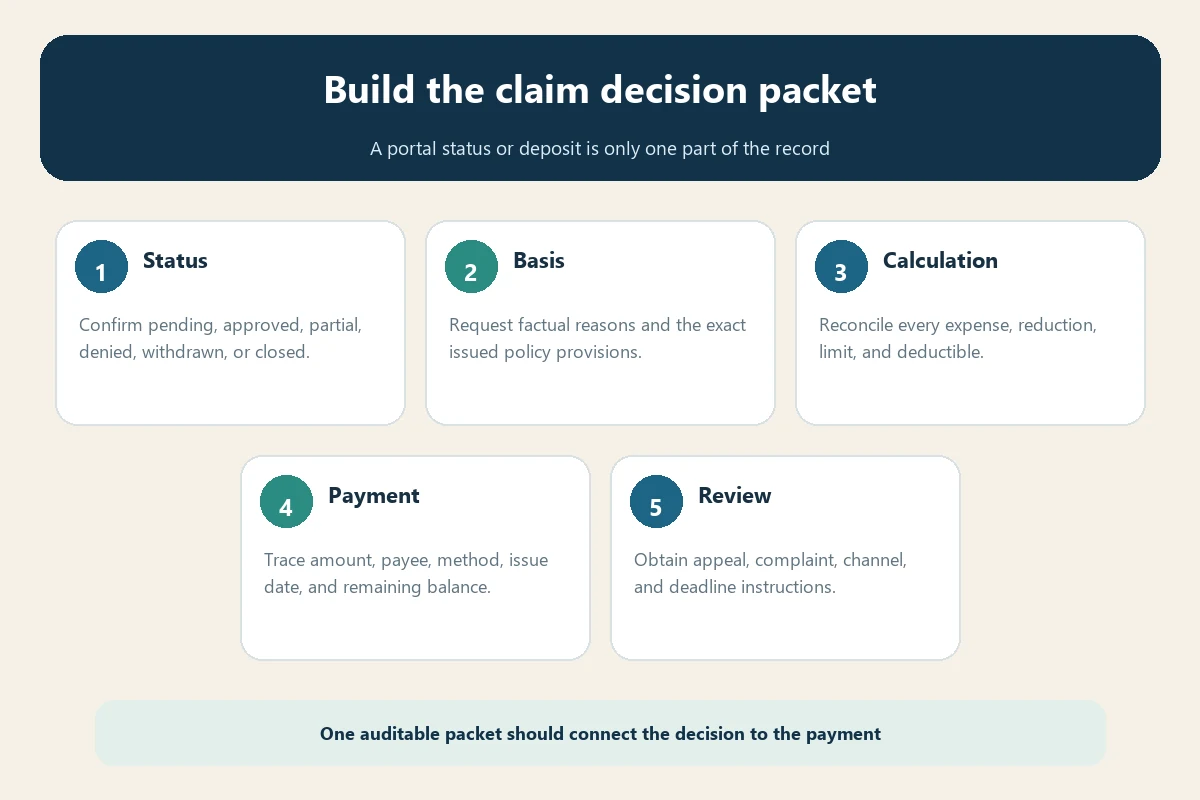
Request a complete decision packet
Request these items in writing:
- formal claim status and decision date;
- each expense or benefit claimed;
- approved, denied, pending, or withdrawn amount for each line;
- policy provision, condition, exclusion, limit, or calculation applied;
- factual reason for each reduction or denial;
- deductible, coinsurance, sublimit, depreciation, refund, or other-insurance adjustment;
- payment amount, payee, method, issue date, and trace number;
- appeal or review instructions and deadline;
- complaint contact and administrator identity.
Ask for an accessible copy if the portal file will not open. Preserve the original electronic file, filename, metadata, and delivery receipt.
Reconcile missing, returned, and corrected letters
A decision may exist but fail to reach the claimant because the administrator used an old postal address, misspelled email, inactive portal account, or the contact details of a travel companion. Ask for the destination used, send date, delivery method, returned-mail status, and document version. Correct contact details through a verified channel and request redelivery without changing the historical record.
If the administrator issues a corrected letter, keep both versions. Create a short comparison showing decision date, correction date, changed expense lines, changed reason or clause, revised payment, and whether the appeal deadline changed. Do not replace the first PDF silently; it may explain why an earlier payment or appeal referenced different numbers.
When the claimant is a minor, incapacitated traveler, estate, or authorized representative, confirm who is entitled to receive the decision and what authority is on file. Avoid sending identity or estate records to an address supplied only in an unexpected message.
Ask the administrator to confirm which letter is final and which claim status now controls. If the corrected letter changes money already issued, request a revised calculation and secure payment or recovery instructions. The final archive should let a reviewer trace every version from submission through correction.
Use a precise written request
Re: Claim [number], policy [number]. The portal currently shows [status], and [payment/no payment] was recorded on [date], but I have not received a complete written determination. Please provide the decision date; line-item disposition; factual and policy basis for each denied or reduced amount; full calculation; payment details; and appeal, review, and complaint instructions with applicable deadlines. Please also confirm the address and channel to which the decision was sent.
Do not state that a missing letter automatically reverses the outcome. The immediate goal is to obtain an auditable record and protect the next procedural step.
If money arrived without an explanation
Do not assume the deposit equals full approval. Compare the payment with the amount claimed and identify the sender, payee, claim number, benefit, and payment date. Ask whether the payment is final, partial, advance, supplemental, corrected, or issued to a provider.
The partial payment calculation guide helps reconcile claimed, eligible, excluded, refunded, deductible, and paid amounts. Preserve the bank or check record without publishing full account details.
If the portal says denied or closed
Request the exact reason and policy basis. “Not covered,” “insufficient documentation,” or “closed” does not identify which fact, clause, deadline, or document controlled. Ask whether closed means finally decided, administratively inactive, withdrawn, duplicate, or awaiting reopening.
Use the claim denial reasons guide to distinguish excluded event, unmet condition, evidence gap, late filing, classification issue, calculation, or other recovery. The response depends on the category.
Audit a partial decision line by line
A letter that says “approved in part” without a calculation is still incomplete for practical review. Build a table with expense ID, submitted amount, administrator’s disposition, stated benefit, allowed amount, reduction, policy citation, evidence relied on, and payment.
If the dispute concerns the benefit section, use the wrong benefit classification guide. If the dispute concerns repeated cost sharing, use the wrong deductible audit. Ask for a revised letter after correction so the final record matches the payment.
Do not let an informal request consume the appeal period
Read the policy and any portal notice for reconsideration, appeal, complaint, arbitration, or legal-action deadlines. Ask whether the deadline runs from the decision date, mailing date, receipt date, payment date, or another event. Do not assume an examiner’s informal review pauses it.
If the deadline may arrive before the missing packet, submit a protective written appeal through the stated channel. Identify the claim, disputed outcome, missing decision materials, known facts, and request to supplement after receipt. Obtain advice when a significant claim or legal limitation is involved.
Understand the state-specific regulatory layer
U.S. insurance regulation is largely state-based, and rules can vary by product, insurer, policy form, claimant, and jurisdiction. Do not copy a deadline from another state or from health, auto, or homeowners guidance and present it as a universal travel-insurance rule.
The Texas Department of Insurance consumer-protection text, for example, states that an insurer must explain in writing why a claim or part is denied. The California Department of Insurance property-claims guide describes written denials with specified reasons in that state’s property context. These sources illustrate state-specific written-decision principles; they do not establish that every provision shown applies to every travel plan.
Identify the underwriting insurer, purchaser’s state, issued policy form, and regulator. The NAIC state insurance department directory provides official contacts. Ask the department whether it regulates the exact product and issue.
Work through a paid-but-unexplained example
A traveler submits $2,400 for unused lodging and replacement airfare after a covered medical interruption. The portal changes to “paid,” and $1,150 appears by ACH. No letter is visible.
The traveler should not guess that the administrator denied $1,250. The difference might reflect a supplier refund, deductible, benefit limit, ineligible expense, payment to another payee, or a first installment. The decision request should list both submitted expense lines and ask for their separate disposition, calculation order, payment recipient, and remaining status.
If a later letter shows the airfare under the wrong benefit, that becomes a classification dispute. If it shows a deductible twice, that becomes a calculation dispute. If it says another document is missing, that becomes a supplementation issue. The written packet turns an unexplained difference into a reviewable question.
Escalate through the verified claim chain
If the examiner cannot provide the packet, request a supervisor or claims manager. Confirm the claims administrator and underwriting insurer; the company that sold the plan may not decide the claim. Preserve names, dates, reference numbers, and delivery receipts.
If internal escalation fails, follow the policy’s complaint procedure and contact the appropriate state insurance department. Submit the policy, claim chronology, status screenshot, payment record, requests for the decision, and responses. Avoid sending unnecessary medical or banking details through an insecure channel.
Preserve the final record
Store the original claim, evidence index, decision packet, corrected letters, appeal, complaint, final payment, refund, and closure confirmation together. The claim record-retention guide explains why payment alone may not end refund, provider, tax, estate, or legal issues.
Written decision checklist
- Confirm whether the status is pending or formally decided.
- Verify the address and delivery channel used.
- Request line-item disposition and factual reasons.
- Request policy citations and complete calculation.
- Trace payment amount, payee, method, and date.
- Obtain appeal, review, complaint, and deadline instructions.
- Protect deadlines while waiting for missing records.
- Check the rule for the correct state and product.
- Preserve the final corrected decision packet.
A portal label and a payment are pieces of the claim record, not substitutes for an explanation. A complete decision packet lets the traveler verify the outcome, correct an error, appeal a dispute, and retain a final record that matches the money actually paid.
