
When a travel insurance claim ACH payment returned to the sender, the claim portal may still display “paid.” That status can mean the disbursement was initiated, not that the claimant received final funds. Trace the original credit, document the bank’s return, correct the cause, and obtain a new payment reference.
This U.S.-focused guide covers returned direct deposits involving a closed or restricted account, incorrect routing or account information, payee mismatch, unsupported account type, payment-vendor error, or bank rejection. It is general information, not banking, legal, tax, cybersecurity, or insurance advice.
Separate the claim decision from payment delivery
A claim approval establishes what the administrator says is payable. An ACH instruction identifies how it attempts to deliver that amount. A returned electronic credit does not necessarily reverse the coverage decision, but the accounting system may need to receive and reconcile the returned funds before a replacement can be issued.
Ask for both records: the written claim calculation and the disbursement record. Compare approved amount, deductions, currency, payee, issue date, method, and net payment. If no written decision exists, use the claim decision letter guide to request one.
| Payment state | What it may mean | Evidence to obtain |
|---|---|---|
| Approved | Claim or benefit passed adjudication | Decision and calculation |
| Scheduled | Payment entered a future batch | Expected effective date |
| Sent | Originator or processor released an ACH entry | ACH trace number |
| Posted | Receiving bank credited an account | Account transaction record |
| Returned | Receiving bank sent the entry back | Return reason, date, and reference |
| Recredited | Payer or processor recognized returned funds | Payment-ledger entry |
| Reissued | A replacement payment was initiated | New trace or check number |
Get the original ACH trace number
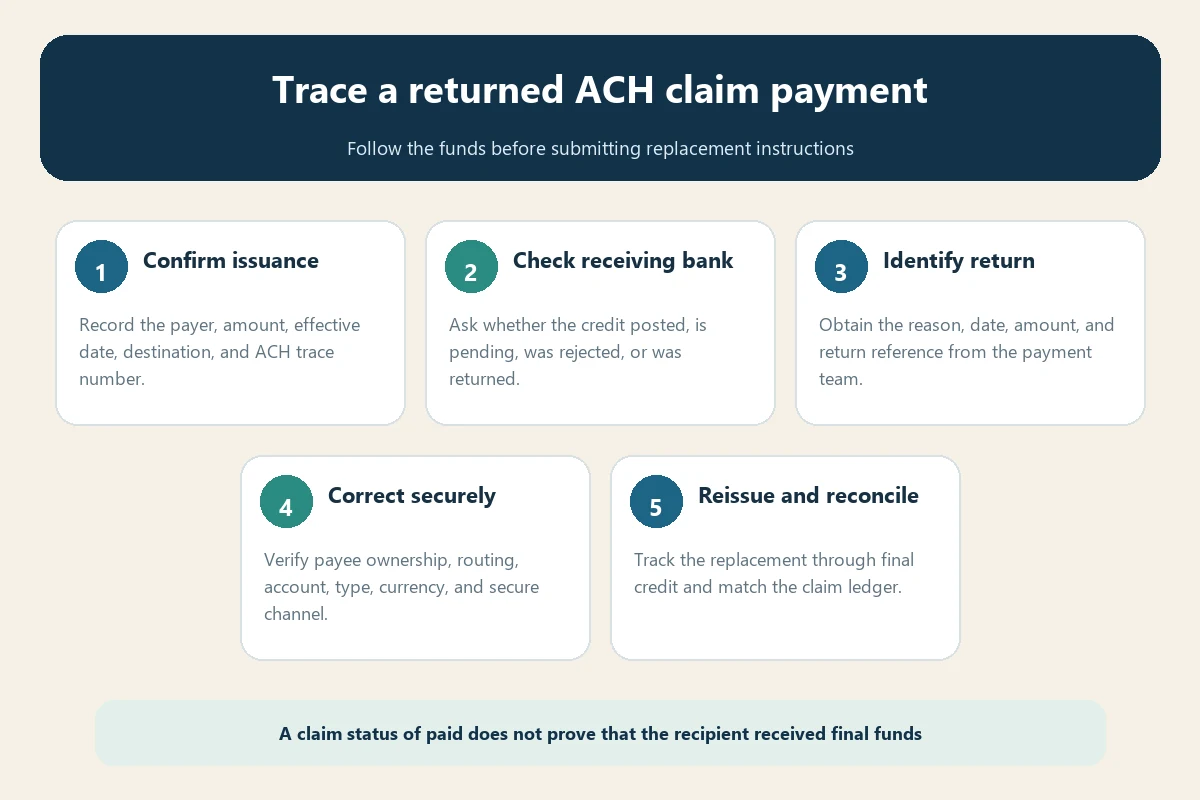
Ask the insurer, administrator, or payment vendor for the full ACH trace number, originating company name, amount, effective date, destination bank routing number, last four digits of the destination account, and account type. Do not accept a portal screenshot saying “complete” as the only proof.
Nacha’s consumer ACH guidance says the sender and the consumer’s bank or credit union are generally best positioned to assist with an expected direct deposit. If a payment went to another bank or wrong account, it advises contacting the company or government agency that sent it. Nacha operates the network rules but does not locate individual transfers.
Provide the trace number to the receiving bank and ask its ACH or deposit-operations team—not only a branch teller—to research whether the credit posted, was held, rejected, corrected, or returned. Record the case number and exact response.
Identify why the credit returned
Do not assume every return is caused by a closed account. Possible causes include:
- invalid routing or account number;
- closed, frozen, dormant, or restricted account;
- unsupported savings, checking, prepaid, trust, or business account type;
- payee or account-title issue;
- non-transaction account that cannot accept ACH credits;
- currency, country, or cross-border limitation;
- duplicate, reversed, or rejected payment;
- receiving-bank or payment-processor exception.
Ask the payer’s treasury or payment-resolution unit for the return reason and date it received the return. A claims examiner may see only “payment issued” and lack access to the processor’s settlement record.
A closed account creates a two-sided trace
If the destination account closed before the effective date, ask the former bank whether the entry arrived and whether it was returned. Obtain a closure letter or account statement when available, but redact unrelated transactions and full identifiers from any reference copy.
The U.S. Treasury’s official Green Book for federal ACH payments describes nonreceipt investigations that consider whether a payment was posted incorrectly or returned because of incorrect information, and whether the recipient changed institutions or has a closed account. A private travel-insurance payment is not a federal benefit and may follow different operating procedures; the federal guide is useful only as an example of the records needed to trace an ACH credit.
Do not send corrected bank details through an unverified message
A failed payment can create urgency that scammers exploit. Verify the company through the policy, official website, or authenticated claim portal before sharing routing and account numbers. Confirm whether the request comes from the insurer, claim administrator, or authorized payment processor.
Never provide a password, PIN, card verification code, or one-time authentication code to receive an ACH credit. Do not install remote-access software or send a “test payment.” The claim payment scam guide provides a separate identity and channel verification process.
Correct every bank field before reissue
Use a verified bank document or authenticated online account—not memory—to compare:
- legal account owner and intended claim payee;
- bank name and U.S. ACH routing number;
- account number and leading zeros;
- checking or savings classification;
- personal, joint, trust, estate, or business ownership;
- account status and ability to accept ACH credits;
- currency and domestic or international route.
A wire routing number, card number, IBAN, SWIFT code, or deposit-slip number may not be the correct U.S. ACH routing information. Ask the bank which details apply to an incoming ACH credit from this originator. Do not email an unredacted statement if the secure portal accepts a purpose-built verification form.
Payee ownership can matter independently
The approved claimant may differ from the policy purchaser, traveler, person who paid an expense, medical provider, beneficiary, estate, attorney, or assignee. Some receiving institutions may post an ACH credit based primarily on account data, while others or the sender may enforce payee verification.
Do not substitute a relative’s account just because it is open. Ask what authorization and account title are required. The claim name-mismatch guide helps reconcile identity across the policy, claim, bank, and payment record.
Request written reissue authorization
Once the original return is located, ask the payment team to confirm:
- original amount, trace, effective date, and destination;
- return reason, return date, and return reference;
- date the payer recredited or reconciled the funds;
- corrected payee and verified destination;
- whether a new authorization or voided check is required;
- replacement method and expected issue date;
- new ACH trace or check number after release;
- contact and escalation path if it does not arrive.
Ask whether changing payment instructions affects this claim only or becomes a standing preference. Retain the confirmation without storing full bank details in a broadly shared claim folder.
Choose a replacement method based on the failure
If the ACH failed because of a correctable data entry error, a new transfer may be efficient. If account ownership, cross-border eligibility, repeated rejection, or vendor compatibility remains uncertain, a check or another supported method may create a clearer trail.
Use the claim payment method guide to compare ACH, check, digital payment, fees, verification, and tracing. A replacement method should not change the approved benefit amount without a new written calculation.
Track the replacement through final settlement
For the new ACH entry, obtain a new trace number and effective date. Ask the bank to research it if it is absent after the stated processing window. Save the account transaction showing the final credit, but protect unrelated balances and transactions.
Do not treat “pending” as final, and do not spend funds that the bank says remain subject to return or review. Reconcile the credited amount with the decision, including any currency conversion, deductible, prior payment, or offset. The claim status follow-up guide provides a dated communication log for stalled stages.
If the payer says the money never returned
Ask both institutions to anchor their answer to the original trace. The receiving bank should state whether it received and returned the entry; the sender should state whether its bank or processor received the return. Request escalation to ACH operations, treasury, or payment reconciliation when customer-facing systems disagree.
Do not create a second payment request that omits the first transaction. Duplicate issuance can lead to reversal or recovery if the original later posts. Instead, provide a single timeline connecting claim approval, original trace, bank response, return, payer reconciliation, and replacement.
Unauthorized or misdirected credits need prompt action
If the trace shows a credit to an account you did not designate, notify the payer and your bank promptly and ask for their misdirected-payment investigation. Preserve the authorization screen, confirmation, bank details supplied, change history, login alerts, and correspondence.
The OCC explains that electronic payments including ACH are governed by federal electronic-transfer rules, while precise protections depend on the transaction and facts. Its checking-account rights guide notes that consumers generally should notify their bank about statement errors promptly. A missing incoming insurance credit is not automatically the same as an unauthorized debit, so ask the bank which process applies rather than assuming one deadline or remedy.
Escalate with a complete evidence packet
If reissue stalls, send the claim administrator the decision, payment confirmation, original trace, bank case, return evidence, corrected instruction receipt, reissue request, and timeline. Ask for the exact unresolved step, owner, and completion date.
If appropriate internal escalation fails, identify the relevant insurance department through the NAIC state regulator directory. Banking issues may instead belong with the institution’s regulator or consumer complaint channel. Explain which organization made which decision and avoid asking one regulator to resolve another party’s records.
Bottom line
A returned ACH travel claim payment requires more than resubmitting account numbers. Obtain the original trace, confirm the receiving bank’s disposition, record the return reason and payer recredit, correct the secure payment instruction, and obtain a new trace. Only the final matching account credit proves that the approved claim payment reached the intended recipient.
