
If a travel insurance complaint receives no state response, first verify that the submission completed, locate the complaint or case number, check the regulator’s official portal and email filters, and contact the consumer-services unit using the existing case record. Do not immediately file the same complaint again.
An absent confirmation, delayed acknowledgment, quiet investigation, missing email, incomplete filing, jurisdiction review, or wrong contact address can look identical from the consumer’s side. The correct follow-up depends on the department’s procedure and the evidence of submission. This guide is general information, not legal advice.
Preserve proof of the original submission
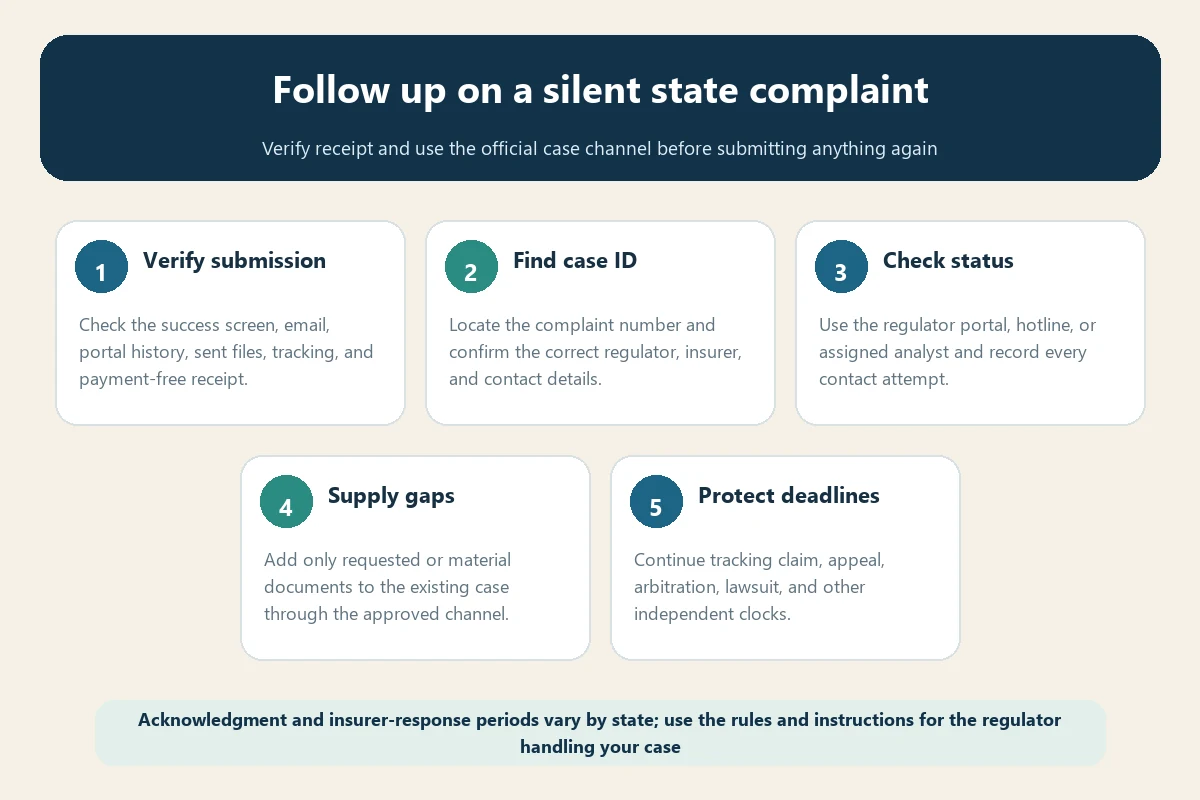
Save the final success screen, PDF copy, upload list, confirmation email, sent-message record, fax report, postal tracking, case number, and submission date. If you used a portal, export the complaint history and record the account email.
List every document and page count. The claim status follow-up guide provides a compact log for submissions, contacts, promised actions, and outstanding items.
Confirm that the final submit step occurred
Some portals show a review page before the complaint is actually filed. The Kansas Department of Insurance complaint instructions distinguish the review screen from the final submit action and explain that a successful filing produces a case number and downloadable PDF.
If you saved only a draft or review page, complete the official submission once. If a case number exists, treat it as an open or received record until the department says otherwise.
Search for the acknowledgment safely
Check inbox, spam, junk, quarantine, blocked senders, portal notifications, and the email address entered on the form. Search by the regulator’s domain, “complaint,” “case,” “consumer services,” and the insurer’s name.
Do not click a suspicious message merely because it mentions the complaint. Navigate independently to the regulator’s government website and log in from the official link.
Use the complaint number as the anchor
A complaint ID lets staff locate the correct record and prevents documents from being attached to a different case. Put it in the subject line, first paragraph, filenames when instructed, and every telephone note.
The Pennsylvania Insurance Department portal FAQ describes the complaint ID as the receipt that the department received the filing and tells consumers to reference it when communicating or submitting documents.
Check the official portal before calling
Look for the complaint in submission history, status, comments, messages, documents, assigned investigator, and action-required sections. Confirm that your email and telephone number remain current.
Take a dated screenshot of the status without exposing it publicly. Record any portal outage or error message, but do not repeatedly refresh or resubmit the complaint.
Distinguish acknowledgment from resolution
An acknowledgment confirms receipt and often provides a case number. It does not mean an examiner has completed review, the insurer has answered, or the department has found a violation.
Likewise, a quiet period after acknowledgment can reflect jurisdiction screening, document review, insurer response time, reassignment, or case complexity. Ask which stage the file is in rather than demanding a final outcome immediately.
Do not apply one state’s timeline nationwide
The Massachusetts Division of Insurance complaint page says consumers generally receive an acknowledgment or missing-information notice within two weeks when jurisdiction is identified. Nebraska describes an acknowledgment with a tracking ID and gives companies 15 business days to respond to its request.
Those are state-specific examples. Your department may use a different acknowledgment target, insurer-response period, extension rule, or communication method. Use the official instructions for your case.
Verify the correct department has the complaint
Review the policy delivery state, purchaser residence, licensed insurer, state endorsement, and agency notice. A complaint sent to the wrong regulator may be referred, returned, or held while authority is reviewed.
The wrong-state complaint guide explains how to confirm jurisdiction and preserve the first filing without creating inconsistent duplicate records.
Contact consumer services with a concise request
Provide your name, case number, submission date, insurer, policy or claim number, contact information, and one question: whether the complaint was received and what action, if any, is required from you.
Do not send a new twenty-page narrative with a status inquiry. Ask the department where additional evidence belongs and whether an analyst has been assigned.
Use a five-line status request
A useful inquiry can be brief: identify the complaint number, date filed, regulated company, policy or claim number, and the specific confirmation requested. Ask whether the case is open, whether jurisdiction was accepted, whether an examiner or analyst is assigned, and whether any item is due from you.
Attach the receipt only if staff cannot locate the filing. Do not resend sensitive exhibits unless the department confirms the approved channel and asks for them. If the original complaint itself may be incomplete, compare the record with the state travel insurance complaint filing guide before supplying a focused supplement.
End with one reliable email address and telephone number. Save the sent inquiry and any automated ticket number so the follow-up becomes part of the chronological audit trail.
Use the channel the regulator identifies
Some agencies prefer portal comments; others publish a hotline, email, fax, or postal address. The Washington Office of the Insurance Commissioner page provides a dedicated option to check an existing complaint’s status.
Record the date, channel, person, reference number, and promised next step for every contact. Avoid sending the same message through every channel on the same day unless instructed.
Check whether the filing was incomplete
A department may need authorization, signature, policy declarations, insurer legal name, claim decision, or proof that the consumer attempted to resolve the issue internally. Look for an action-required notice in the portal and email.
Supply the missing item through the existing case. Include an index and explain what the document proves. Do not upload unrelated health, identity, or financial records.
Add documents to the existing case
The Pennsylvania portal guidance advises consumers to upload documents to the existing complaint and warns against submitting multiple complaints about the same issue. Kansas likewise tells consumers with an outstanding complaint not to complete a new form.
Use the complaint ID, clear filenames, and a short cover note. Preserve the upload confirmation and original files.
Avoid accidental duplicate complaints
A duplicate can split evidence, create two case numbers, delay assignment, or generate inconsistent summaries. Before refiling, ask the department whether the first submission exists and whether it wants a replacement or supplement.
If a duplicate was already created, disclose both case numbers and ask staff which record will remain active. Do not conceal the earlier filing.
Track the insurer response separately
The regulator may have acknowledged the complaint while waiting for the company’s explanation. Ask whether the response period started, whether an extension was granted, and whether the department needs anything from you.
When the insurer response arrives, use the complaint response review guide to compare it with the policy, chronology, evidence, calculations, and original questions.
Respond promptly to an agency request
Read every request for its deadline, permitted format, secure channel, scope, and consequence of nonresponse. Ask for clarification before sending an undefined set of sensitive records.
If you need more time, request it before the deadline and obtain written confirmation. A closed-for-no-response outcome can be different from a finding that no insurer violation occurred.
Review a closure carefully
If the file closes while you were waiting, identify whether the reason was missing consumer information, no jurisdiction, resolved complaint, no violation, or another disposition.
The complaint closure guide explains how to audit the finding and determine whether the department permits a rebuttal or additional evidence.
Protect other deadlines during regulator silence
Do not assume a pending or unacknowledged complaint pauses the insurer’s appeal deadline, contractual limitation period, statute of limitation, arbitration deadline, chargeback window, supplier refund period, or tax obligation.
Continue timely claim and appeal steps. If a substantial amount or near deadline is involved, consult a qualified attorney promptly.
Use a measured follow-up schedule
Follow the department’s published timing first. If none is stated, verify receipt after a reasonable delivery period, then space inquiries so staff can act. Escalate sooner when a deadline, urgent health issue, fraud, identity theft, or active financial loss requires it.
Each follow-up should add a clear question or material fact. Repeated daily messages with no new information can make the record harder to review.
Keep a permanent complaint audit file
Retain the policy, claim, appeal, complaint, submission proof, case ID, portal exports, messages, contact log, added documents, insurer response, rebuttal, closure, payment record, and deadline chart.
The final file should show when the complaint was submitted, how receipt was verified, every follow-up, what the agency requested, and how the matter ended.
Bottom line
When a travel insurance complaint receives no state response, verify the final submission and case number, search the official portal and email record, contact consumer services through the approved channel, attach material documents to the existing file, avoid duplicate complaints, and protect every independent deadline. A documented status inquiry is stronger than simply submitting the same complaint again.
