
To reopen a travel insurance complaint, read the closure notice, identify a material reason for further review, contact the state insurance department using the original complaint number, and ask for a specific action in writing. The strongest request shows what changed after closure or what decisive fact the prior review missed.
Reopening is not automatic and state procedures differ. A regulator may reopen the existing matter, accept supplemental information without changing its status, correct the record, direct you to a new complaint, or explain that another appeal or legal process is appropriate. This guide is general information, not legal advice.
Start with the closure notice
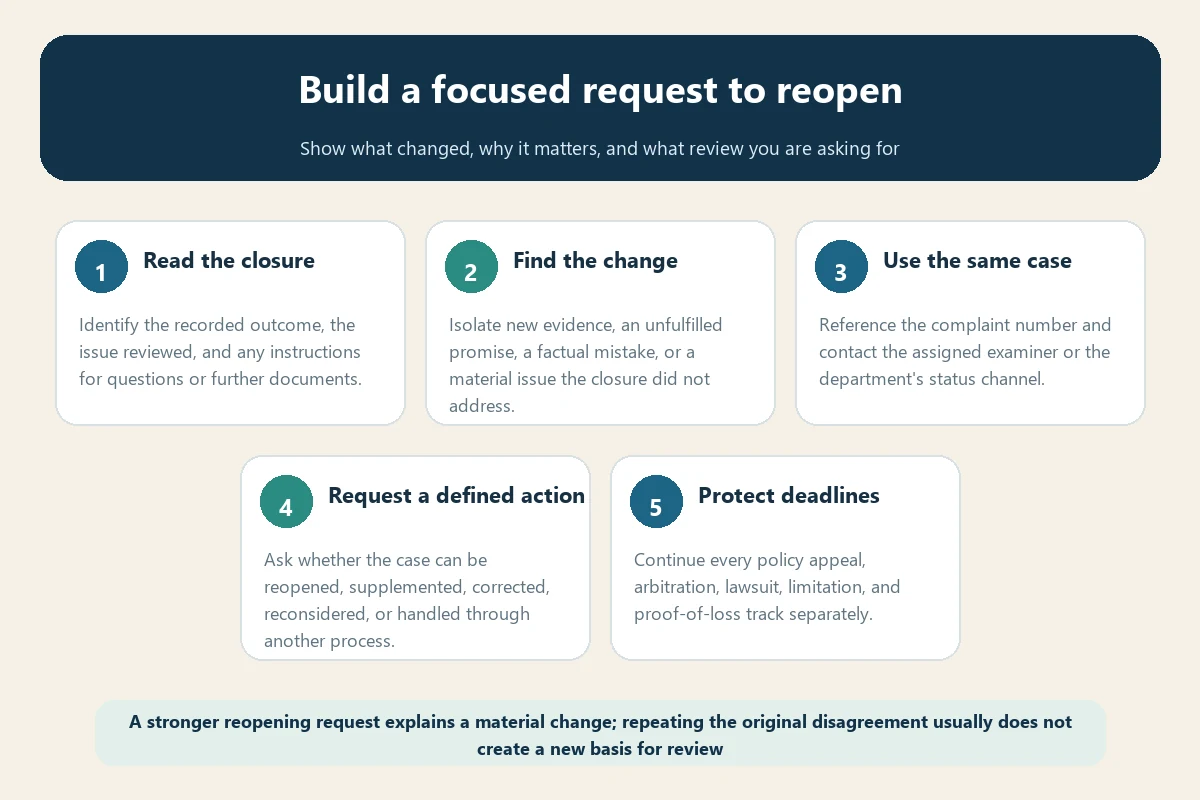
Before writing anything, identify the closure date, disposition, issue reviewed, insurer’s position, policy language cited, documents considered, and any instruction for questions or additional material. Separate an unfavorable conclusion from a factual omission. Disagreeing with the result alone may not establish a reason to reopen.
The National Association of Insurance Commissioners explains that state departments investigate complaints within their authority, forward accepted complaints to insurers, obtain company explanations, and assess conduct under the policy and applicable rules. Its complaint reports also use dispositions for closed matters. The exact effect of closure therefore depends on the department and recorded outcome.
Identify a material basis to reopen
A focused request normally points to information that could affect the regulator’s understanding of claim handling or compliance. Common examples include:
- A newly obtained policy endorsement, certificate, or application page that changes the applicable terms.
- A dated medical, carrier, hotel, employer, or payment record that resolves a disputed fact.
- An insurer promise described in the closure that was not performed.
- A company response that omitted a document, used the wrong policy version, or misstated the timeline.
- Evidence that the insurer received a required document earlier than it claimed.
- A material issue raised in the complaint that the closure did not address.
- A mistaken identity, claim number, company, or jurisdiction that can now be corrected.
Explain why the material was unavailable earlier. If it existed but you overlooked it, say so accurately and show why it matters now. Do not label the same narrative “new evidence” merely because it has been rewritten.
Distinguish reopening from an internal claim appeal
A regulator complaint reviews insurer conduct within the department’s authority. An internal appeal asks the insurer to reconsider coverage or payment under the policy. These tracks may overlap factually, but one does not necessarily replace the other.
If the insurer issued a new denial or final appeal response after the complaint closed, give that document to the regulator and ask which route applies. The denied travel insurance claim appeal guide helps organize the insurer-facing submission. Continue to satisfy policy deadlines unless an authoritative source confirms otherwise.
Use the original complaint number
Contact the assigned examiner, consumer portal, or status channel shown in the acknowledgment and closure. Include the original complaint number, policyholder, insurer, claim identifier where appropriate, closure date, and current contact details. This lets staff retrieve the complete history.
Washington’s Office of the Insurance Commissioner explains in its official complaint-response system guidance that closed cases appear in a closed section and, if the agency decides to reopen one, it moves back to open complaints. That page is written for company users, but it confirms an important distinction: the regulator makes the reopening decision and the existing case retains its identity.
The Washington OIC system guidance also states that certain documents may be uploaded after closure. Do not assume your state offers the same functionality; ask how a consumer should submit post-closure evidence.
Create a one-page reopening statement
Lead with the requested action, then make the change easy to verify:
- Identify the original complaint and closure.
- State the new fact, evidence, or unfulfilled action.
- Quote the relevant closure sentence or company position briefly.
- Explain exactly how the new material affects that point.
- List numbered exhibits with dates and sources.
- Ask whether the department will reopen, supplement, correct, or redirect the matter.
Re: Complaint [number], closed [date]. I request further review because [new evidence or material change] directly affects [specific closure finding or unresolved issue]. Exhibit 1 shows [fact], which differs from the company’s statement that [concise description]. Please advise whether the existing complaint can be reopened or supplemented, what status will be recorded, and whether any further response is required from me or the company.
Keep the tone factual. Do not accuse an examiner or insurer of misconduct without evidence. A precise comparison between the closure and the new record is easier to assess than a long repetition of the original dispute.
Build an exhibit index
Give each attachment a stable label, descriptive name, date, source, and one-sentence relevance note. For example: “Exhibit 2 — airline cancellation notice — March 4 — carrier — confirms cancellation preceded the insurer’s stated date.” Use searchable PDF files when accepted and avoid password protection unless instructed.
Submit only records relevant to the requested review. Redact unrelated account numbers, identification numbers, and third-party information according to agency instructions. Keep unredacted originals securely. The complaint privacy guide explains why insurer sharing, retention, and public-record rules should be checked before uploading sensitive documents.
Ask the regulator the right procedural questions
- Does this department reopen closed complaints?
- Should the evidence be added to the old case or filed as a new matter?
- Will the insurer receive the new material and have another response period?
- Will reopening change the closure disposition or create a new case number?
- Is there a deadline or required form for requesting reconsideration?
- What written notice will confirm acceptance or denial of the request?
- Does another division, agency, appeal, or hearing process control the issue?
Pennsylvania’s official Consumer Services Portal FAQ tells users with an open complaint to add a comment so the assigned investigator is notified and to reference the complaint ID when mailing documents. Although it addresses open matters, it illustrates why a case-specific channel and identifier are preferable to an unconnected new submission. Review your state’s current instructions.
See the Pennsylvania Insurance Department portal FAQ and the NAIC’s state insurance complaint overview for official examples of complaint routing and documentation.
When the promised resolution failed
If the complaint closed because the insurer promised payment, correction, reconsideration, or a written explanation, document the promise and the failure. Include the closure wording, dates, follow-up messages, account or claim activity, and current status. State whether part of the promise was completed.
Ask whether the examiner prefers reopening, post-closure follow-up, or a new complaint about subsequent conduct. The distinction matters because the failed promise may be part of the original handling or a new event.
When the closure found no violation
A no-violation result generally means the department did not find a regulatory or policy-handling breach on the reviewed record. It does not necessarily decide every contract question as a court would. To justify further review, connect new evidence to a specific factual or legal premise in the closure.
The closed complaint with no violation guide explains how to compare the company response, policy text, jurisdiction limits, and remaining options. Avoid asking the department to determine damages or contested facts it says are outside its authority.
Do not create avoidable duplicate complaints
Filing the same dispute again without instruction can split documents across case numbers, slow review, or produce a duplicate disposition. Begin with the existing matter. If staff directs you to file anew, reference the prior complaint and explain the new development in the opening.
If the first matter went to the wrong jurisdiction, the better action may be a referral or filing with the proper regulator. Use the wrong state department guide to assess residence, policy issuance, insurer identity, and regulatory authority.
Track every deadline separately
A reopening request may not pause or extend an insurer appeal, proof-of-loss requirement, contractual limitation, statute of limitation, arbitration period, court deadline, or another agency’s filing period. Put each deadline on a separate calendar with its source and calculation method.
If a deadline may expire while the department considers the request, take appropriate protective action and seek qualified legal advice. Do not rely on a portal status, phone conversation, or pending complaint to toll time unless controlling authority expressly says it does.
Follow up without flooding the file
Save proof of submission and allow the stated response period. If none is stated, send a concise status inquiry through the approved channel, referencing the case number and submission date. Ask whether the material was received and whether a decision on reopening is pending.
The no state response guide provides a documented escalation sequence. Send genuinely new documents as labeled supplements; do not resend the entire file with every message.
If the department declines to reopen
Ask for the decision and reason in writing, the final disposition, and any available review or referral instructions. Determine whether the refusal concerns procedure, jurisdiction, lack of new information, or the limits of consumer assistance. Each reason points to a different next step.
Possible alternatives include the insurer’s appeal, an external review where applicable, arbitration, mediation, another regulator, or legal advice. Do not imply that a new complaint can evade a final agency decision or expired deadline.
Frequently asked questions
Is new evidence required?
Not always, because a broken resolution promise or identifiable processing error may also matter. But the request should identify a material reason beyond repeating disagreement with the outcome.
Will the same examiner handle the reopened complaint?
That depends on staffing and state procedure. Address the existing case and let the department assign it. Preserve all prior correspondence so a new reviewer can understand the history.
Can I add documents after closure?
Some systems permit post-closure documents, while others require staff assistance or a new filing. Washington’s company-facing system is one official example, not a national rule.
Does reopening mean the insurer must pay?
No. It means the department may conduct further review or request another response. Coverage and payment still depend on the policy, facts, law, authority, and applicable process.
Can I reopen a complaint I withdrew?
Ask the department. It may consider the reason for withdrawal, time elapsed, new information, and current authority. The complaint withdrawal guide explains why reopening terms should be requested before closure when possible.
A persuasive reopening request is narrow, documented, and tied directly to the closure. Use the original complaint number, identify the material change, provide indexed evidence, ask for a defined action, obtain the decision in writing, and keep every other claim or legal deadline on its own track.
