
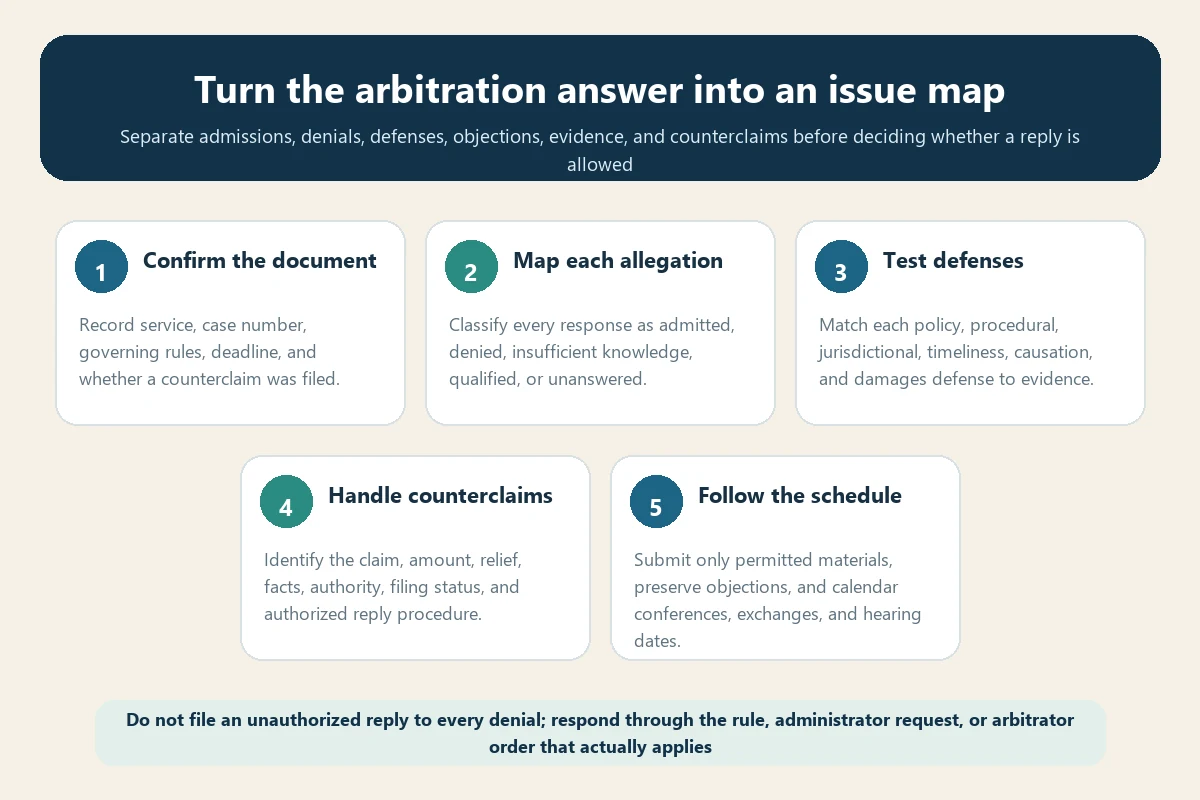
To respond to a travel insurance arbitration answer, first confirm what the insurer filed and which rules govern. Then map every admission, denial, qualification, defense, jurisdiction objection, factual assertion, document, and counterclaim to the original demand and evidence.
Do not automatically file a free-form rebuttal. A reply may be required for a counterclaim, permitted only by rule or order, or unnecessary for ordinary denials. Follow the administrator’s notice and the arbitrator’s scheduling order. This guide is general information, not legal advice.
Confirm what you received
Save the answer, attachments, administrator email, portal record, and proof of service. Record the case number, filing party, legal entity, representative, date and time zone, document title, rule cited, response deadline, and whether the filing includes a counterclaim, jurisdiction objection, or request for relief.
Do not assume every attachment is part of the accepted record. Compare the portal index or administrator notice with the files actually delivered and report missing or corrupted documents promptly.
Read the current governing rules
Use the rule set named in the agreement and accepted by the administrator, including its effective date. The current AAA Consumer Arbitration Rules provide that a respondent may submit an answer within 14 calendar days after AAA requests it. Under those rules, the case moves forward after that period even if no answer is filed.
The same rules address counterclaims differently: a counterclaim must briefly explain the dispute, specify the amount involved and relief sought, and the claimant may file an answer or reply within 14 calendar days after AAA sends notice of the counterclaim. Those details apply to that rule set; another administrator or case-specific order may differ.
Distinguish an answer from a counterclaim
An answer responds to the claimant’s demand. A defense seeks to defeat or limit that demand. A counterclaim asks for affirmative relief against the claimant. An insurer’s request for dismissal or denial of the claimant’s requested relief is not necessarily a counterclaim.
Look for a separately labeled counterclaim, filing fee, amount, factual basis, legal or contractual theory, and requested award. If the status is unclear, ask the administrator whether it accepted a counterclaim and what reply deadline applies.
Create an allegation-response matrix
Copy each numbered demand allegation into a working table. Add columns for the insurer’s response, classification, cited evidence, your evidence, dispute status, and next procedural opportunity. Classify the response as:
- Admitted without qualification.
- Admitted in part and denied in part.
- Denied.
- Insufficient knowledge or information.
- Qualified by a different fact or policy interpretation.
- Not answered.
Use the insurer’s exact position. A statement that a document “speaks for itself” is not the same as agreement with your interpretation.
Preserve useful admissions
Mark admitted purchase date, policy number, coverage period, claim receipt, document receipt, event date, denial date, payment amount, or communication history. These may narrow what needs proof, subject to the governing rules and later orders.
Do not overstate an admission. If the insurer admits receiving a receipt but disputes whether the expense is covered, separate receipt authentication from coverage.
Break compound denials apart
An answer may deny a paragraph containing several facts. Rewrite the paragraph into atomic propositions: the trip was purchased, coverage began, an event occurred, notice was given, an expense was paid, a refund was unavailable, and a policy benefit applies.
Match one exhibit or witness to each proposition. This prevents a broad denial from hiding which fact is actually disputed.
Build a defense inventory
List every affirmative or threshold defense separately, including:
- No agreement to arbitrate or wrong forum.
- Wrong respondent or claimant lacks standing.
- Claim outside the clause’s scope.
- Untimely notice, proof, appeal, demand, or suit.
- Failure to satisfy a condition precedent.
- Event not covered or an exclusion applies.
- Loss not caused by the covered event.
- Expense not incurred, reasonable, necessary, or documented.
- Refund, credit, other insurance, deductible, or limit reduces payment.
- Release, settlement, waiver, estoppel, or prior decision.
- Requested remedy unavailable under the agreement or law.
For each defense, record the policy or rule cited, essential factual assertion, evidence offered, contrary evidence, and whether the issue needs briefing, discovery, or hearing testimony.
Compare the answer with the denial letter
Identify reasons repeated, abandoned, narrowed, or newly introduced. A new explanation is not automatically invalid, but it may require different evidence and may matter to claim-handling arguments.
Use the travel insurance denial reasons guide to separate covered-event, exclusion, documentation, timing, causation, amount, and policy-status issues.
Audit every policy quotation
Locate each quoted clause in the complete policy. Read definitions, insuring agreement, exclusions, conditions, limits, endorsements, and surrounding text. Check whether ellipses or isolated sentences omit a cross-reference or exception.
Cite page, section, and edition in your issue map. If the parties rely on different policy versions, preserve delivery and effective-date evidence rather than debating two texts without establishing which controls.
Review new evidence without rushing a rebuttal
Inventory every new exhibit by file name, description, author, date, source, completeness, and proposition asserted. Flag illegible pages, missing attachments, unexplained spreadsheets, hearsay concerns, inconsistent metadata, or records belonging to another claim.
Ask whether the scheduling order provides an exhibit objection, document exchange, witness, or briefing phase. Preserve objections in the authorized format and time rather than burying them in an unsolicited email.
Handle a jurisdiction or arbitrability objection
The insurer may argue that the clause does not cover the dispute, the claimant sued the wrong entity, a prerequisite was not satisfied, or another forum must decide the issue. Identify who the agreement and rules say decides each question.
The complaint vs arbitration guide explains why a regulator’s involvement does not automatically resolve arbitral authority. Obtain qualified advice when a court filing, stay, enforceability dispute, or limitations period may be implicated.
Respond to a counterclaim methodically
Create a second matrix for the counterclaim. Record each element, alleged fact, amount, requested relief, contract or law cited, evidence, and defense. Confirm whether the administrator accepted it, assessed a fee, and issued a reply deadline.
Do not treat a counterclaim as a rhetorical threat. It seeks affirmative relief and may require a formal answer. Conversely, do not concede that every paragraph labeled “counterclaim” falls within the arbitration agreement or governing rules.
Check the official answering form
AAA publishes an official Arbitration Answering Statement and Counterclaim form that asks for party details, case number, nature and amount of a counterclaim, other relief, arbitrator qualifications, locale, and service on case participants and AAA.
The form is useful for understanding common fields, but it does not prove that it is the correct form for every consumer travel insurance case. Follow the case administrator’s instructions and current rules.
Do not file an unauthorized reply
Ordinary denials may be addressed later through document exchange, briefing, witness statements, or hearing. A reply to a counterclaim may be expressly allowed. A scheduling order may invite a focused submission. These are different procedural permissions.
If uncertain, ask: “Has a counterclaim been accepted, is a claimant reply required or permitted, what rule controls, what is the deadline, and where should it be filed?” Save the written response.
Prepare a concise authorized reply
When a reply is permitted, use the case caption and number, identify the filing answered, respond paragraph by paragraph where appropriate, state defenses to the counterclaim, preserve jurisdictional positions, and specify requested relief. Attach only authorized or necessary exhibits.
Avoid repeating the entire demand. Focus on genuinely new allegations, counterclaim elements, and threshold objections. Use neutral language and verifiable dates.
Reconcile the damages dispute
Compare the claimed total with the insurer’s amount, allowed categories, exclusions, limits, deductible, refunds, credits, exchange rates, depreciation, prior payment, and disputed balance. Create a bridge from the original demand to the current amount.
If a partial payment is involved, use the partial travel insurance payment guide to avoid duplicate or unexplained amounts.
Plan targeted information requests
Identify the smallest set of records needed to test each defense: claim notes, policy version, underwriting or purchase record, communication logs, calculation worksheet, refund verification, medical review, vendor record, or licensing information.
Do not send discovery demands before the rules or arbitrator authorize them. AAA’s official arbitration overview explains that parties provide relevant information, documents, witness lists, and other evidence, with procedure depending on the case.
Prepare for the preliminary conference
Bring a one-page issue list, disputed amount, anticipated witnesses, requested document exchange, confidentiality or protective-order concerns, hearing preference, estimated time, availability, and proposed deadlines. Separate agreed facts from contested issues.
Ask the arbitrator to clarify the sequence for jurisdiction objections, counterclaim response, amendments, exchanges, motions, witnesses, exhibits, and hearing. Record the resulting dates only from the written order or confirmed schedule.
Preserve the original filing history
Keep the demand, acceptance notice, filing date, service proof, fee receipts, deficiency notices, corrected submissions, answer, counterclaim, and administrator messages together. The rejected arbitration demand guide explains how an intake defect can differ from an adjudicative decision.
Coordinate with any insurer appeal or complaint
An arbitration answer may reveal a new factual or policy explanation relevant to a pending insurer appeal or regulator complaint. Update those records only through permitted procedures and use consistent facts.
If an internal review remains open, the travel insurance claim appeal guide helps organize a policy-specific response. Do not assume an appeal, complaint, or settlement discussion pauses arbitration deadlines.
Common mistakes
- Calling every denial a counterclaim.
- Filing a rebuttal without procedural permission.
- Ignoring a real counterclaim reply deadline.
- Responding to compound paragraphs without separating facts.
- Failing to preserve admissions and abandoned denial reasons.
- Quoting policy text without verifying the version.
- Attacking new evidence before checking the objection schedule.
- Conceding jurisdiction merely by addressing the merits.
- Using an old rule set or generic court pleading template.
- Assuming insurer silence or no answer produces an automatic win.
Final answer-review checklist
- Complete answer and attachments saved.
- Service date, rules, and deadlines confirmed.
- Counterclaim status verified with the administrator.
- Every allegation classified in a matrix.
- Admissions and qualified admissions preserved.
- Each defense matched to policy text and evidence.
- New exhibits indexed and procedural objections calendared.
- Damages reconciled line by line.
- Reply filed only if authorized or required.
- Conference and scheduling-order dates tracked.
Bottom line
A professional response to a travel insurance arbitration answer begins with an issue map, not an immediate rebuttal. Separate admissions, denials, defenses, jurisdiction objections, evidence, requested relief, and any accepted counterclaim.
Use the governing rules and case order to decide whether, when, and how to reply. Preserve every deadline and procedural objection, and obtain qualified advice when a counterclaim, enforceability dispute, court proceeding, or limitations question could materially affect the case.
