
A travel insurance arbitration post-hearing brief should explain why the admitted evidence and governing authority support specific findings and an exact award. It should not introduce new facts, documents, theories, or remedies after the hearing unless the arbitrator expressly permits them and gives the other side a fair opportunity to respond.
Confirm that briefing is authorized, which issues are open, what record may be cited, whether reply briefing is allowed, and when the hearing closes. The agreement, rules, and case order control. This guide provides general information, not legal advice.
Confirm that a brief is authorized
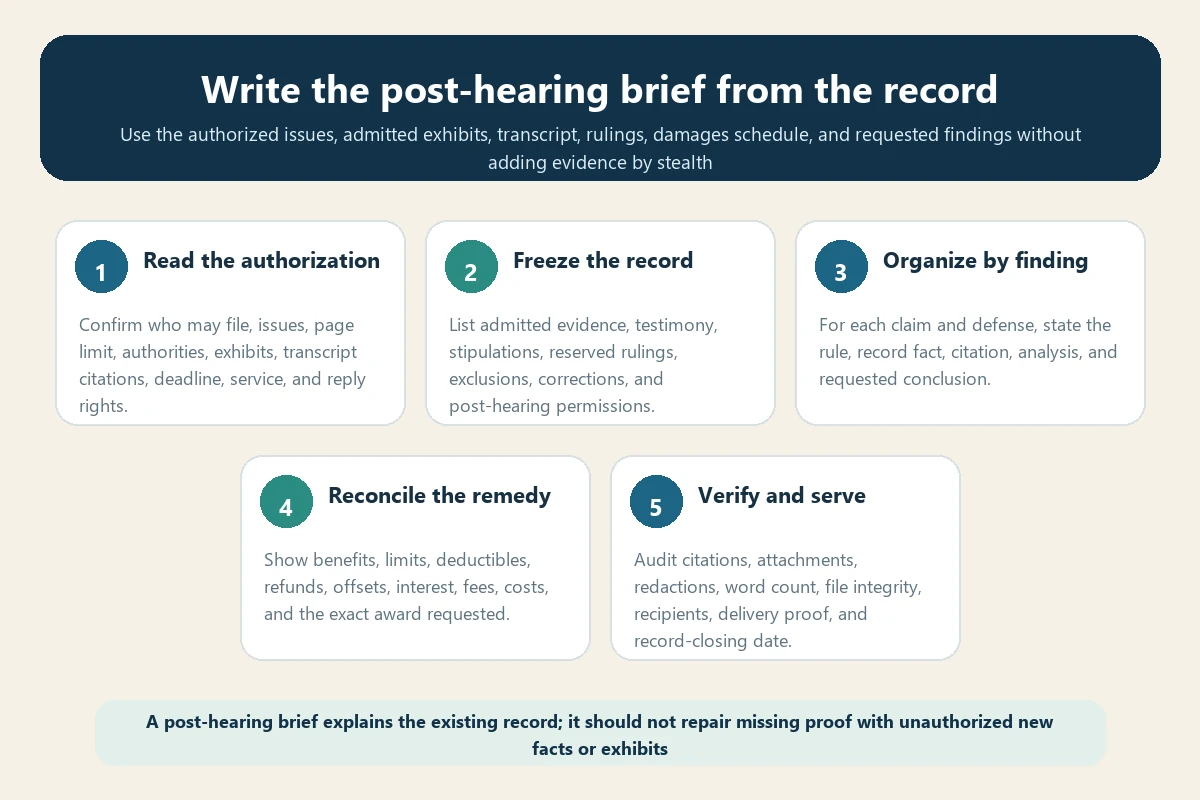
Save the oral direction, written order, administrator notice, or joint agreement. Record who may file, brief type, issues, page or word limit, format, authorities, attachments, transcript citations, filing channel, service recipients, deadline, time zone, reply, and record-closing date.
Do not assume every final hearing includes post-hearing briefs. If authorization is unclear, ask through the case administrator or permitted channel before submitting.
Read the current post-hearing rules
In an AAA consumer case, review the current AAA Consumer Arbitration Rules. They separately address written statements and post-hearing evidence, closing the hearing, reopening the hearing, the award, and related timing.
The rules provide that when parties agree or the arbitrator decides that post-hearing documents or evidence are needed, they are filed through AAA for transmission, and all parties receive an opportunity to review and respond. Confirm the exact current text and case order.
Distinguish argument from new evidence
Argument explains what existing testimony, admitted exhibits, stipulations, and authority mean. New evidence adds a document, fact, declaration, calculation input, expert opinion, or other proof that was not part of the accepted record.
A chart summarizing admitted numbers may be argument or a demonstrative; a chart containing a new refund figure may be evidence. Identify the source of every input and ask permission when uncertain.
Create a final record inventory
Before drafting, list:
- Admitted claimant, respondent, and joint exhibits.
- Excluded, withdrawn, and reserved exhibits.
- Witnesses and completed testimony.
- Stipulations and admitted facts.
- Transcript or official recording status.
- Rulings made during the hearing.
- Issues expressly reserved.
- Corrections or supplemental material authorized.
- Open cost, fee, interest, or remedy submissions.
- Date the hearing or record closes.
Do not cite a working exhibit list as proof that an exhibit was admitted.
Use a proof-to-finding matrix
For each requested finding, record the policy or legal rule, burden if established, admitted fact, disputed fact, exhibit citation, transcript citation, defense, response, and exact conclusion requested.
The arbitration hearing preparation checklist explains how to create this proof map before the hearing; the brief updates it to reflect what actually entered the record.
Organize the brief around decisions
A practical structure is:
- Introduction and exact relief requested.
- Authorized issues and governing policy provisions.
- Findings of fact supported by record citations.
- Analysis of each claim and defense.
- Response to counterclaims if within scope.
- Damages and remedy calculation.
- Requested disposition or proposed findings.
Follow any ordered format instead of this default.
Write a narrow introduction
State what the arbitrator must decide, the policy benefit or dispute, core finding supported by the record, amount requested, and principal unresolved defense. Avoid a long procedural history unless it matters to the authorized issue.
Do not claim the hearing proved something that was never admitted or testified to.
Propose findings of fact carefully
Number each proposed finding and cite the precise exhibit page, transcript page and line, stipulation, or ruling. Separate fact from legal conclusion and argument.
Use neutral, verifiable language. “The insurer received the claim on June 4” is a proposed fact; “the insurer acted outrageously” is argument unless tied to a defined standard and record.
Cite the transcript accurately
Use the official transcript if one was designated. Confirm witness, page, line, correction, and confidential designation. Do not quote rough notes as if they are the official record.
If no transcript exists, follow the arbitrator’s permitted citation method for testimony. Avoid reconstructed quotations.
Audit every exhibit citation
Verify exhibit number, admitted status, page, version, date, and description. Open the cited page and ensure it supports the sentence. Distinguish a party’s exhibit from a joint exhibit.
Use the arbitration document exchange guide to cross-reference production files, hearing exhibits, redactions, and provenance.
Address the policy text in context
Cite the complete insuring agreement, definition, exclusion, condition, limit, and endorsement relevant to each issue. Explain cross-references and exceptions. Do not quote one phrase while omitting text that changes its meaning.
If policy versions were disputed, explain which version entered the record and the evidence of issuance or delivery.
Respond to each live defense
Use the answer, hearing rulings, and evidence to identify defenses still at issue. Address notice, timeliness, exclusion, condition precedent, causation, documentation, amount, offset, refund, jurisdiction, party identity, release, or another preserved defense.
The arbitration answer guide helps distinguish denials, affirmative defenses, jurisdiction objections, and counterclaims.
Do not ignore unfavorable evidence
Identify the strongest contrary exhibit or testimony, state it accurately, and explain why it does not change the requested finding. Silence can make the analysis appear incomplete.
Do not mischaracterize a witness or conceal a qualification that the transcript makes clear.
Reconcile credibility arguments
Use specific inconsistencies, contemporaneous records, personal knowledge, corroboration, timing, and demeanor only if the record supports them. Distinguish a memory gap from a contradiction.
Avoid personal attacks. Explain why one version is more consistent with admitted evidence.
Calculate damages transparently
Provide a table with benefit, expense, original currency, exchange rate and date, policy limit, deductible, refund, credit, other insurance, prior payment, disputed balance, interest if authorized, and requested total. Cite each input.
The partial travel insurance payment guide helps reconcile the original demand, insurer calculation, and remaining balance without double counting.
Separate benefits from additional remedies
List policy benefits, interest, attorney fees, arbitration costs, statutory relief, declaratory relief, or other remedies separately. For each, cite the source of authority, preserved request, supporting evidence, and calculation.
Do not add a new remedy after hearing because it seems available. Confirm it was within the submitted claims and briefing authorization.
Handle fees and costs through the ordered process
Determine whether fees or costs require a separate application, invoices, time records, affidavit, objection period, or later phase. Redact protected information and avoid including settlement communications unless permitted.
Do not assume administrative fee allocation equals authority for attorney fees.
Address reserved rulings
List every exhibit objection, motion, jurisdiction issue, privilege question, or remedy issue the arbitrator reserved. State the requested ruling and record basis within the authorized scope.
Do not relitigate rulings already made unless the order permits reconsideration or clarification.
Use authority permitted by the order
Confirm whether statutes, regulations, cases, policy authorities, or only record argument may be submitted. Use primary authority where possible and identify jurisdiction and current status.
Do not attach a large authority appendix unless requested. Cite stable official sources and pinpoint provisions.
Respect word and page limits
Check cover, table, footnotes, exhibits, certificates, and proposed order against the limit definition. Use headings and concise record citations rather than shrinking type or margins.
If additional space is genuinely necessary, request leave before the deadline and explain why.
Do not attach unauthorized exhibits
A convenient copy of an admitted exhibit may still violate an order limiting attachments. A new declaration, receipt, calculation source, medical note, or web page is new evidence unless the arbitrator determines otherwise.
If a missing item becomes essential, request reopening or supplementation through the governing rule and explain relevance, reason for delay, prejudice, and proposed response opportunity.
Understand record closing
AAA’s official 2024–2025 rule update notes that revised rules address the arbitrator’s timing for deciding whether hearings should be closed. The exact closing date matters because it can affect award timing and whether further submissions are allowed.
Ask for written confirmation of the record-closing date. Do not treat the brief deadline and closing date as identical unless the order says so.
Handle reopening requests carefully
Review the current rule and award deadline. State the specific evidence or issue, why it was unavailable, diligence, importance, prejudice, and proposed procedure. A desire to improve an argument is not the same as newly available material.
Do not submit the new item before permission if the procedure requires a motion first.
Preserve equal access and service
Every authorized brief and submission should be filed and served through the required channel to all recipients. The Federal Mediation and Conciliation Service’s official Arbitrator Code of Professional Responsibility, in a labor-arbitration context, states that an arbitrator should not consider a post-hearing submission not provided to the other party.
That code does not govern every consumer case, but it illustrates the fundamental need for shared submissions and response opportunity. Follow the actual consumer rules and order.
Protect confidential material
Follow the protective order for designations, redactions, sealed or restricted submissions, medical data, transcript excerpts, and service. Do not place sensitive information in a public or unsecured attachment.
The arbitration confidentiality guide explains why a private proceeding does not automatically make later court filings confidential.
Prepare a citation audit
For every citation, verify source exists, was admitted or authorized, page and line are correct, quotation is accurate, context is fair, confidentiality treatment is proper, and the source supports the proposition.
Use a second pass focused only on numbers, dates, names, policy section references, and arithmetic.
Prepare a remedy audit
Confirm the total equals its components, credits are deducted once, currencies are converted consistently, interest dates and rates have authority, fees and costs are separated, and requested nonmonetary relief is precise.
State whether the amount is gross, net of prior payment, or subject to a later calculation.
File and document service
Verify file name, format, size, searchable text, page count, redactions, signatures, case number, recipients, upload folder, deadline, and time zone. Save confirmation, sent copy, file hash if useful, and delivery receipt.
If the portal fails, preserve screenshots and follow the administrator’s official contingency process. Do not assume an email attempt is accepted filing.
Common mistakes
- Assuming post-hearing briefing is automatic.
- Adding new facts or exhibits without permission.
- Citing offered but excluded evidence.
- Using rough notes as transcript quotations.
- Ignoring the strongest defense or contrary proof.
- Requesting remedies not preserved in the case.
- Mixing policy benefits, interest, fees, and costs.
- Missing page, reply, service, or record-closing limits.
- Failing to share the submission with all parties.
- Filing protected material through an insecure or public channel.
Final brief checklist
- Written authorization and deadlines confirmed.
- Final admitted record inventoried.
- Proof-to-finding matrix updated.
- Each fact and argument has an accurate citation.
- Live defenses and contrary evidence addressed.
- Damages and remedies reconciled.
- No unauthorized evidence or theory added.
- Confidentiality and redaction rules followed.
- Format, word count, recipients, and delivery audited.
- Record-closing and reply status documented.
Bottom line
A travel insurance arbitration post-hearing brief should turn the admitted record into clear requested findings. Organize by issue, cite precise exhibits and testimony, address defenses, reconcile the remedy, and stay within the authorization.
Do not use briefing to repair missing proof with new evidence. Confirm equal service, confidentiality, record closure, and award timing, and obtain qualified advice when reopening, privilege, fees, appeal, or court review could materially affect the submission.