

To enforce a travel insurance arbitration award in the United States, first determine whether the insurer must already perform and whether voluntary compliance is still possible. If payment does not arrive, the prevailing party may need to ask a court with jurisdiction to confirm the award and enter judgment before using judicial collection procedures.
Do not skip jurisdiction, venue, service, challenge, confidentiality, or state-law analysis. This guide provides general information, not legal advice. Enforcement rules, deadlines, exemptions, interest, and available remedies vary by agreement, forum, court, state, and procedural history.
Verify that the award is final and payable
Use the travel insurance arbitration award guide to preserve the original transmittal and map every operative term. Confirm the correct payer, payee, principal, interest, fees, costs, offset, prior credit, tax form, performance condition, and due date.
Identify whether the decision is final, partial, interim, clarified, corrected, or subject to an authorized pending request. Do not demand a number that ignores an express deductible, refund credit, prior payment, or condition in the award.
Record the legally relevant dates
Create a chronology for the award date, transmission, receipt, clarification request, correction decision, payment deadline, demand, challenge notice, court filing, service, confirmation order, judgment entry, and each payment. State which document proves every date.
Different events can start different periods. Do not assume a provider request, negotiation, promised payment, partial payment, or motion automatically pauses another deadline.
Send a precise voluntary payment request
Write to the insurer or counsel through the authorized channel. Identify the arbitration, award date, exact operative paragraph, principal, interest calculation if applicable, credits, net amount, due date, secure payment method, requested acknowledgment, and response deadline.
Attach only necessary materials. Do not send bank details by unverified email. Ask the recipient to confirm the legal entity issuing payment, expected release date, remittance reference, and any requested tax documentation.
Do not rewrite the award in the demand
A payment demand should implement the decision, not add damages, fees, penalties, interest, conditions, or releases that were not awarded or otherwise authorized. Separate the undisputed amount from any disputed calculation.
If wording is objectively unclear or arithmetic appears wrong, evaluate the permitted clarification or correction route promptly. A demand letter is not a substitute for a timely request through the administrator or court.
Build an award balance ledger
| Ledger item | Question | Proof |
|---|---|---|
| Principal | What exact amount was awarded? | Operative award paragraph |
| Pre-award interest | Was it included or separately stated? | Award calculation |
| Post-award interest | What authority, rate, base, and dates apply? | Award, statute, judgment, calculation |
| Fees and costs | Which amounts were granted or denied? | Final assessment |
| Credits | What refunds or prior payments reduce the balance? | Remittance and cleared funds |
| Net balance | What remains due on the stated date? | Dated reconciliation |
Handle partial payment without losing the trail
Record the received amount, sender, date, payment reference, allocation, cleared date, and remaining balance. The travel insurance partial-payment guide helps distinguish an undisputed credit from full satisfaction.
Acknowledge receipt accurately without agreeing that a short payment resolves the award unless that is intended and authorized. Preserve any check legend, electronic memo, cover letter, proposed release, or accord-and-satisfaction issue for legal review.
Calculate interest from an identified authority
Interest can arise from the award, agreement, state statute, federal statute, or judgment. The travel insurance claim interest guide explains how to document the rate, principal base, start date, compounding rule, credits, and end date.
Do not assume the policy’s claim-interest rule and a court judgment’s post-judgment interest are the same. Prepare alternative calculations when the governing basis is unresolved and label each one.
Understand what confirmation does
Confirmation asks a court to recognize the arbitration award and enter judgment when legal requirements are met. It is different from asking the administrator to resend the award, asking the insurer to pay voluntarily, or beginning execution without a judgment.
9 U.S.C. § 9 addresses federal confirmation when the parties agreed that judgment may be entered. It describes a one-year period, court-location language, and notice provisions. State arbitration statutes may provide another confirmation route.
Check the agreement before selecting a court
Copy the confirmation language, named court, forum-selection clause, place of arbitration, governing law, service term, and consent-to-judgment language. Determine whether the named court exists, has subject-matter and personal jurisdiction, and can provide the requested relief.
A contract cannot necessarily create subject-matter jurisdiction where the law does not. Nor does an online hearing alone identify the proper district or state court.
Analyze federal jurisdiction independently
The FAA authorizes certain petitions but does not itself supply federal subject-matter jurisdiction in every case. Review the Supreme Court’s official decision in Badgerow v. Walters and obtain current advice about the procedural history, including any prior federal case or stay.
Document the proposed jurisdictional basis, parties’ citizenship, amount facts, federal questions if any, prior docket, agreement, award location, and requested relief. If federal jurisdiction is absent, a court of competent state jurisdiction may be the relevant forum.
Identify the correct parties and relief
Use the legal names in the agreement and award. Verify insurer entity, claimant, successor, estate representative, assignee, counsel, and any party against whom judgment is requested. Do not add an affiliate, administrator, adjuster, parent company, or agent merely because it participated operationally.
State whether the requested judgment concerns money, a declaration, document delivery, another act, or a combination. Match the proposed order to the award without expanding it.
Prepare the confirmation papers
Federal 9 U.S.C. § 13 identifies papers associated with the order and judgment, including the agreement, award, relevant appointment or time-extension materials, notices, affidavits, application papers, and court orders.
Check the governing statute, civil rules, local rules, judge procedures, filing event, cover sheet, proposed order, exhibits, declarations, fees, and electronic-filing requirements. A generic online form may omit a jurisdiction-specific element.
Complete notice and service correctly
Section 9 contains notice provisions, and state routes can differ. Determine whether the filing is commenced as a new action or motion, who must receive notice, how service must occur, whether counsel may accept service, and what proof the court requires.
Preserve summons, waiver, affidavit, certified mail, tracking, electronic notice, acknowledgment, and docket entry as applicable. Filing a petition does not prove valid service.
Expect a challenge or competing motion
The opposing party may move to vacate, modify, or correct, or raise defenses in response to confirmation. Use the award challenge guide to distinguish narrow statutory grounds from a merits disagreement.
Do not assume a challenge automatically stays enforcement, and do not assume confirmation is automatic merely because no voluntary payment arrived. Track response deadlines, any stay request, bond, security, and court orders.
Protect confidential information in court
The arbitration confidentiality guide explains why a private arbitration record can become more visible in litigation. Review the award, policy, passport, medical exhibits, bank details, tax identifiers, addresses, and settlement communications before filing.
Follow the court’s redaction and sealing procedures. Do not over-file the medical merits merely to prove the existence of the agreement and award.
Distinguish award, order, and judgment
The arbitrator issues the award. The court may issue an order confirming it. The clerk then enters or dockets judgment under the applicable procedure. Verify each stage rather than using the terms interchangeably.
Section 13 states that a judgment entered on the award has the same force and effect as a judgment in an action and may be enforced as such. Preserve the signed order, entered judgment, docket date, amount, interest language, and certified copy if needed.
Wait for the legally operative judgment documents
A hearing minute, recommended order, unsigned proposed judgment, electronic notice, and entered judgment can have different significance. Confirm when judgment was entered and whether notice was served.
Ask counsel about any automatic stay, appeal, supersedeas bond, correction, registration, or enforcement waiting period. Do not begin collection from a draft order.
Understand the Rule 69 boundary
The current Federal Rules of Civil Procedure include Rule 69, which addresses execution of federal money judgments and judgment-related discovery. It generally points execution procedure toward the law of the state where the court sits unless a federal statute applies.
This means confirmation is not the final research step. State execution procedure, local forms, exemptions, notice, levy, garnishment, lien, turnover, discovery, and satisfaction rules may control important details.
Use only authorized collection procedures
Potential tools after judgment can include voluntary payment, judgment discovery, writs, bank or wage garnishment where permitted, liens, levies, turnover orders, registration in another jurisdiction, or other court-supervised remedies. Availability depends on the debtor, property, state, judgment, exemptions, and court orders.
Do not contact represented parties improperly, threaten criminal consequences, seize property personally, publish private data, or misstate the amount. Use licensed counsel, court officers, and lawful process as required.
Verify the debtor before pursuing assets
Confirm the legal entity named in the judgment, registered agent, addresses, merger or name-change history, insurer regulatory status, known payment account, and whether bankruptcy, receivership, insolvency, liquidation, or a stay affects collection.
Do not treat a brand name, claims administrator, underwriter, assistance company, or parent as interchangeable. Judgment enforcement normally follows the judgment debtor.
Maintain a judgment balance statement
- Original judgment principal and entry date.
- Authorized interest rate, base, and calculation periods.
- Taxed costs or later fee orders, if any.
- Every payment, credit, refund, reversal, and allocation.
- Collection costs recoverable under identified authority.
- Current balance with an “as of” date.
- Stay, bond, bankruptcy, registration, or enforcement status.
Update the ledger when funds clear, not merely when promised. Provide an accurate payoff figure and retain the calculation sent to the debtor.
File satisfaction when required
Once full payment and required performance are complete, determine who must file an acknowledgment or satisfaction of judgment and by what deadline. Preserve cleared funds, final accounting, release terms, and filed satisfaction.
Do not leave a paid judgment shown as unpaid. Do not file satisfaction before the payment is irrevocably received and every authorized component is resolved.
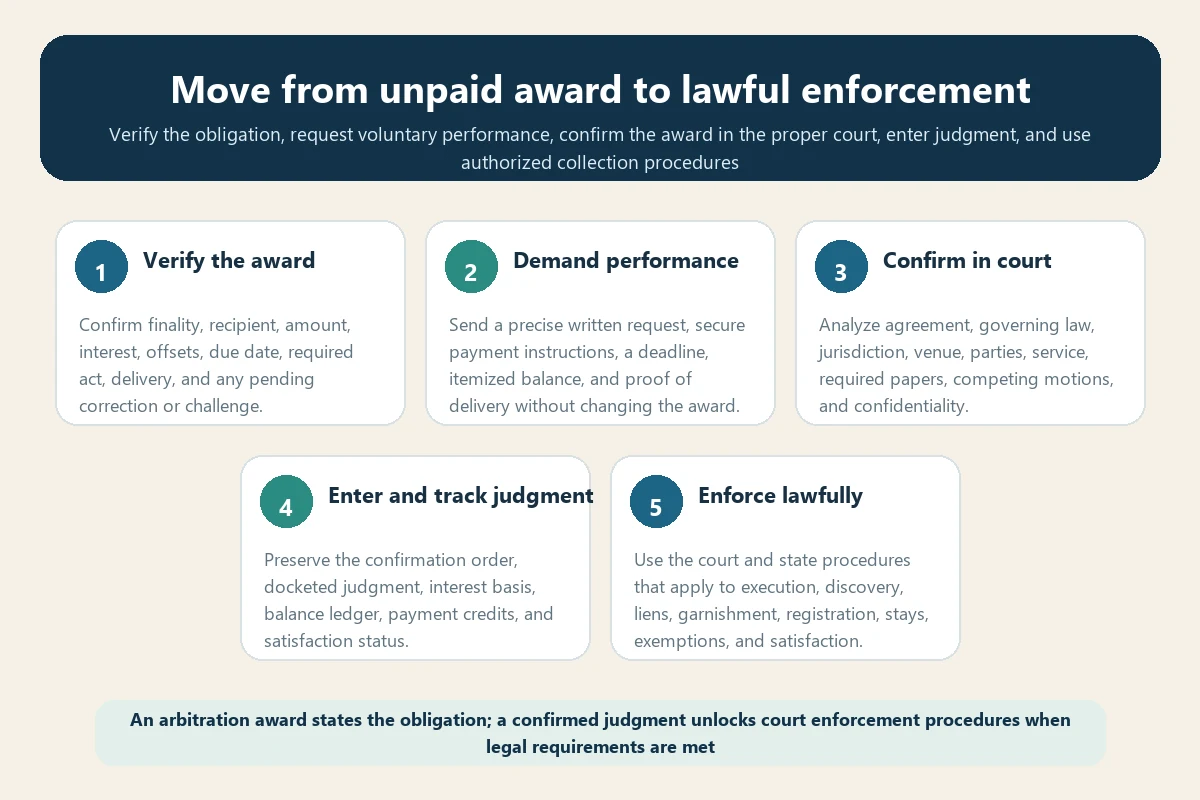
An enforcement sequence
- Preserve the final award and delivery record.
- Reconcile principal, interest, costs, offsets, and prior payments.
- Send a documented voluntary-performance request.
- Identify governing law, jurisdiction, venue, parties, and service.
- Prepare the correct confirmation papers and confidentiality treatment.
- Address any challenge, stay, or competing motion.
- Obtain and preserve the entered judgment.
- Use authorized execution and discovery procedures.
- Credit every payment and file satisfaction when complete.
Bottom line
To enforce a travel insurance arbitration award, verify the obligation and give voluntary performance a documented opportunity. If court action is necessary, confirm the award in a court with jurisdiction, serve correctly, obtain an entered judgment, and maintain an exact balance.
Collection begins only through the procedures the judgment and governing law authorize. Accurate records, restrained demands, confidentiality controls, and timely legal advice protect both enforceability and credibility.