
Travel insurance arbitration evidence objections should identify a specific problem, explain why it matters to a disputed issue, and ask the arbitrator for a practical ruling. An objection is not stronger because it sounds like a courtroom phrase. The governing agreement, provider rules, case orders, and arbitrator’s directions control the process.
This U.S. consumer guide explains how to prepare, make, answer, cure, and record objections in a travel insurance dispute. It provides general information, not legal advice, and does not assume that formal federal or state evidence rules automatically govern an arbitration.
Start with the rules that actually govern the case
Collect the arbitration clause, incorporated rules, amendments, preliminary hearing order, confidentiality order, scheduling order, exhibit directions, and later rulings. Note deadlines for exchanging evidence, written objections, responses, motions, witness lists, translations, and hearing materials.
Current AAA Consumer Arbitration Rules state that formal legal evidence rules need not be followed. The arbitrator determines admission, relevance, and materiality; may exclude cumulative or irrelevant evidence; and considers applicable privilege. Always verify the edition and order governing the particular case.
Separate admissibility from persuasive weight
An arbitrator may receive a document but give it little weight. A weak foundation, unclear source, missing context, or credibility problem does not always require complete exclusion. Ask whether the real concern is that the material should not enter the record, should be used only for a limited purpose, or should receive less weight.
The AAA guide for presenting an arbitration case tells parties to explain how each item is relevant and supports a claim or defense. It also warns that evidence missed at an exchange deadline may not be allowed. That makes preparation and timely disclosure as important as the hearing objection itself.
Build an objection matrix before the hearing
Start with the arbitration exhibit list workflow, then add a private preparation column for each anticipated issue. Do not put privileged strategy notes into a shared index unless the governing order requires them.
| Field | Question to answer | Possible request |
|---|---|---|
| Authority | Which rule, order, or prior ruling applies? | Enforce the ordered process |
| Evidence | Which page, answer, image, or statement is disputed? | Identify the exact portion |
| Problem | Why is it irrelevant, cumulative, privileged, incomplete, unreliable, or late? | State one concrete ground |
| Prejudice | What decision or fair-hearing concern is affected? | Explain practical impact |
| Remedy | Can a narrower step solve the problem? | Exclude, limit, redact, cure, or reserve |
| Ruling | What did the arbitrator decide? | Record status and conditions |
Test relevance and materiality
Connect the disputed evidence to an actual coverage term, exclusion, condition, claimed loss, causation question, notice requirement, mitigation issue, damages calculation, or credibility dispute. “Irrelevant” alone does not show the arbitrator why the item cannot help decide the case.
A useful objection identifies the item and the missing connection: for example, a later marketing page may not show the wording of the policy issued on the purchase date. The response may establish relevance through the correct date, policy form, witness, or limited purpose.
Identify cumulative evidence without blocking necessary proof
Cumulative material repeats a point already established without adding meaningful value. Track the admitted proof before objecting. Five copies of the same denial letter may be unnecessary, while a delivery receipt, original attachment, and later appeal response can prove different facts.
Ask for a representative sample, stipulated fact, time limit, or focused excerpt when complete exclusion is unnecessary. The goal is an efficient record that still permits each party a fair opportunity to present material evidence.
Address authenticity, source, and completeness
Ask who created or received the item, when it was made, where it came from, how it was kept, and whether it changed. A screenshot without a URL, date, surrounding messages, or original file may be difficult to evaluate. A partial email chain may omit the attachment or response that changes its meaning.
Use the document exchange guide to preserve filenames, metadata, hashes, production history, and complete families. Possible cures include providing the native file, full thread, custodian explanation, certification, matching business record, or an agreed copy.
Protect privilege and confidential information
Privilege differs from general confidentiality. A private claim file is not automatically privileged, and a confidentiality label does not decide whether the arbitrator may consider it. Identify the communication, participants, date, privilege asserted, and whether disclosure or waiver is disputed without revealing more protected substance than necessary.
For account numbers, health details, passport data, or unrelated travelers’ information, request targeted redaction, restricted access, sealed treatment if available, or a limited-purpose ruling. Review the arbitration confidentiality guide before exchanging sensitive files.
Challenge late or undisclosed evidence with a practical cure
Identify the missed requirement, when the item was received, why the delay matters, and what preparation is now impossible or costly. Also consider the item’s importance and whether a short recess, supplemental exchange, limited questioning, remote witness, cost allocation, or postponement could cure the problem.
Do not silently save a known disclosure issue for dramatic use at the hearing. Raise it through the authorized channel when the order requires written objections or prompt notice. The hearing preparation checklist helps calendar these cutoffs.
Handle translations, recordings, and demonstratives carefully
For translated material, preserve the source document, translator identity, qualifications or certification when required, matching pagination, disputed language, and controlling version. An arbitration interpreter protocol can also define how interpretation concerns are raised during testimony.
For audio or video, identify the original file, completeness, speakers, recording date, edits, transcript, audibility, and playback method. A transcript may assist review without replacing disputed audio. A demonstrative should summarize admitted proof and should not quietly introduce a new fact, document, or calculation.
Object to testimony with precision
Identify the exact question or answer and the practical defect. Concerns can include lack of personal knowledge, speculation, an unclear or compound question, mischaracterized prior evidence, privileged communication, repeated questioning, or an expert opinion from a witness disclosed only as a fact witness.
Do not argue with the witness or opposing party. Address the arbitrator briefly, pause for a ruling, and follow any instruction to rephrase, lay more foundation, limit the answer, or move on. The witness testimony guide explains preparation and examination structure.
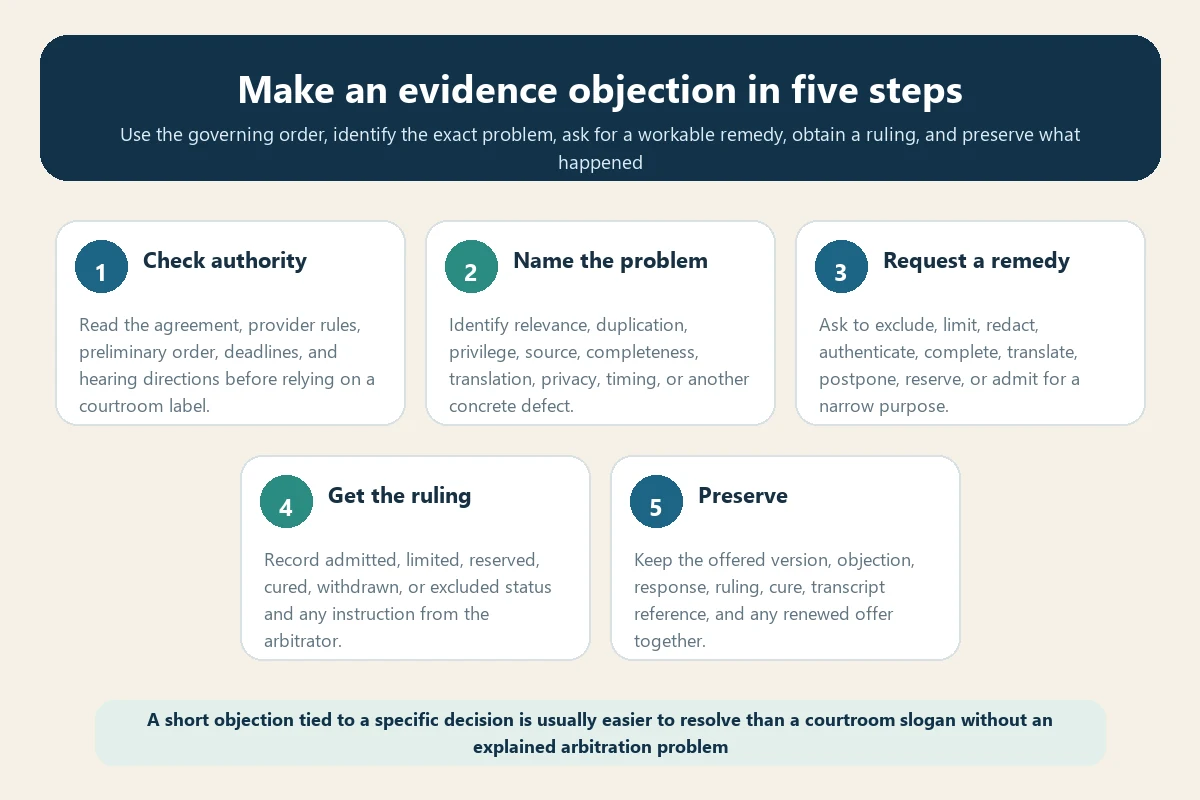
Use a concise objection formula
- Identify the page, exhibit, question, or answer.
- Name the concrete problem and controlling order or rule when useful.
- Explain the material effect in one or two sentences.
- Request a specific ruling or narrower cure.
- Stop and let the arbitrator decide.
For example: “Objection to the undated screenshot on Exhibit R-14, page three. Its source and applicable policy period have not been identified. Please exclude it, or reserve the ruling while the proponent supplies the original page and date.” Adapt the wording to the actual rules and facts.
Answer an objection instead of repeating the evidence
State the disputed issue, the evidence’s connection to that issue, its source, and the requested use. Then offer the smallest reliable cure: complete the chain, identify the author, provide the missing attachment, narrow the date range, redact unrelated data, call the appropriate witness, or accept a limiting instruction.
If the arbitrator excludes an item, ask whether a brief description or preserved copy may remain solely to document what was offered, subject to the governing process. Do not continue using excluded material in an opening statement or later argument.
Track every ruling in real time
Use a live log with exhibit number, page, offer time, objection, response, ruling, limitation, required cure, deadline, corrected version, witness, and transcript reference. Distinguish admitted, admitted for a limited purpose, ruling reserved, conditionally admitted, withdrawn, and excluded.
If the ruling is unclear, respectfully ask for clarification before moving on. The hearing transcript guide explains how objections and rulings can be preserved when a reporter or other authorized record is used.
Do not assume another forum’s rule controls
FINRA Rule 12604 is a useful comparison: its panel decides admission, need not follow state or federal evidence rules, and document production does not presume hearing admissibility. But FINRA securities arbitration rules do not govern an AAA travel insurance case unless the applicable agreement and process make them relevant.
Avoid copying an objection list from court or another arbitration forum. Translate every concern into the authority, facts, fairness issue, and requested decision in this case.
Preserve an excluded or limited offer
Follow the arbitrator’s directions for preserving the offered version, purpose, objection, response, and ruling. Keep the clean file separate from notes. If permission is given to cure or renew the offer, record the deadline and the difference between the original and corrected version.
Before the record closes, compare the ruling log, final exhibit list, and transcript or authorized recording. The arbitration closing argument guide can help ensure the final presentation cites only the evidence and uses the arbitrator permitted.
Avoid common objection mistakes
- Assuming formal courtroom evidence rules automatically apply.
- Objecting with a label but not identifying the actual problem.
- Confusing exchange, upload, identification, and admission.
- Calling every credibility weakness a reason for exclusion.
- Revealing privileged substance while trying to protect it.
- Waiting until the hearing despite an earlier written deadline.
- Ignoring a narrower cure that protects fairness and efficiency.
- Continuing to argue after the arbitrator has ruled.
- Failing to record a limited, reserved, or conditional ruling.
Final evidence objection checklist
- Confirm the agreement, current rules, orders, and objection deadlines.
- Map each disputed item to an issue, witness, source, and purpose.
- Separate admissibility, limited use, and persuasive weight.
- Prepare concise grounds, practical impact, and requested remedy.
- Protect privilege, privacy, translations, and complete context.
- Raise late disclosure issues through the authorized channel.
- Offer a cure when it can solve the problem fairly.
- Record every offer, objection, response, ruling, and condition.
- Preserve excluded or corrected versions only as directed.
- Reconcile the ruling log before the hearing record closes.
A disciplined objection process helps the arbitrator focus on reliable, material proof while giving both sides a fair opportunity to be heard. Precision matters more than theatrical phrasing: identify the evidence, explain the problem, request a workable decision, and preserve the result.