
Travel insurance arbitration opt out refers to a contractual opportunity to reject an arbitration agreement within a stated period and by a stated method. Not every policy or set of booking terms offers this option, and the exact clause controls.
An opt-out is not cancellation of travel insurance, rejection of coverage, a free-look refund request, exclusion from a class settlement, or waiver through litigation conduct. This U.S. consumer guide explains how to audit and document the contract process; it is not legal advice or a recommendation to choose court over arbitration.
Start with the purchase-time documents
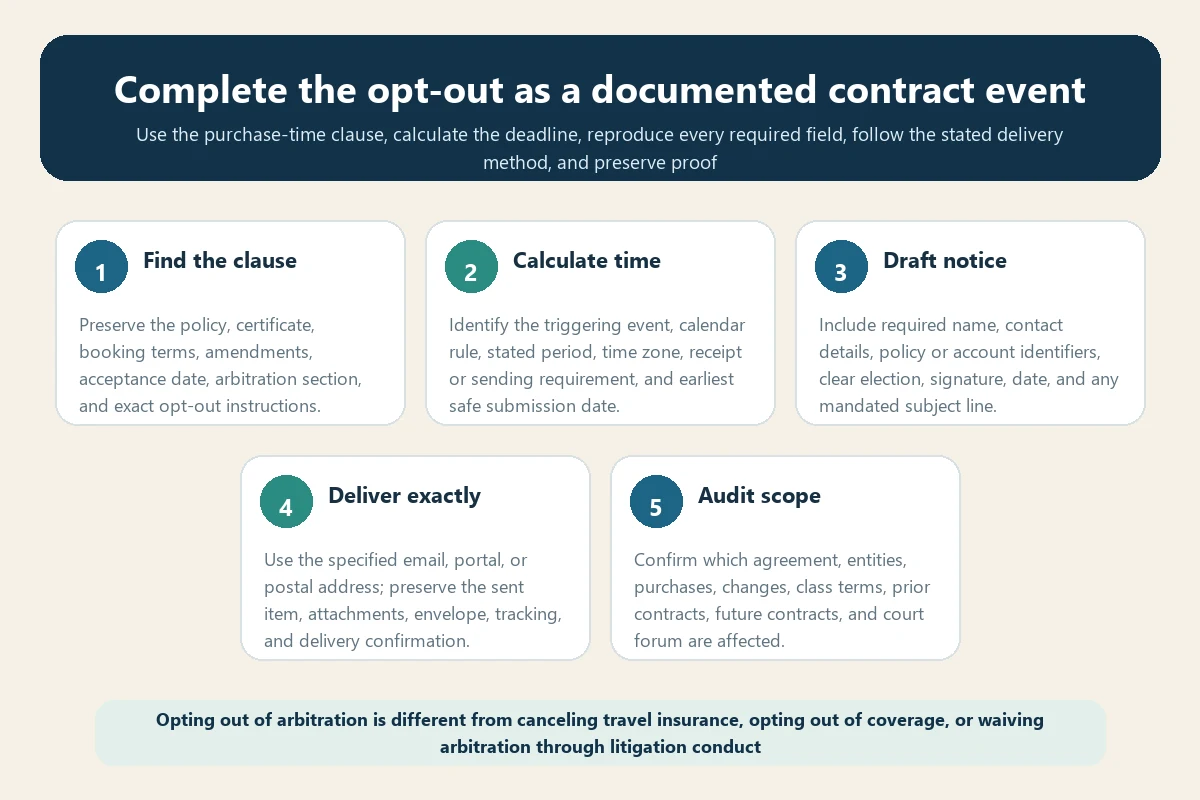
Collect the policy or certificate, plan description, booking terms, confirmation email, attachments, website terms, amendment notices, and any separate supplier or assistance agreement. Identify which entity offered the opt-out and which product or account it covers.
Use the version accepted or delivered at purchase. A current website may have a different address, deadline, or scope.
Confirm that the clause actually offers an opt-out
The official AAA Consumer Arbitration Q&A explains that some companies allow consumers to opt out within a specific period and that consumers should follow the agreement’s timing and instructions carefully.
AAA does not create an opt-out where the contract has none. Search the complete documents for “opt out,” “reject arbitration,” “decline arbitration,” “right to reject,” and “notice.”
Distinguish four different opt-outs
- Arbitration opt-out: rejection of a contractual arbitration agreement.
- Coverage opt-out: deselection of travel insurance during checkout.
- Free-look cancellation: cancellation of the plan for a refund under stated conditions.
- Settlement exclusion: a request not to be bound by a class settlement.
Use the title and defined terms from the correct document. Sending a plan cancellation request may not reject arbitration, and rejecting arbitration does not necessarily cancel coverage.
Identify the deadline trigger
The period might run from purchase, acceptance, account creation, policy delivery, first use, or notice of amended terms. Record the triggering event and its timestamp, not only the final date.
Calculate calendar days or business days exactly as the contract states. Note time zone, weekend and holiday rules, and whether notice must be sent, postmarked, or received before expiration.
Do not rely on an assumed 30-day window
Thirty days is common but not universal. Some clauses use another period or provide a new right only for material changes. An earlier agreement may continue if only a later amendment is rejected.
Create a version table with agreement date, notice date, trigger, deadline, delivery rule, and scope. Submit well before the deadline where possible.
Copy every required notice element
Requirements may include full legal name, mailing address, email, telephone number, policy or certificate number, booking or account identifier, purchase date, clear rejection statement, signature, and date. Some specify a subject line or require personal rather than attorney submission.
Use a short, unambiguous statement tied to the exact agreement. Do not add demands, claim arguments, confidential medical records, or unnecessary personal data.
Address the correct legal entity
A travel protection package can involve an insurer, underwriter, plan administrator, producer, booking platform, assistance company, and travel supplier. The recipient named in the opt-out clause may differ from the claims department.
Reproduce the legal name, department, email, portal, and postal address exactly. Do not substitute a customer-service chat unless the clause permits it.
Follow the permitted delivery method
If the clause requires email, send from any account specified and preserve the full sent message and headers. If it requires mail, retain a copy, envelope, postage record, tracking, and delivery result. If it requires a portal, save screenshots and confirmation numbers.
Sending through multiple methods may create backup evidence but does not cure failure to use a mandatory method. Avoid exposing sensitive identifiers in an insecure channel.
Build a proof-of-delivery packet
Save the operative clause, final signed notice, attachment hash or filename, sent timestamp, recipient, transmission record, tracking history, delivery receipt, automated response, and any human confirmation. Export email in a format that preserves headers.
Create a one-page index so the event can be proven years later. Keep an encrypted backup separate from the travel account.
Ask for confirmation without changing the notice
A concise request for written confirmation can reduce later dispute. But silence does not necessarily determine validity, and a confirmation request should not make the election conditional.
If the company says the notice is incomplete, preserve the response and cure immediately where possible without conceding that the first notice failed.
Study a real travel-policy example
A published WorldTrips travel policy form illustrates a written postal opt-out directed to a named insurer and states that opting out does not affect other policy parts or separate prior or future arbitration agreements.
This example shows why scope matters; it is not a template for another company. Use only the actual clause governing the purchaser’s plan.
Check whether sending or receipt controls
A clause may require that notice be “sent,” “postmarked,” “delivered,” or “received” within the period. Those are different events. Preserve evidence for each and avoid waiting until the last permitted day.
For postal delivery, record carrier acceptance and recipient delivery. For email, record the sent item, server response, bounce notices, and confirmation.
Audit the scope of a successful opt-out
Determine whether it covers the arbitration agreement, a new amendment, class-action language, only the named consumer, related travelers, one policy, one account, specified entities, or future disputes. Check what court forum and governing law remain.
The arbitration severability guide helps map which contractual layer survives. Do not assume an opt-out removes unrelated dispute terms.
Review prior and future agreements
Some clauses state that opting out does not affect earlier or future arbitration agreements. Others replace prior versions. List every policy renewal, new trip, account update, and amended term separately.
A fresh purchase may create a new opt-out period, but only the governing documents can prove it. Do not reuse an old notice without checking the new identifiers and recipient.
Understand the formation relevance
A federal travel-related decision, Maggi v. International Travel Network, considered an available opt-out while addressing formation and unconscionability arguments. The decision illustrates that an unused opt-out can become part of the enforceability record.
It does not mean every opt-out makes every clause enforceable. Apply the controlling law and actual facts.
Separate opt-out from unconscionability
An available opt-out can affect bargaining or procedural-unfairness analysis under some state law, but it does not replace review of notice, assent, one-sided terms, delegation, or substantive restrictions.
The unconscionability guide provides a two-sided evidence matrix. Keep the opt-out proof as one component.
Separate opt-out from waiver by conduct
Contractual opt-out is a timely election under the agreement. Waiver by litigation conduct asks whether a party later relinquished an arbitration right through inconsistent action.
Use the arbitration waiver guide for the latter. Do not use the terms interchangeably.
Plan the remaining dispute path
Opting out does not prove a travel insurance claim or guarantee a court forum has jurisdiction. Continue the insurer’s claim and appeal process, preserve limitation periods, identify proper parties, and determine available court, small-claims, complaint, or negotiated paths.
The complaint versus arbitration guide helps distinguish regulatory and private remedies.
Do not treat small claims as an opt-out notice
A small-claims option is a forum pathway for an eligible individual dispute; a contractual opt-out rejects the arbitration agreement as specified by the contract. Filing in small claims does not necessarily satisfy an earlier opt-out procedure, and sending an opt-out notice does not establish small-claims jurisdiction.
Check the arbitration clause, current administrator rules, and the chosen court’s amount, venue, party, service, and remedy requirements. Preserve any election, objection, transfer request, dismissal, or ruling separately from the opt-out packet.
If arbitration remains applicable, the arbitration demand guide explains the clause attachment, party identification, claim statement, requested relief, service, fees, and filing confirmation. Keeping the pathways separate prevents one procedural act from being mischaracterized as another.
Avoid common opt-out mistakes
- Using current terms instead of the accepted version.
- Confusing arbitration opt-out with plan cancellation.
- Assuming every clause uses 30 days.
- Calculating from the wrong triggering event.
- Sending to the claims department instead of the named recipient.
- Omitting a signature, identifier, or required subject line.
- Using an unapproved delivery method.
- Keeping no evidence of the exact notice sent.
- Assuming one opt-out covers earlier or future agreements.
- Ignoring the dispute forum that remains afterward.
Final arbitration opt-out checklist
- Preserve the purchase-time agreement and opt-out clause.
- Identify the trigger, deadline, time zone, and receipt rule.
- Copy every required notice field and identifier.
- Use the exact named recipient and permitted method.
- Send early and preserve transmission and delivery evidence.
- Request written confirmation without conditioning the election.
- Audit affected agreements, entities, travelers, and terms.
- Check prior, amended, renewal, and future contracts separately.
- Keep coverage, claims, appeals, and deadlines moving.
- Store a complete indexed proof packet securely.
A reliable opt-out is simple in wording but exact in execution. It uses the correct contract version, meets the actual deadline, follows every delivery instruction, preserves durable proof, and states clearly which arbitration agreement the consumer rejects.
