
Travel insurance arbitration incorporation by reference matters when one agreement points to another document containing supplier restrictions, policy terms, arbitration procedures, delegation language, fees, or deadlines. The dispute is whether the outside text became part of the accepted contract.
This U.S. consumer guide explains how to audit the host agreement, reference language, target document, notice, access, assent, versions, conflicts, scope, and proof. It is not legal advice.
Map the complete document chain
Start with the document the purchaser signed or accepted. Then trace every reference to platform terms, supplier rules, policy forms, certificates, confirmations, privacy statements, arbitration rules, fee schedules, and amendments.
Draw each link rather than describing everything as “the terms.” A booking may contain several references with different legal purposes.
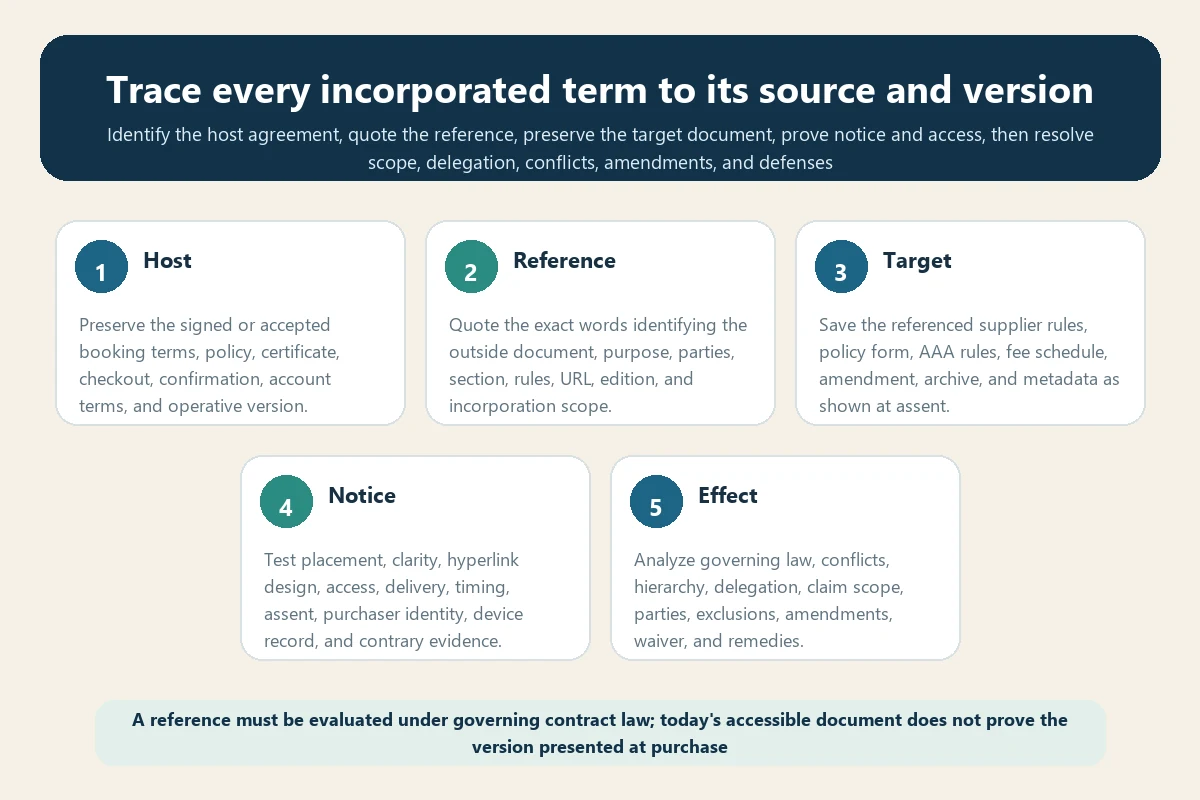
Identify the host agreement
The host is the document that allegedly imports outside material. Record its title, parties, effective date, version, transaction, governing law, signature or assent method, and full text.
Do not assume that a booking confirmation, policy certificate, or webpage is the host merely because it mentions another document. State why it is asserted to be contractual.
Quote the reference exactly
Copy the complete sentence and surrounding definitions. Note whether it says “incorporated by reference,” “subject to,” “governed by,” “available at,” “apply,” or merely provides information.
The wording can identify the incorporated purpose and limits. A reference to supplier cancellation rules may not necessarily import an unrelated dispute clause.
Preserve the target document
Save the exact policy form, supplier rules, AAA rules, fee schedule, or other text allegedly incorporated. Record the title, publisher, edition, effective date, URL, archive timestamp, and file hash.
A current webpage is not proof of the version available when the traveler accepted the host agreement. If a link changed targets, preserve redirect history, server records, archived captures, and transaction emails showing what destination was presented.
Prove the operative acceptance event
Reconstruct the checkout screen, notice placement, hyperlink styling, scroll state, checkbox or button, purchaser identity, device record, timestamp, and confirmation. Preserve screenshots and underlying records.
Use the clickwrap agreement guide to examine the acceptance interface separately from incorporation.
Start with applicable contract law
Identify contractual choice-of-law terms, forum rules, transaction contacts, and controlling state decisions. Incorporation requirements may address clear identification, knowledge or notice, availability, assent, and consistency.
Do not treat a general nationwide checklist as the legal test. Quote the elements and burdens from the governing jurisdiction.
Use the FAA as the federal baseline
Section 2 of the Federal Arbitration Act addresses written arbitration provisions and preserves generally applicable contract grounds. Whether an outside document became part of the agreement ordinarily begins with contract formation law.
The FAA favors enforcement according to the agreement actually made; it does not cure an unidentified or unaccepted target document.
Check whether the target was clearly identified
Record whether the reference provides a document name, issuer, section, date, edition, form number, URL, or rule set. Compare those identifiers with the target offered in the dispute.
A generic phrase such as “all applicable rules” may create a different issue from a reference to a named edition of the AAA Consumer Arbitration Rules.
Test availability and access
Determine whether the target document was attached, linked, displayed, emailed, downloadable, or available on request before acceptance. Test the historical URL if evidence exists and record broken links or access barriers.
Later ability to retrieve a document does not establish reasonable access during the transaction.
Audit hyperlink design
For online purchases, preserve font, color, contrast, underlining, proximity, surrounding language, button text, mobile layout, and whether the link opened the stated target.
A hidden footer link and a conspicuous checkout disclosure present different notice records even if both point to the same file.
Separate incorporation from assent
Incorporation asks whether the host effectively includes outside text. Assent asks whether the party agreed to the host or target under governing law. These questions overlap but should not be collapsed.
An explicit acceptance action can still point to an ambiguous target, while a clear reference can appear in a host agreement whose formation is disputed.
Analyze current travel-platform drafting
Travelocity’s current official terms state that specified Travel Provider rules are provided before booking and incorporated by reference. The same terms separately describe arbitration under identified AAA rules and travel insurance products.
This illustrates multiple document layers within one booking path. It does not prove the terms or links presented for a historical transaction.
Preserve AAA rules and fees
The AAA’s official consumer rules page provides current rules, forms, fee schedules, and archived materials. Record the rule edition named or available when the contract was accepted.
Rules, fee schedules, and consumer due-process requirements may change. Do not cite only today’s landing page when a prior edition controls.
Do not overread rule incorporation
Incorporating arbitration rules may supply procedures, definitions, or delegation language, depending on the contract and governing law. It does not automatically resolve every formation, party, scope, or conflicting-contract question.
Use the arbitrability guide to separate who decides from what the parties actually agreed to arbitrate.
Resolve conflicting contracts first
A traveler may accept platform terms with arbitration and later receive policy or promotion terms selecting court. Identify hierarchy, merger, supersession, amendment, transaction scope, and chronology.
In Coinbase, Inc. v. Suski, the U.S. Supreme Court explained that a court must determine which contract governs when parties have conflicting agreements about dispute resolution. The case is not about travel insurance, but its contract-first lesson is relevant.
Match each target to its purpose
Build a table showing host, reference text, target, asserted purpose, transaction, parties, and claimed effect. Supplier rules may govern cancellation; a policy controls coverage; AAA rules address procedure.
Do not use incorporation for one purpose to import every provision in a document without applying the governing scope rule.
Analyze incorporated parties and claims
Read defined parties, affiliates, agents, suppliers, providers, beneficiaries, assigns, spouses, heirs, and representatives. Then map each asserted claim and defendant to the incorporated clause.
Incorporating a document does not automatically establish that every travel company may enforce it. Use the third-party beneficiary guide for intended enforcement rights.
Keep nonsignatory theories distinct
Incorporation by reference, agency, equitable estoppel, third-party beneficiary, assignment, assumption, and alter ego are different doctrines. A party may assert alternatives, but each needs its own evidence.
The agency theory guide helps test authority and control without using document incorporation as a substitute.
Audit amendments and dynamic links
Determine whether the host incorporates a fixed edition or whatever rules appear at a URL in the future. Preserve amendment authority, notice method, effective date, assent, opt-out, and treatment of existing bookings.
Use the updated terms guide to evaluate revisions without assuming a dynamic link proves acceptance of later text.
Test exclusions and carve-outs
Read small-claims options, informal notice requirements, class waivers, emergency-relief clauses, venue, claim-value thresholds, mass-arbitration procedures, and insurance-specific exclusions.
An incorporated ruleset may be modified by the host agreement. Apply the contract’s hierarchy and conflict language before treating a default rule as controlling.
Build a transaction-specific chronology
Record account creation, quote, booking, insurance selection, premium charge, confirmation, policy delivery, trip change, loss, claim, denial, appeal, notice of dispute, and arbitration demand.
Place each document version and delivery event on that timeline. This reveals whether the target existed and was accessible before assent or appeared only later.
Preserve evidence reproducibly
Save native HTML, PDFs, screenshots, response headers, emails, terms archives, database records, and link targets. Record source, custodian, collection date, file hash, and transaction identifier.
Create a citation index with the exact page, paragraph, screen, or rule number supporting each incorporation assertion and defense.
Avoid common errors
- Treating any hyperlink as automatic incorporation.
- Failing to preserve the target version available at acceptance.
- Confusing a reference for information with contractual importation.
- Assuming incorporation of procedures proves delegation or party status.
- Ignoring conflicts, hierarchy, later contracts, or amendment limits.
- Using supplier rules to decide unrelated policy coverage questions.
Use a disciplined review sequence
- Identify the host agreement and prove its formation.
- Quote the complete reference language.
- Preserve the exact target document and version.
- Apply governing state law to identification, notice, access, and assent.
- Resolve conflicts, hierarchy, amendments, and chronology.
- Map parties, claims, scope, delegation, exclusions, and defenses.
- Record every conclusion in a reproducible document matrix.
Know when tailored legal review matters
Prompt legal review is useful when links are unavailable, contract versions conflict, significant deadlines are running, multiple entities seek enforcement, a later agreement selects court, or court and arbitration proceedings overlap.
Qualified counsel can determine governing law, evidence burdens, procedural deadlines, and the legal effect of each reference in the actual transaction.
Final takeaway
Travel insurance arbitration incorporation by reference requires a traceable chain from an accepted host agreement to a clearly identified and preserved target document. A current link or generic reference is not enough by itself.
Audit notice, access, assent, version, purpose, conflicts, parties, scope, delegation, amendments, and defenses separately. That document-first method produces a clearer arbitration analysis.