

Travel insurance arbitration assignment disputes ask whether transferring a policy benefit, payment right, cause of action, booking right, or entire contract also carries an arbitration obligation. The answer depends on the instrument, governing law, and exact right or duty transferred.
This U.S. consumer guide explains how to audit the assignor, assignee, contract, claim, consent, notice, anti-assignment language, arbitration scope, and defenses. It is not legal advice.
Start by defining the transfer
State whether the document assigns policy benefits, claim proceeds, reimbursement rights, a cause of action, booking rights, or the entire agreement. Do not use “assignment” as a label for every transfer.
Identify whether duties were delegated or expressly assumed, because transferring rights and transferring obligations are different questions.
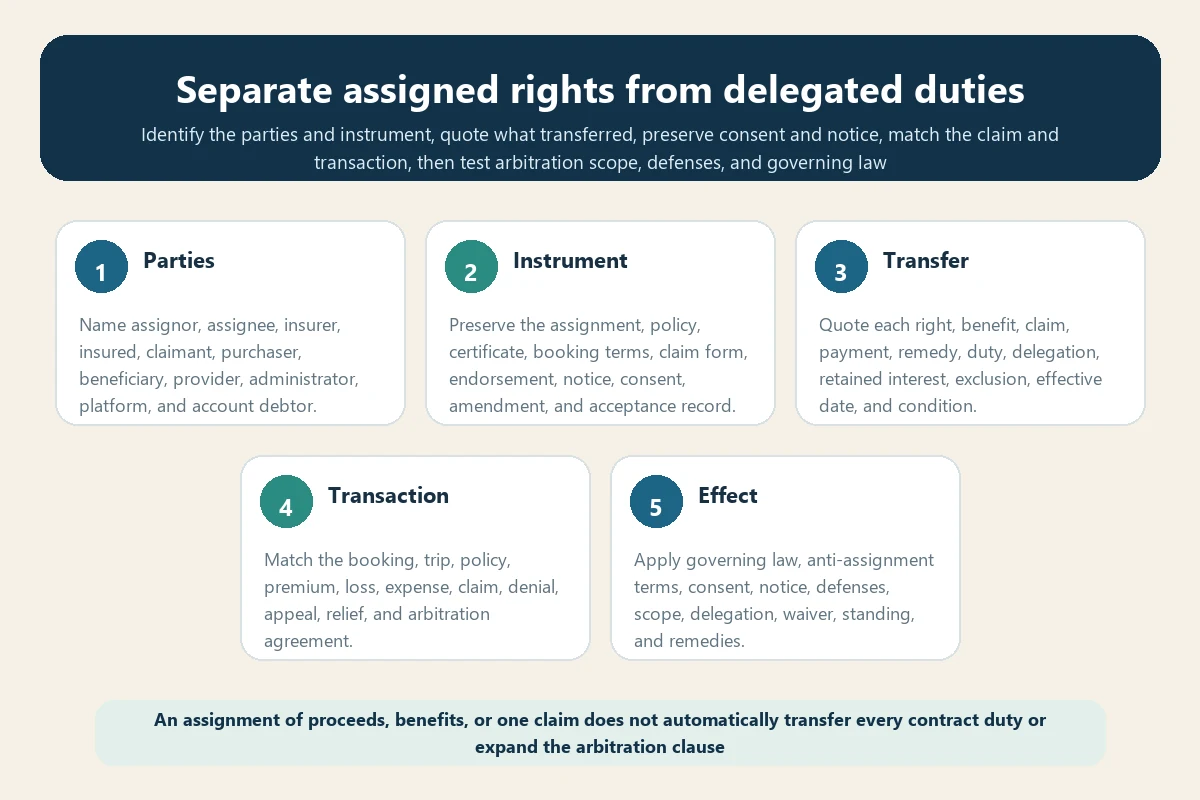
Name every legal party
List the assignor, assignee, insurer, insured traveler, policyholder, purchaser, beneficiary, provider, claims administrator, platform, account debtor, and claimant. Record legal names rather than brands.
Specify who seeks arbitration and who resists. The enforcement direction matters.
Preserve the assignment instrument
Save the signed assignment, electronic record, claim form, provider agreement, policy endorsement, purchase contract, email, or court filing allegedly making the transfer.
Record its date, signatures, authority, consideration, effective date, conditions, governing law, notarization, delivery, acceptance, and transaction identifier.
Collect the underlying contracts
Preserve the policy, certificate, platform terms, booking rules, confirmation, amendments, arbitration clause, and incorporated rules. Mark the parties, versions, and formation evidence.
An assignment cannot be evaluated without the contract that created the right allegedly transferred.
Prove the operative terms and assent
Reconstruct checkout notice, hyperlink design, purchaser identity, assent action, timestamp, confirmation, and version. Later copies cannot prove the purchase-time terms by themselves.
Use the clickwrap agreement guide to audit online formation evidence.
Apply governing state law
Identify choice-of-law clauses, forum rules, policy delivery state, transaction contacts, and controlling appellate authority. Record rules for assignability, delegation, consent, notice, defenses, and arbitration obligations.
Assignment law varies. Do not substitute a national summary for the jurisdiction’s elements.
Use the FAA as a boundary
Section 3 of the Federal Arbitration Act addresses stays for issues referable to arbitration under a written agreement. State-law transfer principles help determine whether an assignee may invoke or must honor that agreement.
The FAA does not establish that every transferred travel benefit includes every dispute-resolution duty.
Use Arthur Andersen carefully
In Arthur Andersen LLP v. Carlisle, the U.S. Supreme Court recognized that traditional state-law principles can permit enforcement of arbitration agreements by or against nonparties.
The decision rejects a categorical nonsignatory bar. It does not decide which rights or duties a particular travel assignment transferred.
Quote the grant clause
Extract every noun and verb describing what is sold, assigned, transferred, conveyed, delegated, assumed, retained, or excluded. Include schedules and definitions.
A transfer of “all rights and remedies” differs from an assignment of “benefits payable for this expense.” Do not broaden the instrument beyond its text.
Separate benefits from causes of action
A medical provider may receive a right to direct payment without receiving ownership of a bad-faith or consumer-protection claim. An assignee of proceeds may lack other contractual remedies.
For each asserted claim, identify whether it was assigned, retained, prohibited, or created after the transfer.
Separate assignment from delegation
Assignment commonly transfers a right. Delegation concerns performance of a duty. An assignor may remain liable for delegated duties unless governing law or a novation provides otherwise.
Record which party promised performance and whether the other contracting party consented to substitution.
Distinguish assignment from assumption
An assignee may expressly assume specified obligations, but assignment alone should not be treated as proof of every assumed duty without applying governing law and text.
Use the assumption theory guide to test writings, conduct, knowledge, performance, and intent separately.
Read anti-assignment language precisely
Search for prohibitions on assigning the policy, rights, claims, benefits, proceeds, duties, or the agreement without consent. Record whether the clause applies before loss, after loss, or to specified transfers.
Do not assume that one anti-assignment clause has the same effect in every state or at every stage of a claim.
Distinguish pre-loss and post-loss transfers
Record whether the assignment occurred before the insured event, after the loss but before filing, after denial, or during litigation. Some jurisdictions distinguish restrictions on transferring the policy itself from transfers of an accrued payment right or cause of action.
Identify when each right arose, whether it was contingent, and whether the assignor had completed proof-of-loss or appeal requirements. Apply controlling state authority rather than assuming the timing distinction has the same effect nationwide.
Audit provider and assistance-company assignments
A hospital, air-ambulance company, evacuation provider, or travel-assistance vendor may request an assignment, direction to pay, authorization, lien, or power of attorney. Preserve the form and classify it accurately.
Determine whether the provider receives only direct payment, may pursue an unpaid benefit, may appeal, or owns broader claims. Verify whether the traveler remains responsible for charges and whether the insurer acknowledged the transfer. Use the travel insurance claim filing guide to keep claim authority, evidence submission, and payment instructions distinct.
Audit consent and notice requirements
Identify required written consent, filing, acknowledgment, delivery address, form, timing, signature, and supporting documents. Preserve proof of receipt and any response.
A policy may state that the insurer is not bound until it receives and files a signed assignment.
Study a travel-policy example
A Travelex travel insurance policy form illustrates language allowing assignment of some or all rights, privileges, and benefits while requiring a signed copy and limiting the assignee to the assignor’s rights.
This is a drafting example, not the policy for every traveler. Preserve the actual state-specific form and endorsements.
Compare current platform drafting
Travelocity’s current official terms separately discuss assignment of rights and duties and arbitration involving assigns. Reading both sections prevents conclusions based on one word alone.
Current terms do not prove what an earlier traveler accepted.
Match the exact transaction
Link the assignment to the booking, trip, policy, premium, loss, expense, provider, claim number, denial, appeal, and requested relief. Travelers may have multiple overlapping policies.
An assignment for one medical bill does not necessarily cover a different cancellation claim or booking.
Map defenses carried with the claim
Identify contractual defenses, exclusions, offsets, limitations, proof requirements, deadlines, and dispute procedures that governing law permits against the assignee.
An assignee often receives no greater right than the assignor held, but apply the actual statute, contract, and consumer protections.
Test arbitration clause scope
Read covered parties, assigns, claims, products, dates, transactions, exclusions, carve-outs, remedies, and survival language. Determine whether the assigned right falls within the clause.
Use the arbitrability guide to separate formation, delegation, scope, conditions, and merits.
Address delegation without skipping assignment
Preserve delegation language and incorporated rules. Identify who allegedly accepted delegation and whether a court or arbitrator decides assignment validity, party status, or scope.
A delegation clause does not eliminate the need to identify the agreement and transfer instrument.
Handle deceased travelers and estates
Death may involve survival statutes, beneficiary designations, estate authority, probate orders, and assignments by authorized representatives. These concepts should not be merged.
Use the deceased traveler estate guide to verify who may sign and receive payment.
Preserve standing and authority evidence
Collect identity records, corporate authority, provider invoices, powers of attorney, probate documents, signatures, licenses, and assignment chains. Record any gaps or competing transfers.
The claimant must connect its asserted right to a valid chain under governing law.
Build an assignment matrix
Use one row per transferred item. Include assignor, assignee, instrument, date, right, duty, claim, consideration, consent, notice, restriction, defense, arbitration clause, scope, delegation, and result.
Cite exact pages and transaction records so another reviewer can reproduce the analysis independently and verify every transfer step.
Avoid common mistakes
- Treating assignment of payment as transfer of the whole policy.
- Combining assignment, delegation, assumption, novation, and agency.
- Ignoring anti-assignment terms, consent, or notice requirements.
- Assuming every claim or defense travels with one assigned benefit.
- Skipping transaction matching, formation, scope, or delegation.
- Using a sample policy instead of the operative state form.
Use a disciplined review sequence
- Identify the parties, transfer instrument, agreement, and enforcement direction.
- Quote every assigned right, delegated duty, exclusion, and condition.
- Apply governing state law and anti-assignment rules.
- Verify consent, notice, authority, and the assignment chain.
- Match each claim, benefit, expense, and defense to the transaction.
- Analyze arbitration scope, delegation, timing, waiver, and remedies.
- Record results in a reproducible matrix.
Know when legal review matters
Prompt legal review is important when deadlines are running, significant claims are assigned, anti-assignment language is disputed, multiple assignees exist, estates are involved, or court and arbitration proceedings overlap.
Qualified counsel can determine governing law, validity, standing, defenses, and whether the arbitration clause accompanies the transferred right.
Final takeaway
Travel insurance arbitration assignment requires item-by-item analysis. Transferring proceeds, benefits, one claim, or an entire agreement can produce different arbitration consequences.
Preserve the instrument, operative contract, rights, duties, consent, notice, restrictions, transaction, defenses, scope, and delegation separately. That creates a defensible record.
