
Travel insurance arbitration alter ego disputes arise when a party asks to disregard corporate separateness and extend an arbitration agreement to a related company, parent, subsidiary, affiliate, owner, or officer that did not sign it.
This U.S. consumer guide explains how to audit legal entities, ownership, control, formalities, finances, alleged misuse, contracts, claims, governing law, and defenses. It is not legal advice.
Begin with separate legal identities
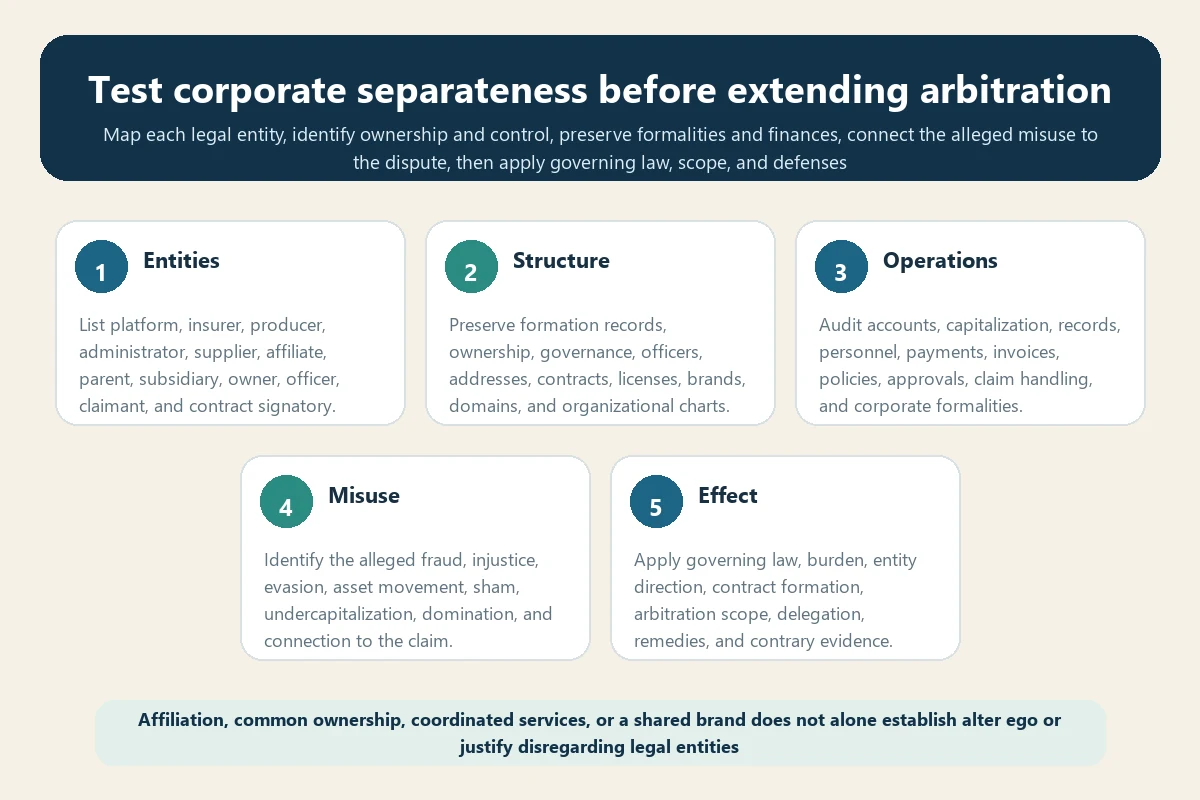
List every platform, insurer, producer, claims administrator, assistance company, supplier, parent, subsidiary, affiliate, owner, officer, and claimant by legal name.
Do not combine entities because they share a logo, website, mailing address, or customer-service channel. Corporate separateness is the starting point.
Identify the enforcement direction
Record whether a nonsignatory affiliate seeks to enforce a signatory’s clause, a claimant seeks to bind a parent or owner, or one related company seeks arbitration against another.
The direction matters. Do not assume a finding used to impose liability automatically works identically to create enforcement rights.
Inventory every contract
Preserve platform terms, policy, certificate, producer agreement, administration contract, assistance agreement, supplier rules, checkout, confirmation, amendments, and arbitration rules.
For each document, record parties, version, formation, governing law, covered entities, claim scope, and exclusions.
Prove the operative agreement
Reconstruct notice, assent, purchaser identity, timestamp, screen design, confirmation, and terms version. Alter ego does not excuse proving the written arbitration agreement asserted.
The clickwrap agreement guide helps preserve online formation evidence.
Determine governing law
Identify choice-of-law clauses, state of formation, forum rules, transaction contacts, and controlling appellate authority. Record the jurisdiction’s elements and burden for alter ego or veil piercing.
Standards differ. Some require unity or domination plus fraud, injustice, or inequitable use connected to the claim.
Use federal arbitration law carefully
Section 2 of the Federal Arbitration Act places written arbitration provisions on ordinary contract footing. It does not create a nationwide federal alter-ego test.
State corporate and contract principles ordinarily supply the nonsignatory analysis.
Read Arthur Andersen as a boundary
In Arthur Andersen LLP v. Carlisle, the U.S. Supreme Court recognized that traditional state-law principles may allow arbitration agreements to be enforced by or against nonparties, including through alter ego or veil piercing.
The decision rejects a categorical bar. It does not establish alter ego for any travel group.
Map ownership without stopping there
Collect formation records, ownership percentages, subsidiaries, parents, mergers, acquisitions, officers, directors, managers, and organizational charts. Date every record.
Complete ownership or overlapping leadership may be relevant, but ownership alone ordinarily does not erase separateness.
Audit corporate formalities
Preserve governing documents, board and member approvals, minutes, resolutions, separate books, tax filings, licenses, contracts, and required registrations.
Record actual failures rather than assuming online operations lack formalities, and preserve dated evidence for every asserted deficiency.
Trace bank accounts and payments
Identify which entity charged the premium or booking, held funds, paid claims, issued refunds, paid employees, invoiced services, and received fees. Preserve statements and ledgers where lawfully available.
Shared payment infrastructure may reflect a documented service arrangement rather than commingling.
Evaluate capitalization and solvency
Record capitalization, insurance reserves, solvency filings, asset transfers, dividends, loans, guarantees, and the timing of financial changes. Compare the relevant state’s factors.
Financial difficulty alone does not automatically prove that another entity is the debtor’s alter ego.
Map personnel and operational control
Identify who hired staff, set policies, supervised claims, approved denials, controlled systems, designed products, set prices, selected vendors, and handled complaints.
Distinguish parent oversight, contracted administration, agency, and daily domination under the governing test.
Audit intercompany service agreements
Shared staff, technology, accounting, compliance, marketing, claims systems, or customer support may operate under written service agreements. Preserve the agreements, pricing, invoices, service levels, data roles, approval limits, and termination provisions.
Compare the written allocation with actual performance. A documented service relationship can support separateness, while unexplained control or inconsistent records may support further inquiry. Neither conclusion should be assumed from a shared email domain.
Build a corporate-change chronology
Record formation, acquisitions, mergers, conversions, name changes, product transfers, administrator replacements, policy novations, asset movements, and dissolutions. Link every event to the travel booking, premium, loss, and claim dates.
A company that joined the group after the disputed transaction should not be treated as historically involved without evidence. Likewise, a later reorganization may affect successor or assignment analysis without establishing earlier alter ego.
Separate marketing unity from legal responsibility
A website may present one seamless travel brand while disclosures allocate booking, underwriting, payment, assistance, and claims functions among separate entities. Preserve both the marketing presentation and the legal disclosures shown to the traveler.
Compare who made the representation, collected money, issued the policy, decided the claim, and promised the disputed service. Marketing unity may be relevant to notice or apparent authority, but alter ego requires the governing corporate-law test.
Preserve public-facing representations
Save webpages, policies, confirmations, email domains, call scripts, privacy notices, licenses, corporate disclosures, and support messages. Record the legal entity named in each.
A unified brand presentation may create confusion but does not alone establish veil piercing.
Read current platform terms precisely
Travelocity’s current official terms distinguish the service entity, group companies, payment entities, travel providers, subsidiaries, and companies offering products through the platform.
This illustrates why entity definitions and transaction roles matter. Current terms do not prove a historical booking’s structure or assent.
Identify the alleged misuse
State the fraud, injustice, evasion, asset stripping, sham, undercapitalization, or abuse alleged. Connect it to the corporate structure and travel-insurance dispute.
A generalized belief that a result is unfair is not a substitute for the jurisdiction’s required inequity or misuse.
Connect the theory to the claim
For each defendant and claim, identify duty, conduct, injury, remedy, signatory contract, alleged alter ego, and factual connection. Analyze policy breach, misrepresentation, bad faith, and consumer claims separately.
One corporate relationship may be relevant to one claim but not another.
Match the exact transaction
Link every entity and act to the booking, policy, premium, trip, loss, claim, denial, appeal, and requested relief. A group may use different entities for different states or products.
Do not use a payment entity from one booking to establish alter ego for an unrelated claim.
Separate alter ego from agency
Agency concerns authority for a task. Alter ego asks whether separateness should be disregarded under an exceptional state-law standard. The doctrines use different evidence.
Use the agency theory guide to test manifestations, authority, control, and role-specific conduct.
Keep beneficiary and estoppel theories distinct
A contract may expressly grant an affiliate enforcement rights without veil piercing. Equitable estoppel may focus on contract-dependent claims. Neither automatically proves alter ego.
Compare the third-party beneficiary guide and equitable estoppel guide.
Test arbitration scope after entity status
Even if alter ego is established, read covered claims, parties, dates, transactions, products, exclusions, remedies, survival, and venue. Veil piercing does not rewrite the clause.
Use the arbitrability guide to separate formation, delegation, scope, conditions, and merits.
Address delegation carefully
Preserve delegation language and incorporated rules. Identify who accepted delegation and whether a court or arbitrator decides the alter-ego, formation, or scope issue.
A broad delegation provision should not be used circularly to establish authority over an entity whose contract relationship is disputed.
Preserve contrary evidence
Collect separate tax records, accounts, licenses, contracts, boards, personnel, capitalization, invoices, and decision-making evidence. Record legitimate business purposes for shared services.
A reliable audit tests both the alleged unity and evidence of genuine separateness.
Build an entity-factor matrix
Use one row per entity pair and factor. Include ownership, governance, formalities, accounts, capitalization, personnel, contracts, operations, representations, alleged misuse, claim connection, governing element, contrary proof, and result.
Cite exact documents, dates, pages, and transactions so another reviewer can reproduce the conclusion and verify each entity factor against the governing legal standard independently.
Avoid common mistakes
- Treating a shared brand or parent-subsidiary relationship as automatic alter ego.
- Failing to identify governing law and the required injustice.
- Combining agency, beneficiary, estoppel, successor, and veil-piercing theories.
- Ignoring separate accounts, contracts, licenses, records, or personnel.
- Skipping transaction matching, arbitration formation, scope, or delegation.
- Using current corporate webpages to prove historical structure.
Use a disciplined review sequence
- Map every legal entity, contract, and enforcement direction.
- Prove the operative arbitration agreement.
- Identify governing law, elements, and burden.
- Preserve ownership, control, formalities, finances, and operations.
- Identify alleged misuse and connect it to each claim.
- Test contrary evidence, scope, delegation, and defenses.
- Record results in an entity-factor matrix.
Know when legal review matters
Prompt legal review is important when multiple affiliates are sued, ownership is opaque, insolvency or asset transfers are alleged, substantial deadlines are running, or court and arbitration proceedings overlap.
Qualified counsel can determine governing law, discovery needs, burdens, procedural deadlines, and whether corporate separateness may be disregarded.
Final takeaway
Travel insurance arbitration alter ego is an exceptional, evidence-heavy entity analysis. Affiliation, coordination, ownership, or a shared customer experience does not automatically bind every company to arbitration.
Map structure, formalities, finances, operations, misuse, claims, contract scope, and contrary evidence separately. That produces a defensible conclusion.
