
Travel insurance examination under oath arbitration disputes arise when an insurer requires a claimant to answer questions under oath and produce documents before deciding a claim. An EUO is not simply a customer-service interview, deposition, or arbitration hearing. Its authority and consequence depend on the policy and governing law.
This U.S. guide provides a document-first method for checking authority, scope, scheduling, subjects, production, counsel, materiality, prejudice, and cure. It separately addresses arbitration formation, discovery, delegation, and remedies. It is educational, not legal advice.
Confirm that the policy authorizes an EUO
Collect the exact examination-under-oath clause and every related cooperation, proof-of-loss, document-production, concealment, fraud, and legal-action provision. Preserve “as often as reasonably required” or similar limits.
Do not assume an investigator’s request creates authority absent policy language or governing law. Match the issued form, endorsement, state, plan, and claimant.
Use the condition-precedent arbitration guide to determine whether attendance controls claim payment, legal action, or another contractual duty.
Distinguish the EUO from other events
An ordinary recorded statement may be informal. A deposition occurs in litigation under procedural rules. Arbitration testimony follows the agreement, rules, and tribunal orders. An EUO is a contractual claim-investigation procedure.
Label each event correctly in the chronology. Completion of one does not automatically satisfy or excuse another.
Collect the complete claim file
Preserve the application, certificate, schedule, benefits, definitions, exclusions, conditions, endorsements, claim form, proof, receipts, medical records, carrier reports, correspondence, portal history, and prior statements.
Use the travel-insurance claim-filing guide to inventory ordinary evidence before addressing the additional EUO request.
Authenticate the request
Record requester, insurer, administrator, law firm, examiner, contact details, date, proposed location, remote option, oath procedure, court reporter, recording, interpreter, and required confirmation.
Verify authority through known contact information rather than sending sensitive documents to an unverified address.
Request a written scope
Ask for the claim issues, proposed subjects, policy provisions, requested documents, intended attendees, expected length, and whether the examination may continue on another day.
A subject list helps the traveler locate accurate records and identify an overbroad or irrelevant area before testimony begins.
Audit reasonable scheduling
Preserve dates offered by both sides, travel, work, medical needs, caregiving, time zones, location, remote access, interpreter availability, and counsel availability.
Do not ignore a date. Respond promptly with specific alternatives and request written confirmation of any extension.
Determine governing law
Review choice-of-law wording, residence, policy situs, place of contracting, forum rules, and insurance statutes. States differ on EUO enforcement, frequency, reasonableness, counsel, materiality, prejudice, substantial compliance, and remedy.
A rule from homeowners or auto insurance may be instructive but is not automatically controlling for travel insurance.
Prepare a source-backed chronology
Build a timeline from quote and purchase through trip deposit, departure or cancellation, loss, treatment, notice, claim, submissions, requests, decision, appeal, and EUO demand. Link every date to a record.
Review prior statements for honest inconsistencies that need correction. Do not create a rehearsed story; prepare to distinguish memory from documented fact.
Organize production by request
Create an index listing each demanded item, policy authority, relevance, custodian, date range, availability, production date, objection, and substitute. Bates-number or consistently name files.
Preserve exactly what was sent and proof of receipt. The cooperation-clause arbitration guide provides a request-by-request matrix.
Protect medical information
Use valid patient authorization for third-party medical records where required. Identify providers, records, date range, recipient, purpose, expiration, and signer authority.
HHS explains the required distinction between consent and a valid HIPAA authorization in its official authorization guidance.
Identify records the claimant cannot control
A claim can depend on a relative’s illness, carrier investigation, foreign hospital, police agency, or tour operator. Document requests made, authority limitations, fees, translations, delays, and denials.
Offer a targeted release, certified statement, or other lawful substitute rather than claiming possession of unavailable records.
Consider qualified counsel
Testimony is under oath and can affect coverage, civil disputes, fraud allegations, and later proceedings. Ask qualified local counsel about representation, scope, objections, privilege, documents, and correction procedures.
Confirm whether the issued form or applicable state endorsement expressly permits representation at the EUO.
Answer only from knowledge
Listen to the complete question, ask for clarification when needed, and distinguish personal knowledge, estimate, memory, and information learned from documents. Do not guess.
Correct a mistake promptly on the record. Identify a document that would provide the accurate answer rather than improvising.
Preserve material questions
Typical subjects can include purchase, trip cost, itinerary, loss, cancellation reason, treatment, prior symptoms, ownership, receipts, other coverage, refunds, communications, and mitigation.
Materiality depends on the claim and governing law. Record why a disputed question could change eligibility, coverage, exclusion, amount, causation, or fraud analysis.
Address privilege and privacy carefully
Do not disclose attorney-client communications merely because a broad question is asked. Identify the legal basis for any privilege or privacy objection with counsel.
Separate protected communications from underlying facts and nonprivileged claim documents.
Handle language and disability access
Request a qualified interpreter, accessible format, breaks, remote accommodation, or other necessary support in advance. Preserve the request and response.
Accuracy under oath depends on understanding. Do not proceed through a material language barrier without addressing it.
Review the transcript
Ask how the transcript or recording can be obtained, reviewed, corrected, and signed. Note deadlines and the method for submitting an errata sheet.
Corrections should be accurate and explained, not used to rewrite unfavorable testimony after the fact.
Understand historical authority cautiously
The Supreme Court’s decision in Claflin v. Commonwealth Insurance addressed insurance examination and false answers in a nineteenth-century fire-policy dispute.
It illustrates the longstanding investigative function but does not establish every modern travel-insurance procedure. Apply current state law and the issued words.
Use modern circuit decisions precisely
An official Fifth Circuit decision discusses failure to attend EUOs, requested documents, material breach, and prejudice under Mississippi law.
A separate official Fifth Circuit decision quotes examination, cooperation, concealment, and legal-action clauses. Confirm context, precedential status, and governing law.
Distinguish nonattendance from incomplete answers
Failure to appear, refusal to continue, refusal to answer a material question, and incomplete document production are different facts. Analyze each request and consequence separately.
A disputed question should not be used to characterize the entire examination without reviewing the transcript and governing standard.
Test insurer diligence and reasonableness
Preserve explanations for the EUO, scheduling flexibility, specific document requests, responses to objections, and whether the insurer already possessed the information.
Repeated examinations may require a fact-specific reason. Quote any contractual frequency limit.
Measure material breach
Connect the alleged failure to a material claim issue and identify whether the traveler had a genuine opportunity to comply. Separate willful refusal from mistake, inability, or partial performance.
The word material requires evidence, not repetition.
Measure actual prejudice
Identify what investigation was blocked, what fact remained unverifiable, what evidence was lost, and how the insurer’s position changed because of the specific failure.
The notice-prejudice arbitration guide helps test causal harm and burden under governing law.
Offer cure promptly
If an EUO was missed or incomplete, respond in writing with an explanation, alternative dates, remaining documents, proposed scope, and request to keep the claim open.
Cure may not be available in every jurisdiction or circumstance, but silence usually weakens the record.
If the claim is denied, compare the letter’s stated EUO breach with the travel-insurance claim-denial guide and preserve every alternative rationale.
Separate EUO from arbitration discovery
The EUO occurs under the insurance contract during claim investigation. Arbitration discovery occurs after a dispute begins under the arbitration agreement, applicable rules, and tribunal orders.
Do not assume an EUO transcript automatically substitutes for testimony or is automatically admissible. Preserve authenticity and objections.
Test arbitration formation and scope
Preserve offer, assent, delivery, parties, incorporation, authority, and version. Then quote whether disputes about claim duties, EUO breach, fraud, or denial fall within the formed clause.
A coverage condition cannot create arbitration consent by itself.
Keep delegation separate
Identify any delegation clause and incorporated rules. Map who decides formation, scope, EUO compliance, discovery, evidentiary use, coverage, and remedies.
A tribunal can control its discovery without necessarily deciding whether the original arbitration agreement was formed.
Apply the FAA accurately
9 U.S.C. §2 addresses enforcement of written arbitration provisions involving commerce. It does not create EUO authority or define material breach.
Keep state insurance merits separate from federal and state arbitration rules.
Create an EUO matrix
Use columns for clause authority, request date, examiner, subjects, documents, location, access needs, response, attendance, disputed questions, transcript, materiality, prejudice, cure, decision-maker, and remedy.
Mark every item complete, disputed, unavailable, cured, or unresolved.
Questions for qualified counsel
- Does the issued travel policy authorize this EUO?
- Are the timing, location, frequency, subjects, and production reasonable?
- Which questions and documents are material?
- What privileges, privacy rules, and accommodations apply?
- Do breach, prejudice, substantial compliance, waiver, or cure apply?
- Who decides EUO compliance, arbitrability, discovery, and remedies?
Practical takeaway
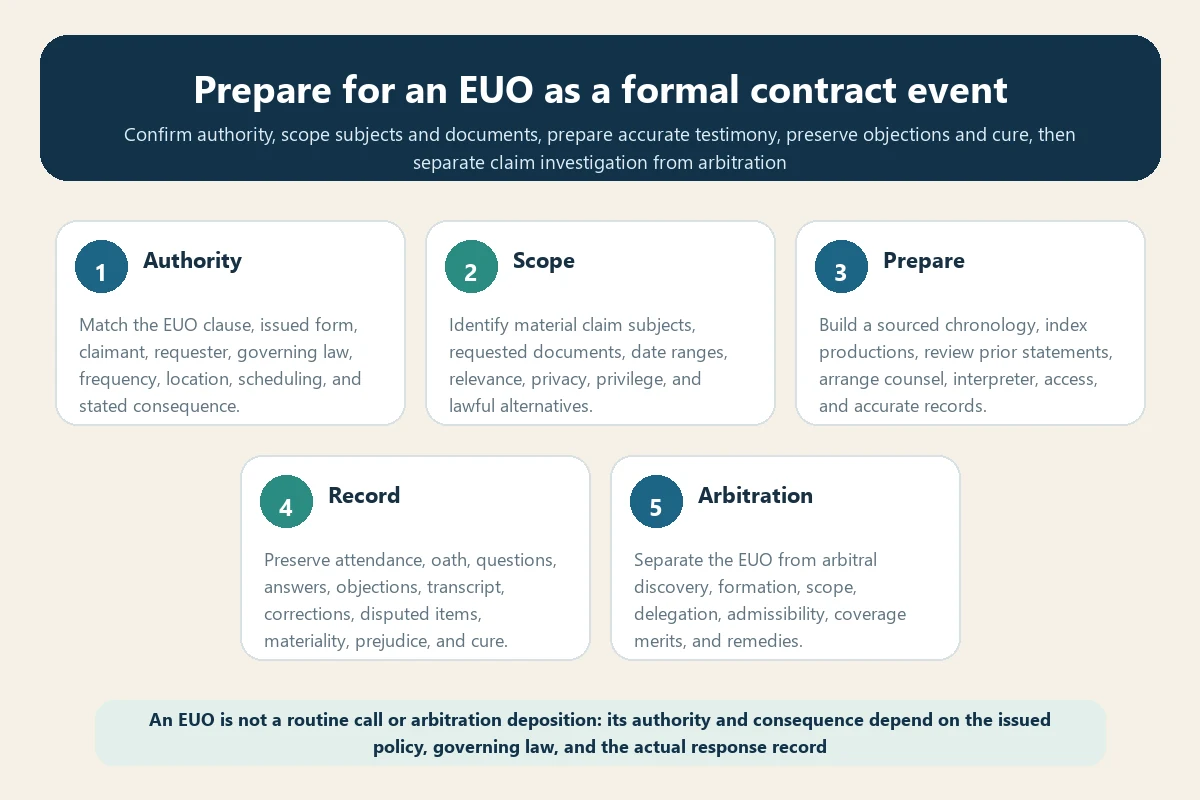
Treat a travel-insurance examination under oath as a formal contractual event. Confirm authority, organize the record, prepare accurate testimony, address scheduling and access, preserve objections, review the transcript, and respond promptly to alleged deficiencies.
Keep the EUO separate from arbitration discovery. Policy compliance, formation, scope, delegation, evidence, coverage, and remedies require distinct analysis.
Appraisal usually addresses the amount or value of a covered loss, while arbitration can address a broader contractual dispute; neither label should substitute for the issued clause. Use this travel insurance appraisal clause arbitration guide to classify the dispute, satisfy prerequisites, select qualified neutrals, preserve valuation evidence, and separate coverage from amount.
Choice of law identifies the substantive rules proposed for a dispute; it does not automatically choose the court, create jurisdiction, or erase mandatory insurance protections. Use this travel insurance choice of law clause guide to preserve the issued policy, map state contacts, distinguish forum language, and calendar every potentially applicable deadline.
