

Travel insurance arbitration interim measures are temporary protections ordered before the final award to preserve property, information, access, funds, evidence, or another condition necessary for a meaningful decision. They should address a demonstrated present risk, not decide the entire coverage dispute early.
The arbitration agreement, current provider rules, arbitrator appointment, case orders, and applicable law control. This U.S. consumer guide provides general information, not legal advice. Interim relief from an appointed arbitrator, emergency relief before appointment, and temporary relief from a court are different procedures.
Define the threatened event precisely
Identify what may happen, who controls it, when it could occur, what evidence supports the risk, and why a later final award may not repair the practical loss. Avoid broad claims that everything must remain unchanged.
In a travel insurance dispute, possible concerns might involve preservation of a claim file, continued access to a portal record, protection of a specific payment or property, disclosure of sensitive medical material, destruction of source data, or another case-specific condition. The requested measure must fit the actual authority and facts.
Read the current interim-measures rule
Current AAA Consumer Arbitration Rules permit the arbitrator to grant interim measures they decide are necessary, including an injunction or an order protecting property. The measure may take the form of an interim award, and the arbitrator may require security for its costs.
The rule also states that the arbitrator may grant a remedy, relief, or outcome available in court when deciding an interim measure. Verify the applicable rule edition, agreement limitations, law, and scope of arbitral authority before requesting a particular remedy.
Distinguish interim measures from emergency measures
Interim measures under current AAA Consumer Rule R-35 are decided by the arbitrator. A separate emergency-arbitrator procedure can provide relief before the ordinary arbitrator is appointed, but the current Consumer Rules do not supply that framework.
AAA’s official article ADR: What’s Your Emergency? explains that Consumer Rules do not provide emergency measures and discusses possible alternatives. Do not file a commercial emergency application in a consumer case unless the agreement and governing process authorize it.
Confirm whether an arbitrator has authority to act now
Record the arbitrator’s appointment and acceptance, applicable rules, pending jurisdiction objections, stays, court proceedings, and any order limiting motions. If no arbitrator is in place, determine what the agreement, provider, and applicable law permit rather than assuming staff can issue merits relief.
Use the arbitrator selection guide to preserve appointment, disclosures, challenges, and authority dates. An administrator generally does not substitute for the arbitrator on a contested interim remedy.
Check the agreement for court-relief language
Some arbitration clauses address temporary court relief, preservation orders, small-claims options, venue, or waiver. Read the complete clause and incorporated rules. Do not quote only the sentence requiring arbitration.
Current AAA Consumer Rule R-35 states that a party’s request for interim measures from a judicial authority is not incompatible with the arbitration agreement or a waiver of the right to arbitrate. That does not create court jurisdiction, prove entitlement, or select the proper court.
Build an authority-and-timing matrix
| Question | Record | Decision control |
|---|---|---|
| Which rules apply? | Agreement, filing date, provider notice | Correct rule edition |
| Who can decide? | Appointment, court case, delegation | Authorized decision-maker |
| What is threatened? | Dated event and supporting proof | Present practical risk |
| When will it occur? | Deadline, notice, system setting | Time available for response |
| What relief is requested? | Proposed order | Narrow operative terms |
| How long should it last? | Milestone or expiration date | Review and termination |
This matrix prevents urgency from obscuring authority. A serious problem still requires the correct decision-maker and procedure.
Show why ordinary scheduling is insufficient
State the next case date, time needed for ordinary briefing, threatened event date, and why waiting would impair the usefulness of a final award. Explain when the risk became known and what prompt steps were taken.
If the event can be paused by agreement, administrator clarification, secure export, preservation notice, short extension, or routine motion, explain those efforts. Interim relief should not replace an available simple cure.
Use specific evidence, not predictions alone
Support the request with declarations based on personal knowledge, complete communications, system notices, contract records, claim files, payment history, technical logs, or other reliable material. Identify source, date, page, and relevance.
Separate confirmed facts, reasonable inferences, and unknowns. Do not present speculation about an insurer’s future action as an established event. Use the evidence objections guide to anticipate source, completeness, privilege, relevance, and timing concerns.
Connect temporary protection to the final case
Explain which final claim, defense, remedy, or evidentiary issue could become ineffective without temporary protection. A preservation order may protect proof; a confidentiality measure may prevent disclosure; a property order may keep an identified asset available.
Avoid asking the arbitrator to declare coverage, award all damages, or decide credibility merely by labeling the request “interim.” If the relief effectively grants the final result, identify the authority and demanding standard rather than concealing its effect.
Request the narrowest workable relief
Define the exact person or entity bound, protected item, prohibited or required act, effective time, expiration, exceptions, reporting, access, storage, and review date. Use objective terms that can be followed and verified.
Consider whether redaction, read-only access, secure preservation, limited recipients, an escrow-like control if authorized, a temporary hold, or a short status-quo period solves the problem with less burden.
Draft an operational proposed order
A proposed order should identify:
- The evidence and issue considered.
- The temporary measure granted or denied.
- Who must act or refrain from acting.
- The protected property, data, funds, or access.
- Effective date and service method.
- Security or cost condition, if authorized.
- Compliance proof and reporting.
- Expiration, review, modification, or dissolution event.
- Effect on the remaining schedule and merits.
A vague instruction to “preserve the status quo” can create a second dispute about what the status quo was.
Follow the authorized motion process
Determine whether advance permission, a short request, full motion, conference, response, reply, or oral hearing is required. State the urgency without using it to bypass the other party’s fair opportunity to respond unless an authorized process permits different notice.
The motion practice guide helps separate permission, briefing, evidence, proposed relief, and ruling. Serve every party through the case channel.
Address notice and the opportunity to be heard
Document recipient, delivery method, time, attachments, response deadline, and any attempt to provide faster notice. If immediate action is requested before a full response, explain authority, exact duration, harm during the response period, and the proposed prompt follow-up process.
Do not send a private merits request to the arbitrator. Current AAA communication rules generally route arbitrator communications through the AAA and require simultaneous sharing unless otherwise directed.
Evaluate security and cost
Current Rule R-35 permits the arbitrator to require a security payment for the costs of interim measures. Identify requested vendors, storage, monitoring, transfer, custodian, or other implementation expense and who proposes to advance it.
Do not assume security is automatic or that it equals the disputed claim amount. Ask for an itemized, proportionate condition tied to the temporary measure and governing authority.
Protect sensitive claim records
Interim applications may contain medical records, passport data, bank details, portal credentials, or third-party information. Redact unrelated data, use secure transmission, limit recipients, and request protected treatment when authorized.
The arbitration confidentiality guide distinguishes privilege, privacy, cybersecurity, contractual confidentiality, and provider procedure. Confidentiality itself may also be the subject of narrowly tailored interim protection.
Oppose or narrow the request precisely
Answer authority, timing, actual risk, evidentiary support, connection to final relief, burden, proposed duration, security, and alternatives. Identify what protection can be agreed and what remains disputed.
A useful response can offer preservation without admitting liability, narrower data fields, limited recipients, a shorter duration, prompt review, substitute security, or a schedule that avoids deciding the merits prematurely.
Distinguish an interim order from an interim award
The current rules allow interim measures to take the form of an interim award. Record the document’s title, signature, findings, scope, effective date, service, fees or expenses, modification terms, and whether any judicial step is contemplated.
Do not assume every procedural order is an award or every interim award resolves final claims. The arbitration award guide helps distinguish interim, partial, consent, and final decisions.
Track compliance without expanding the order
Create a log for operative term, responsible party, due date, delivery, receipt, objection, cure, cost, status, and evidence of completion. Use the order’s exact language.
If compliance is disputed, request clarification or enforcement through the authorized process. Do not privately expand a preservation requirement into a broader production duty or merits admission.
Review the measure as circumstances change
An interim measure should have a milestone, expiration, or review mechanism. Update the arbitrator if the threatened event is canceled, property is secured, data is preserved, the parties settle, or the measure becomes unnecessary or excessively burdensome.
Record any modification, extension, dissolution, or replacement order and its effect on deadlines, evidence, costs, and the final hearing.
Understand court procedure separately
Federal Rule of Civil Procedure 65 illustrates notice and detailed-order requirements for federal injunctions and temporary restraining orders. It does not automatically govern a private arbitration or establish federal jurisdiction.
Court authority, standards, notice exceptions, bond requirements, service, venue, and appeal can be jurisdiction-specific. Obtain legal advice before seeking or opposing judicial interim relief.
Avoid common interim-measures mistakes
- Assuming consumer rules include an emergency arbitrator before appointment.
- Failing to identify the authorized decision-maker.
- Calling ordinary scheduling pressure irreparable urgency.
- Using predictions without dated source evidence.
- Requesting final coverage or damages as temporary relief.
- Drafting an order with no duration, exceptions, or compliance method.
- Ignoring notice, response, security, or implementation cost.
- Sending a private request to the arbitrator.
- Confusing an interim order with a final award.
- Leaving protection in place after its purpose ends.
Final interim measures checklist
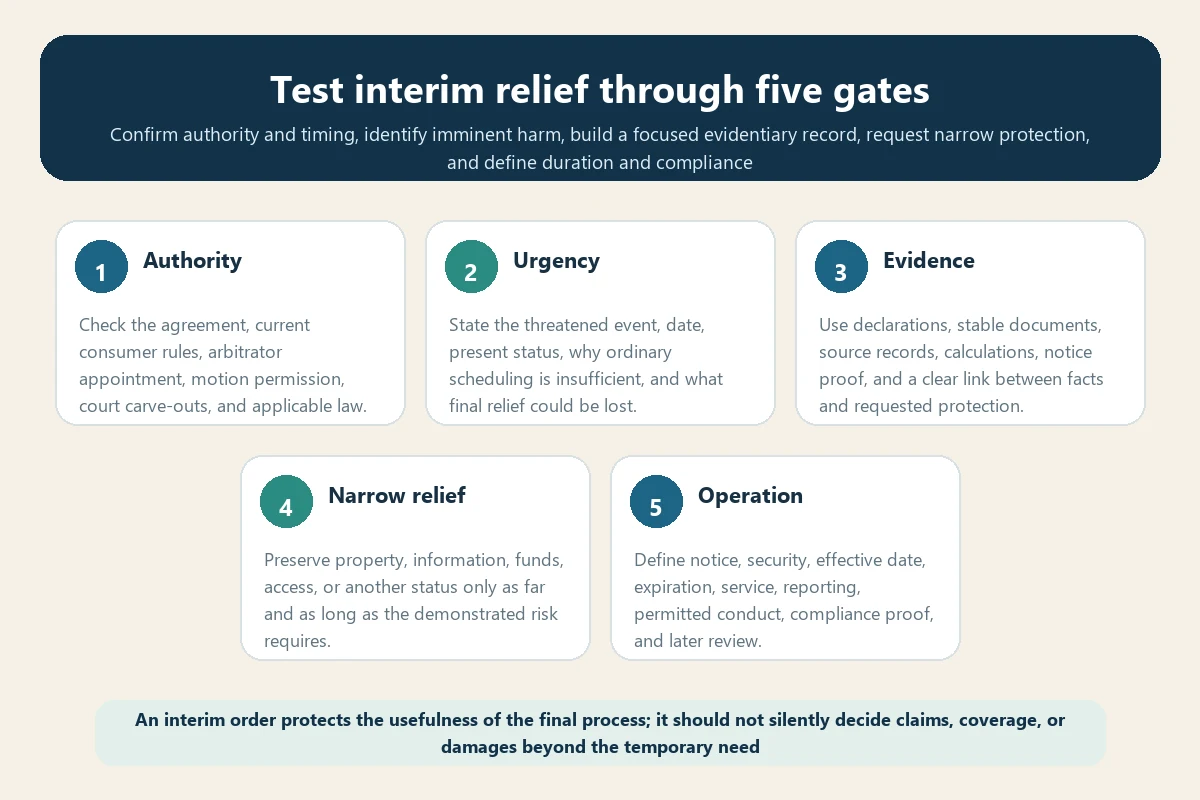
- Confirm the agreement, current rules, appointment, and authority.
- Identify the threatened event and exact timing.
- Explain why ordinary scheduling or a simple cure is insufficient.
- Support urgency with stable, cited evidence.
- Connect temporary protection to meaningful final relief.
- Request the narrowest operational measure.
- Define notice, security, duration, exceptions, and review.
- Serve every party and preserve a fair response process.
- Track the signed order or interim award and compliance.
- Modify or end the measure when circumstances change.
Effective interim relief preserves the usefulness of arbitration without pre-deciding the dispute. Confirm authority, prove a time-sensitive risk, supply reliable evidence, request a narrow and workable order, and define exactly how long the protection lasts and how compliance will be verified.
