

A travel insurance arbitration postponement request asks the authorized decision-maker to move a hearing, conference, or related case event because good cause prevents fair or practical use of the existing date. Filing the request does not postpone anything. The current schedule remains operative until a written notice or order changes it.
The arbitration agreement, current provider rules, case orders, administrator instructions, and applicable law control. This U.S. consumer guide provides general information, not legal advice. Distinguish a hearing postponement from a routine deadline extension, adjournment after a hearing begins, stay, withdrawal, or settlement.
Identify exactly what must move
State the current date, time, time zone, event, duration, format, and controlling notice or order. A request to move a final evidentiary hearing can affect more than the hearing itself. It may also change exhibit exchange, witness disclosure, objections, transcript arrangements, briefs, record closure, and the award schedule.
Use the arbitration timeline to map every dependent deadline before proposing a new date. Do not request “more time” without identifying the event and complete downstream effect.
Read the governing extension and postponement rule
Current AAA Consumer Arbitration Rules permit parties to modify certain time periods by agreement and allow the AAA or arbitrator to extend certain periods for good cause, subject to stated exceptions. The arbitrator may grant a postponement for good cause on agreement, a party request, or the arbitrator’s own initiative.
Verify the exact rule edition and order governing the case. An agreement between parties may not be enough when the arbitrator, administrator, venue, reporter, interpreter, or other scheduled resource must confirm the change.
Separate postponement from extension
A postponement usually moves a scheduled hearing or conference. An extension moves a filing or performance deadline. An adjournment pauses or continues a hearing already underway. A stay suspends some or all proceedings under a separate authority. Use the term in the governing rule or order and state the exact relief.
If only one witness disclosure or exhibit response needs more time, moving the entire hearing may be unnecessary. Conversely, a short filing extension may not cure the absence of a material witness at the final hearing.
Show good cause with specific facts
Good cause is a decision standard, not a slogan. Explain the event, date learned, material effect, prior preparation, promptness, expected duration, and why a reasonable alternative cannot protect a fair presentation. Tailor supporting documentation to the issue and redact unnecessary private details.
| Possible event | Useful facts | Possible narrower cure |
|---|---|---|
| Medical emergency | Timing, functional limitation, expected availability | Remote appearance or short delay |
| Witness unavailable | Material testimony, prior scheduling, alternate dates | Reorder witnesses or written statement |
| Late material evidence | Receipt date, importance, review needed | Supplemental response or limited continuation |
| Technology failure | Test results, failed system, support attempts | Alternate platform or telephone backup |
| Interpreter problem | Language, cancellation, replacement efforts | Qualified remote substitute |
| Extreme travel disruption | Official notice, route, location, alternatives | Virtual participation |
Do not disclose a diagnosis, passport, account number, or unrelated family detail merely to make the request sound serious. Provide only what is reasonably necessary under the procedure.
Demonstrate diligence
Record when the hearing was set, when preparations began, what arrangements were made, when the problem appeared, and when notice was sent. Explain efforts to obtain records, confirm witnesses, retain an interpreter, test technology, or secure alternate travel.
A late request needs a clear chronology. Silence until the eve of the hearing can undermine the request when the problem was known earlier. If immediate notice is impossible, document why and contact the authorized channel as soon as practical.
Confer with the other party when appropriate
State the current date, reason at a suitable level of detail, length requested, alternatives, available replacement dates, and deadlines affected. Record the response accurately as consent, opposition, no position, partial agreement, or no response by a stated time.
Do not represent that the case is postponed because both parties agree. Submit the agreement through the required channel and await confirmation. Keep settlement discussions and privileged communications separate from scheduling facts.
Test less disruptive alternatives
A good request explains why narrower options do or do not work. Consider a short extension, remote appearance, telephone participation, witness reorder, partial hearing, bifurcation, written testimony if permitted, replacement interpreter, backup device, limited supplemental exchange, or proceeding on undisputed issues.
The virtual hearing guide helps test remote alternatives. The interpreter guide covers qualifications, conflicts, oath, technology, corrections, and backup.
Explain why the affected evidence is material
If the request concerns a witness or document, connect it to a policy element, disputed fact, defense, loss amount, or credibility issue. Identify what the evidence would establish and why other admitted proof is insufficient, without turning the scheduling request into the entire merits case.
Use the witness testimony guide and exhibit list workflow to show a specific need rather than a vague claim that more preparation would be helpful.
Propose realistic replacement dates
Provide several dates after checking every party, arbitrator if the process permits, witness, representative, interpreter, reporter, platform, and necessary facility. State time zones and expected session length. Avoid proposing dates that simply transfer the same conflict.
Include a revised schedule for exchange, objections, witness lists, technology checks, hearing materials, transcript, briefs, and record closure. Mark it “proposed” until approved.
Address cost and prejudice
Identify nonrefundable travel, reporter, interpreter, expert, facility, or vendor costs that may result. Explain measures taken to cancel promptly, preserve deposits, reschedule efficiently, and prevent duplication. Do not state that a fee must be waived without checking the governing fee schedule and authority.
Also identify prejudice from denial and from delay. A fair request acknowledges both: the requesting party’s ability to present material proof and the other party’s cost, witness availability, finality, or time-sensitive need.
Use a complete written request
- Case caption and number.
- Exact event and date to be moved.
- Rule, order, or authority for the request.
- Specific good-cause facts and date discovered.
- Diligence and prompt notice.
- Other party’s position.
- Narrower alternatives considered.
- Requested replacement dates and revised schedule.
- Supporting documents and privacy controls.
- Proposed order and proof of service.
Follow any permission and briefing requirements in the motion practice guide. A short administrator message may be appropriate in one case, while another requires an authorized formal motion.
Protect medical and personal information
When illness, disability, family emergency, or protected information supports the request, submit the least sensitive proof that establishes functional need and timing. Use redaction, restricted access, or a request for protected treatment when authorized.
Do not copy unnecessary recipients or upload unredacted records to an incorrect portal field. Preserve the source record securely and follow the arbitration confidentiality guide.
File through the authorized channel
Confirm whether the request goes to the case administrator, arbitrator through the administrator, online portal, or another ordered method. Share it with every party as required. Save upload receipts, sent messages, attachments, timestamps, page counts, and any fee notice.
The AAA self-represented administration sheet emphasizes written communications, sharing them with other parties unless directed otherwise, following deadlines, and promptly contacting the administrator when a deadline cannot be met.
Keep preparing while the request is pending
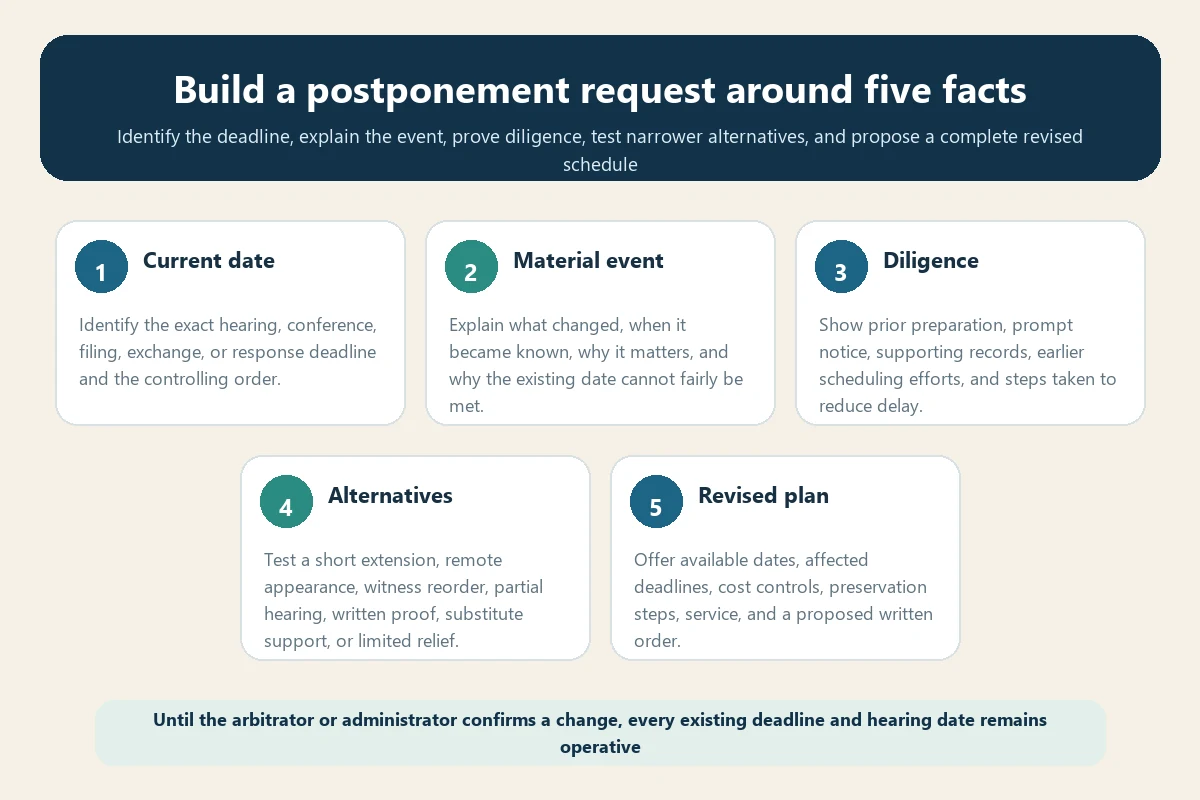
Unless an authorized notice says otherwise, assume the hearing and every deadline remain in effect. Continue witness preparation, exhibit exchange, filings, technology tests, and attendance planning to the extent possible.
Do not cancel travel, release a reporter, tell a witness not to attend, or miss a filing solely because the request was acknowledged. Receipt is not approval.
Respond to a postponement request precisely
If another party requests delay, verify the event, chronology, evidence, length, prior postponements, alternatives, costs, prejudice, and proposed dates. State consent, opposition, or narrower relief and explain why. Avoid personal attacks or unsupported claims about motive.
A useful response can propose a shorter delay, preserve existing exchange deadlines, allow one witness remotely, divide the hearing, condition relief on prompt documentation, or request cost allocation only when authorized.
Record the ruling and updated schedule
Save the signed order or official notice. Record granted, denied, partially granted, conditions, new dates, unchanged dates, fees, cost allocation, required proof, and future status conference. Distribute the operative schedule to every witness and vendor.
Update the case calendar only from the confirmed ruling. If any downstream deadline is unclear, request clarification promptly rather than making a private assumption.
Understand the risk of nonappearance
Current AAA rules state that, unless law provides otherwise, arbitration may proceed when a properly notified party fails to appear and fails to obtain a postponement. An award may not rest solely on default; the attending party must present evidence the arbitrator requires.
Do not treat a denied postponement as permission not to attend. Obtain legal advice promptly if participation becomes impossible or the ruling may affect important rights.
Do not import another forum’s fee rule
For comparison, FINRA Rule 13601 contains specific postponement timing, fee, and repeated-postponement provisions for FINRA industry arbitration. Those rules do not govern an AAA travel insurance case merely because both are arbitration forums.
Check the exact provider, case type, filing date, and applicable fee schedule before stating that a late fee, cancellation charge, or waiver applies.
Preserve a denied request
Keep the request, supporting facts, service, opposition, ruling, objection if authorized, alternatives offered, and practical effect. Continue complying with the order and make a focused record of any material evidence or participation problem.
The federal standard governing possible award challenges is narrow and fact-specific. The award challenge guide explains record preservation and deadlines without suggesting that an unfavorable scheduling ruling automatically permits court relief.
Avoid common postponement mistakes
- Requesting “more time” without naming the exact event.
- Waiting after the problem and material effect are known.
- Providing excessive private information instead of focused proof.
- Ignoring remote, partial, or shorter alternatives.
- Offering no available replacement dates or revised schedule.
- Assuming party agreement automatically changes the hearing.
- Canceling preparations before written approval.
- Applying another arbitration forum’s fee rule.
- Failing to calendar unchanged deadlines.
- Missing the hearing after the request is denied.
Final postponement request checklist
- Identify the exact operative event, date, order, and decision-maker.
- Explain the material event, discovery date, and good cause.
- Document diligence and provide prompt notice.
- Confer and state the other party’s position accurately.
- Test narrower alternatives and explain the result.
- Propose several dates and a complete revised schedule.
- Address cost, prejudice, privacy, and supporting proof.
- File and serve through the authorized channel.
- Keep every existing date until a ruling changes it.
- Record the decision and update all dependent plans.
A persuasive postponement request is prompt, specific, proportionate, and operational. Show why the existing date no longer permits a fair process, document reasonable diligence, offer less disruptive cures, and give the arbitrator a complete schedule that can be adopted.
