
Travel insurance policy rescission arbitration disputes arise when an insurer seeks to treat a policy as void from inception because of an alleged application misstatement, omission, or concealment—and the parties disagree about whether the arbitration clause still governs.
This U.S. consumer guide explains how to audit the application, underwriting, materiality, notice, premium return, severability, delegation, and defenses. It is not legal advice.
Distinguish rescission from claim denial
A claim denial applies policy terms to a particular loss. Rescission is asserted to unwind or avoid the policy, often from inception. Cancellation and nonrenewal generally operate differently and may be prospective.
Identify the insurer’s exact stated action rather than relying on a customer-service label.
Preserve every application version
Save the quote, application, checkout screen, eligibility questions, medical or trip questions, definitions, instructions, signature, confirmation, policy, certificate, endorsements, amendments, and recordings lawfully available.
Record dates, time zones, devices, purchaser identity, insured travelers, agent involvement, corrections, and how each answer entered the insurer’s system.
Identify the exact challenged statement
Quote the question and answer in full. State what the insurer says was false or incomplete, what the asserted true fact is, when it existed, who knew it, and which traveler it concerned.
Do not combine several application fields into a generalized accusation of misrepresentation.
Read definitions and instructions together
Terms such as physician, treatment, diagnosis, symptom, trip cost, residence, destination, foreseeable, pre-existing condition, and traveling companion may have contract-specific meanings.
Preserve help text, examples, hover text, linked definitions, and any language stating whose knowledge or health history must be reported.
Check whether the question was ambiguous
Record grammar, date ranges, compound questions, undefined terms, yes-or-no constraints, screen layout, accessibility, translations, and prior explanations. Compare what a reasonable applicant could understand under governing law.
An after-the-fact interpretation should not replace the words the applicant actually saw.
Identify who supplied the answer
Determine whether the traveler, purchaser, spouse, family member, travel advisor, producer, platform, employer, or insurer representative entered or changed the information. Audit authority and the principal-agent relationship.
The arbitration agency guide helps separate actual authority, apparent authority, manifestations, and reliance.
Determine governing state law
Review choice-of-law language, residence, place of contracting, policy situs, forum rules, and state insurance statutes. Rescission standards, required intent, materiality, notice, timing, and remedies vary.
Do not treat one state’s rule as a national standard for all travel insurance.
Use a state statute as an example, not a universal rule
For example, Florida Statutes section 627.409 addresses representations in insurance applications and circumstances in which a misrepresentation, omission, concealment, or incorrect statement may prevent recovery.
Its text includes fraud, materiality, and what the insurer in good faith would have done with the true facts. Other jurisdictions may use different elements or protections.
Separate falsity from materiality
An answer may be inaccurate without satisfying the governing test for rescission or preventing recovery. Determine whether the fact mattered to acceptance of risk, premium, policy amount, exclusion, eligibility, or the hazard that produced the loss.
Create separate evidence columns for falsity, knowledge or intent where relevant, materiality, reliance, and remedy.
Audit the underwriting decision
Request or preserve underwriting guidelines, eligibility rules, filed forms, rates, decision tables, referrals, manuals, prior versions, and testimony where lawfully available. Identify the rule in force on the purchase date.
A conclusory statement that the policy would not have issued should be compared with contemporaneous underwriting evidence and actual alternative outcomes.
Test the counterfactual precisely
Ask what the insurer says it would have done with the true facts: decline the application, charge a different premium, issue lower limits, add an exclusion, remove a waiver, or decline only one traveler.
Match that outcome to the jurisdiction’s statutory language and the policy actually purchased.
Preserve medical chronology carefully
When health information is involved, organize symptoms, appointments, tests, diagnoses, treatment, medications, referrals, stability periods, and application dates. Use records rather than retrospective summaries where possible.
Limit collection and sharing to relevant records through secure channels; medical evidence can be sensitive and broader than the disputed question. The pre-existing-condition waiver denial guide helps separate waiver eligibility from broader application issues.
Audit trip-cost and booking statements
Rescission allegations can also involve trip cost, deposit dates, destination, residence, traveler count, cancellation history, or purpose of travel. Reconcile invoices, confirmations, refunds, credits, and payment records.
Separate an estimate made when buying coverage from a later trip-cost increase or booking change.
Check corrections and amendments
Preserve calls, emails, portal edits, revised confirmations, endorsements, and insurer acknowledgments. Record whether the applicant attempted to correct the answer before a loss or claim.
Determine whether the insurer accepted the correction, adjusted premium, modified coverage, or reserved rights.
Analyze insurer knowledge and conduct
Record when the insurer or its agents learned the true facts, what records it possessed, whether it continued collecting premium, and how it handled the policy and claim afterward.
Potential waiver, estoppel, or statutory timing arguments require jurisdiction-specific analysis. Use the arbitration waiver guide only for the distinct issue of inconsistent enforcement conduct.
Preserve the rescission notice
Keep the complete notice, envelope, delivery data, effective date, cited statute, application answer, factual basis, premium calculation, refund method, appeal or review route, and signer’s authority.
Check whether the notice rescinds the entire policy, one insured, one benefit, an endorsement, or only denies the claim.
Trace the premium return
Record gross premium, taxes, fees, commissions, refunds, offsets, checks, electronic transfers, uncashed instruments, and delivery dates. Determine what restoration the governing law requires and when.
Do not assume that issuing a refund conclusively proves a valid rescission or that retaining it necessarily waives every objection.
Separate rescission from reformation
Reformation changes contract text to reflect an asserted true agreement; rescission seeks to unwind the contract. Other remedies may include denial of recovery, exclusion enforcement, damages, or cancellation.
Identify the exact relief requested and its statutory or contractual basis.
Apply the Federal Arbitration Act carefully
Section 2 of the Federal Arbitration Act generally makes written arbitration provisions involving commerce enforceable on ordinary contract footing, subject to generally applicable contract defenses.
The statute does not decide the insurance rescission merits or eliminate relevant state insurance law.
Understand Buckeye’s separability rule
In Buckeye Check Cashing, Inc. v. Cardegna, the U.S. Supreme Court distinguished a challenge to a contract as a whole from a challenge directed specifically to its arbitration provision.
A policy-rescission allegation aimed at the entire contract therefore does not automatically answer whether the arbitration clause is separately enforceable. Apply current controlling law to the actual challenge.
Separate formation from validity
In Granite Rock Co. v. International Brotherhood of Teamsters, the Supreme Court emphasized that courts must be satisfied that the parties formed the arbitration agreement before ordering arbitration.
A claim that no agreement was formed is analytically different from a claim that an otherwise formed policy is voidable because of a misstatement.
Target the correct provision
Identify whether the objection challenges the insurance policy as a whole, the arbitration clause, a delegation term, online assent, notice, authority, scope, or a state-law restriction. Preserve evidence for each separately.
The arbitration severability guide provides a clause-by-clause framework.
Analyze delegation separately
If a party says the arbitrator must decide rescission or arbitrability, identify the exact delegation language and incorporated rules. Determine whether a challenge is specifically directed to delegation and who formed it.
Use the arbitrability guide to separate formation, delegation, scope, procedural conditions, and merits.
Check state insurance arbitration restrictions
Some states regulate or restrict arbitration clauses in insurance contracts, and federal preemption questions may be complex. Identify the policy type, issuing insurer, state, statutory text, appellate authority, and any international component.
Do not assume a clause is valid or invalid nationwide because another insurance line or jurisdiction reached a particular result.
Define the dispute’s scope
Read whether the clause covers policy validity, application statements, rescission, refunds, claim denials, statutory claims, agents, or post-rescission conduct. Note temporal limits, exclusions, forum, remedies, and survival language.
Broad language still requires a valid agreement and applicable law.
Build an evidence matrix
Create rows for each question and answer, alleged truth, ambiguity, actor, authority, knowledge, materiality, underwriting rule, counterfactual decision, insurer knowledge, notice, premium return, remedy, policy formation, clause formation, severability, delegation, scope, and defenses.
For each row, cite supporting and contrary evidence, source, custodian, date, and authenticity. This prevents one inaccurate answer from carrying every element.
Preserve reasonable defenses
Potential defenses include truthful answer, ambiguous question, wrong actor, lack of knowledge where required, immateriality, unsupported underwriting counterfactual, insurer knowledge, correction, waiver or estoppel, defective notice, untimeliness, inadequate premium restoration, partial rather than total remedy, no clause formation, targeted clause defense, state insurance restriction, or claim outside scope.
An insurer asserting rescission should address contrary underwriting records, agent communications, corrections, continued premium collection, and inconsistent claim conduct.
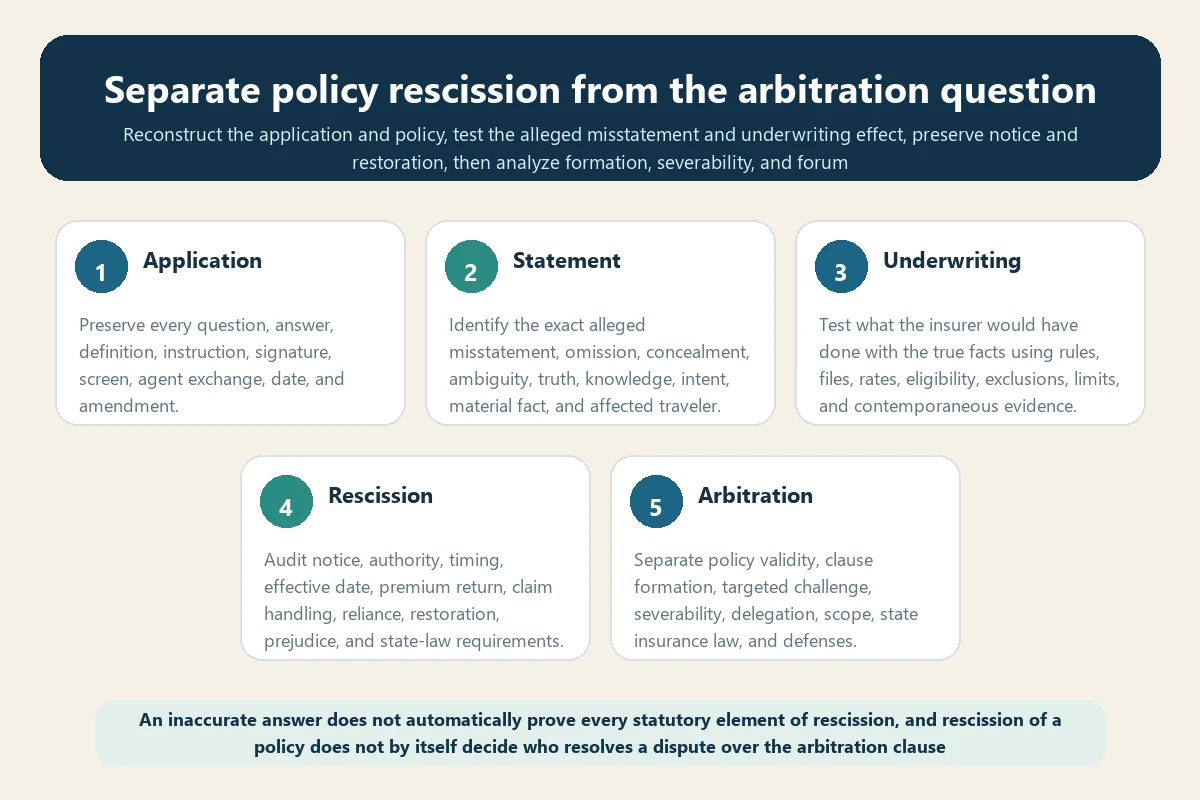
Use a disciplined decision sequence
- Classify the action as rescission, denial, cancellation, or another remedy.
- Preserve the exact application, policy, and alleged statement.
- Determine governing insurance and contract law.
- Test falsity, knowledge or intent, materiality, and underwriting effect.
- Audit notice, timing, authority, and premium restoration.
- Separate policy validity from arbitration formation and clause defenses.
- Analyze severability, delegation, scope, restrictions, and remedies.
Bottom line
Travel insurance policy rescission arbitration requires two disciplined analyses. First, determine whether the application evidence and governing insurance law support the asserted rescission. Second, decide whether a valid arbitration agreement exists and who resolves the policy-validity dispute.
An inaccurate answer does not automatically prove every rescission element, and an asserted policy rescission does not by itself establish that the arbitration clause vanished or survived.
