
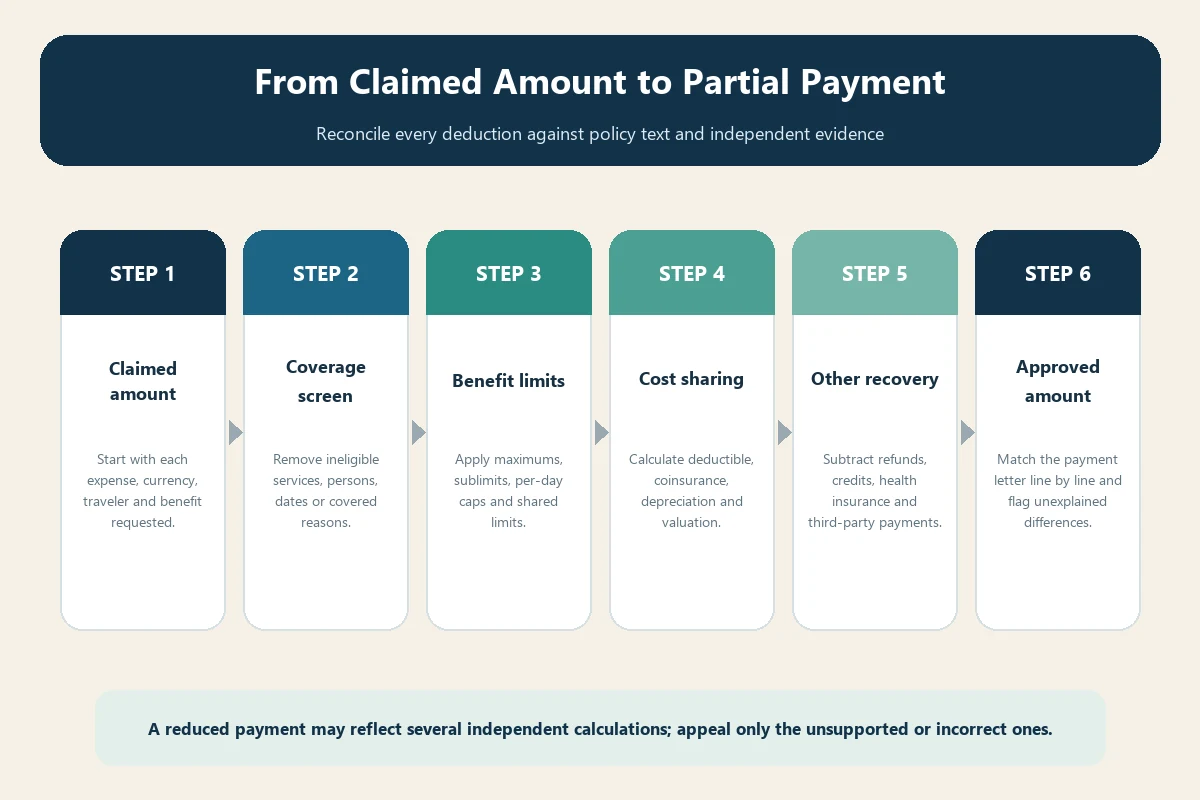
A travel insurance claim partial payment explanation should reconcile the amount requested with the amount approved. A reduced payment is not one decision; it can combine uncovered expenses, benefit limits, deductibles, coinsurance, depreciation, supplier refunds, another insurer’s payment, currency conversion, or missing documentation.
Do not compare only the claim total and deposit. Request the payment statement, policy provisions, and line-level calculation. Then rebuild the arithmetic by traveler, benefit, provider, supplier, date, and currency before deciding whether the payment is correct or should be appealed.
Key takeaways
- A partial payment can include several different deduction reasons.
- Match every deduction to a policy provision, factual record, and claim line.
- A provider bill, patient responsibility, and eligible travel expense are not always the same amount.
- Refunds, credits, other insurance, and later payments must be reconciled.
- Protect appeal deadlines while requesting a clearer calculation.
Start with the payment statement
Locate the insurer’s EOB, benefit statement, settlement letter, or claim determination. It should identify the claim, insured, benefit, amount submitted, approved amount, payment, and reasons for reductions or denial. If it gives only a total, ask for a line-by-line breakdown and the policy sections applied.
Also verify the payee and payment method. An insurer may have paid a hospital, assistance company, travel supplier, or another insured directly, so the traveler’s deposit can be less than the total claim payment.
Build a claim bridge
Create a table that starts with every requested line and ends at the payment. Use columns for original cost, eligible cost, excluded amount, supplier refund, other-insurance payment, deductible, coinsurance, limit, currency adjustment, depreciation, and approved amount. Each difference needs a reason code or note.
Do not make one row called “miscellaneous trip expenses.” Separate hotel, meals, transportation, medical providers, baggage items, and unused bookings. Benefit limits apply more accurately when the expenses are categorized.
Covered event but uncovered expense
An insurer can accept that a covered event occurred while excluding some expenses. A covered flight delay may trigger meal and hotel benefits but not an upgrade, alcohol, entertainment, or costs outside the covered period. A medical emergency can be covered while routine follow-up or unrelated treatment is excluded.
Read the benefit’s eligible-expense definition, not only the covered-reason list. Ask which fact made the line ineligible and provide targeted evidence if that fact is wrong.
Benefit maximums and sublimits
The schedule can impose a total maximum, daily or per-person limit, item sublimit, dental sublimit, evacuation limit, or common-carrier limit. A claim can be fully eligible but paid only to the applicable cap.
Verify whether the limit is per insured, trip, event, day, item, or policy. Group claims often produce mistakes when a family total is applied as though it were one person’s limit or vice versa.
Deductible and coinsurance
Travel medical policies can apply a deductible before payment and coinsurance after the deductible. Confirm whether the deductible is per policy, person, trip, incident, or coverage period. Check whether it applies separately to medical and another benefit.
When another insurer pays first, the travel policy determines how its deductible interacts with the remaining eligible amount. Do not assume the first plan’s deductible automatically satisfies the travel deductible.
Primary and secondary coverage
A secondary travel medical carrier may subtract the amount paid or payable by Medicare, Medicare Advantage, employer coverage, or another plan. It may also wait for an EOB. Use our Explanation of Benefits guide to distinguish billed, allowed, paid, adjusted, and patient-responsibility amounts.
If the first payer reprocesses the claim later, submit the revised EOB. The travel insurer may owe more or seek a reconciliation, depending on the change.
Supplier refunds and credits
Cancellation and interruption payments commonly subtract cash refunds and other recoveries. A credit or voucher can receive policy-specific treatment based on restrictions and use. Ask which supplier statement the insurer relied on.
Follow our supplier refund statement guide. If money arrives after the insurance payment, use the later refund and recovery workflow.
Insured trip cost and underinsurance
Some trip cancellation, interruption, or waiver provisions depend on the trip cost insured and timely updates after bookings change. The insurer can compare the cost declared with the loss submitted. Review the declarations and every cost increase, not only the final trip total.
Ask the carrier to identify any proportional calculation or uninsured component. Do not assume a partial payment means a generic coinsurance penalty; use the actual contract wording.
Currency conversion
A foreign invoice, card posting, health-plan EOB, and insurer conversion can show different dollar amounts. Compare the original currency, rate source, date, direction, rounding, and fees. Our currency exchange claim guide gives the audit fields.
If the insurer used a different rate, ask for its source and date. A better rate found online today does not prove the historical calculation was wrong.
Depreciation and baggage valuation
Baggage and personal-property benefits can value an item using actual cash value, depreciation, repair, replacement, or another policy method. High-value categories may have sublimits or exclusions. Compare the item age, condition, original proof, replacement estimate, and calculation.
A current replacement receipt does not automatically prove original value. Ask for the depreciation schedule or item-level explanation when available.
Reasonable and customary charges
Medical policies can limit payment to reasonable and customary, usual and customary, negotiated, or other defined charge standards. A foreign hospital’s billed amount may exceed the amount the carrier considers eligible. Request the definition, data basis, geographic area, and calculation applied.
Do not confuse a provider discount with insurer payment. Obtain the final provider ledger to see contractual adjustments, deposits, refunds, and patient balance.
Missing or unreadable documents
A carrier may pay documented lines and leave others pending or denied. Check whether the letter says “partial payment,” “additional information required,” or “final determination.” Ask for the exact missing record by claim line.
Use our alternative proof guide when a receipt is unavailable. For foreign treatment, submit the original and required translation rather than an English total alone.
Timing and multiple payments
A claim can be paid in stages. One benefit may be approved while medical records, supplier refunds, or another payer remain pending. Confirm whether the file is open, partially closed, or finally closed for each benefit.
Do not appeal a line that is merely pending without first confirming status. Conversely, do not let a small initial payment obscure a final denial or appeal deadline for the balance.
Per-person versus household calculations
Family and group claims can appear short when costs are not assigned to individual insureds. A hotel room may be one shared charge, while meals, medical expenses, baggage, and insured trip cost can be person-specific. Ask how the carrier allocated shared expenses and applied each person’s limit or deductible.
Create separate subtotal columns for every insured and a shared-cost allocation note. Do not divide a charge equally if the booking invoice, rooming list, age pricing, single supplement, or policy uses another basis. A child’s lower tour fare or an adult’s private room can change the correct allocation.
Taxes, tips, and service charges
An itemized receipt can include taxes, gratuities, resort fees, delivery fees, and service charges. The underlying expense may be eligible while one add-on is excluded or capped. Ask which component was removed and under what wording.
For an automatic gratuity or mandatory tax, preserve the merchant invoice rather than assuming it is covered. For a voluntary tip, identify it separately. Transparent itemization lets the adjuster apply the contract without rejecting the entire expense.
Verify the actual deposit
Compare the decision amount with ACH, check, virtual card, or direct-provider payment. Account for bank rejection, stale check, foreign transfer fee, withholding, offset, or split payees only when the documentation supports it. Never send banking information in response to an unverified message.
If a payment is missing, confirm through the insurer’s official number or portal and ask for trace information. A claim calculation dispute is different from a payment-delivery problem.
Ten-question audit
- Which benefit did each expense use?
- Was the event accepted but the expense excluded?
- Which maximum or sublimit applied?
- How was the deductible calculated?
- What did another insurer pay or deny?
- Which refund or credit was subtracted?
- What trip cost was insured?
- Which exchange rate and date were used?
- Was depreciation or a charge allowance applied?
- Is each unpaid line denied, pending, or missing proof?
Request a corrected calculation
Send a short reconciliation that identifies each disputed line, insurer calculation, policy provision, corrected fact, supporting exhibit, and requested amount. Do not resubmit an entire unsorted file. Follow the packet method in our travel claim guide.
If the insurer confirms a final adverse decision, use our appeal workflow. Calendar the deadline before requesting clarification.
When to escalate
Ask for supervisor or internal review when the arithmetic or fact remains unresolved. A state insurance department can review complaint handling and applicable rules, but it does not guarantee coverage. For a large claim, approaching legal deadline, or complex legal issue, consider qualified counsel.
FAQ
Why did the insurer pay less than the receipts?
Receipts show expense, but policy eligibility, refunds, other insurance, deductibles, limits, and valuation can reduce payment.
Is a partial payment a final decision?
Not always. Check whether each benefit and line is approved, denied, pending, or awaiting records.
Can I cash the check and still appeal?
Settlement and release rules vary. Review the letter, check language, policy, and applicable law before acting.
What if the math is wrong?
Submit a line-by-line correction with documents and protect the formal appeal deadline.
Bottom line
A partial travel insurance payment should be auditable from claim total to approved amount. Separate coverage, limits, deductibles, other payers, refunds, currency, valuation, and missing proof. Confirm what is final, request a line-level calculation, and appeal only the specific facts or provisions that remain wrong.
Sources
- NAIC — What to Know About Travel Insurance
- NAIC — Travel Insurance Model Act
- NAIC — State Insurance Departments
- New York DFS — Travel Insurance
- California Department of Insurance — Travel Insurance Guide
- Washington OIC — Complaint Process
Reviewed August 16, 2026. This article is general educational information, not legal, accounting, or coverage advice. The issued policy and written claim decision control.
