

An assignment of benefits in a travel insurance hospital claim can direct some insurance rights or payment to a medical provider or another party. It is not automatically or legally the same as direct billing, a guarantee of payment, a medical-record authorization, a power of attorney, or an assignment of the entire policy.
The legal effect depends on the form, issued policy, provider agreement, insurer acceptance, and applicable law. Read the scope, amount, revocation, dispute, appeal, recovery, and patient-responsibility language before signing. Obtain advice for a broad, irrevocable, or high-value assignment.
Key takeaways
- An assignment can redirect payment without guaranteeing that an expense is covered.
- Direct billing is an operational arrangement; a guarantee of payment is a separate commitment.
- A medical authorization releases records but does not necessarily assign money or claim rights.
- The patient may remain responsible for deductibles, exclusions, limits, and uncovered balances.
- Request a final provider ledger showing every insurer payment, adjustment, refund, and balance.
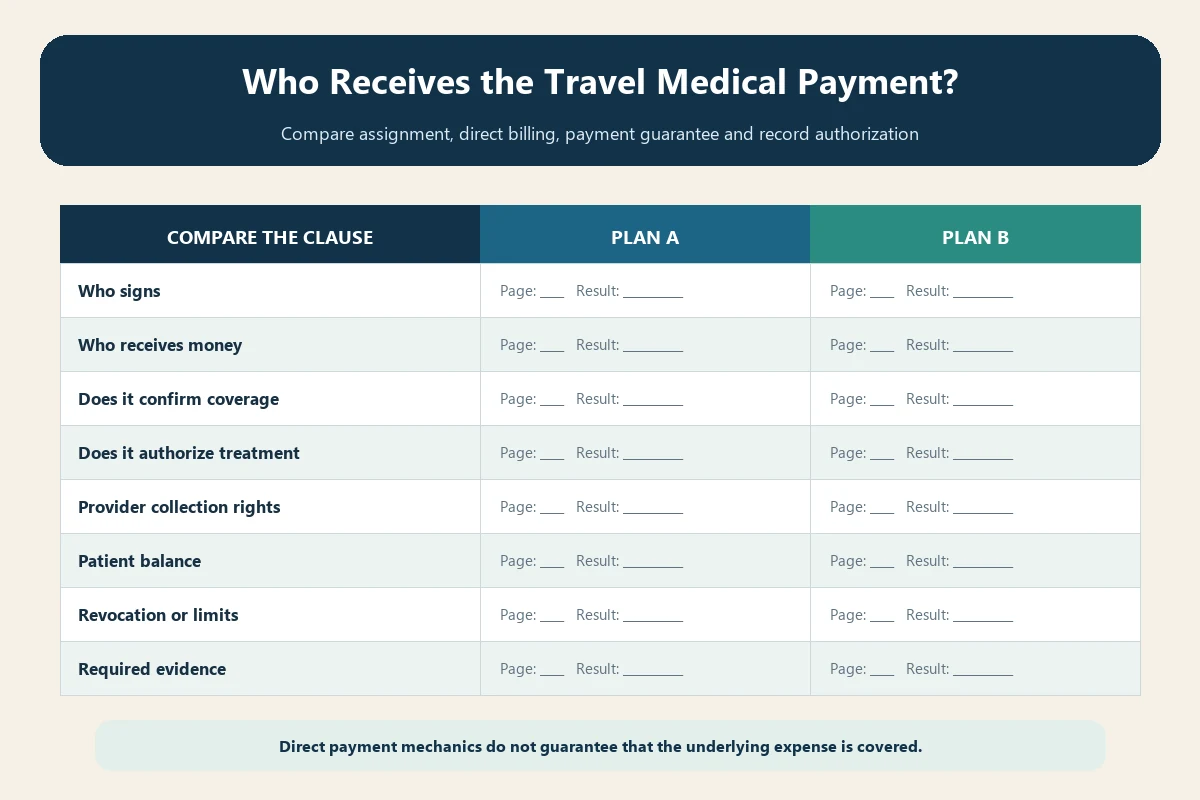
What assignment of benefits means
An assignment of benefits, often shortened to AOB, is an agreement that can transfer or direct specified insurance benefits or payment rights to a provider or other assignee. Some forms only authorize direct payment. Others add authority to submit records, communicate, appeal, collect, or endorse a check.
Never rely on the title alone. Read every operative clause, referenced attachment, signature block, and incorporated provider term before authorizing payment rights. A sentence assigning “all rights and benefits” is broader than a direction to pay one identified hospital invoice up to the approved amount.
What it does not prove
An assignment does not establish that the event is covered, the treatment is medically necessary, the provider’s full charge is eligible, or the policy limit is sufficient. The insurer still applies exclusions, deductible, coinsurance, reasonable-charge provisions, preauthorization, other insurance, and documentation requirements.
The provider can retain a balance even after accepting assignment, depending on contract and law. Ask whether it agrees to wait for the claim, accept the insurer’s payment as partial or full satisfaction, or bill the patient for any remainder.
Assignment versus direct billing
Direct billing means the provider sends an invoice to the insurer or assistance company rather than requiring the traveler to pay first. It may happen without a formal assignment, and an assignment does not force the insurer or provider to create a direct-billing arrangement.
Our travel medical direct-billing guide explains the operational workflow. Confirm which entity receives the invoice, whether the case is only “on file,” and whether the patient must pay a deposit.
Assignment versus guarantee of payment
A guarantee of payment is a statement or commitment to a provider, usually issued after assistance review and subject to terms. It can specify an approved service, amount, period, or conditions. A member card or policy certificate is not itself a payment guarantee.
Ask for the guarantee reference, recipient, covered amount, excluded charges, expiration, and update process. Verify that the hospital credit office—not only the treating clinician—received and accepted it.
Assignment versus medical authorization
A medical-record authorization permits disclosure of described health information to stated recipients. It does not necessarily transfer the right to insurance money, settle the claim, or authorize a provider to appeal. Conversely, an AOB may contain privacy language but still fail to satisfy a provider’s release requirements.
Review the separate fields in our medical records authorization guide. Avoid signing duplicative forms without understanding which party needs each one.
Assignment versus power of attorney
A power of attorney can authorize an agent to act for the principal within its scope. An AOB directs specified benefits or rights. Neither term should be used casually as a substitute for the other. A broad provider form may include agency language that deserves review.
Authority can be affected by incapacity, death, state law, and form requirements. For serious injury, deceased travelers, minors, or disputed authority, obtain qualified advice.
Fields to review before signing
- patient, provider, policy, claim, and service dates;
- benefits, invoices, and dollar amount covered by the assignment;
- right to submit, negotiate, appeal, sue, settle, or receive records;
- whether the assignment is revocable and how;
- expiration or completion event;
- provider collection rights against the patient;
- refund and overpayment duties;
- attorney-fee, lien, venue, arbitration, or governing-law terms;
- permission to endorse checks or access payment information; and
- redisclosure of medical and financial information.
Blank amounts, open-ended providers, unrelated services, or handwritten changes should be resolved before signature. Keep the final signed copy, every attachment, delivery confirmation, and any later amendment or revocation notice.
Foreign hospital complications
A foreign provider may not recognize a U.S. travel policy or assignment form. Local law, language, billing practice, and banking rules govern its process. The hospital can require payment or a local guarantee even when the traveler signs an AOB.
Ask the assistance company whether it has a network relationship, can issue a guarantee, or needs a specific provider form. Preserve the original-language agreement and obtain an accurate translation for material terms.
Provider deposits
A hospital may collect a deposit while direct billing is arranged. The final ledger should show the deposit, insurer or assistance payment, contractual adjustment, patient responsibility, and refund. Do not assume the hospital automatically returns a deposit after receiving insurance money.
Request the refund method and expected date. When a credit posts later, report it under our later refund and recovery guide.
Primary and secondary insurance
An assignment to a travel insurer does not erase another payer’s priority. Medicare, Medicare Advantage, employer coverage, or another plan may need to process the expense first. The provider can also assign or bill different payers under different forms.
Obtain the first payer’s EOB and match it to the provider ledger. Use our EOB guide. Prevent duplicate payment by telling each payer and the provider about the others.
Partial payment and remaining balance
If the insurer pays less than the provider’s bill, identify whether the difference is deductible, coinsurance, excluded treatment, charge allowance, policy limit, currency, missing proof, or a provider accounting error. An assignment does not decide who ultimately bears the balance.
Use our partial claim payment audit. Ask the provider to pause collection while a documented correction or appeal is pending, but do not assume it must agree.
Checks with multiple payees
A claim check can name the traveler and provider jointly. Endorsement, deposit, replacement, or disagreement can then require both parties’ cooperation. Verify the payee wording and do not sign another person’s name.
If the provider has already been paid or released the balance, send the final ledger to the insurer and request corrected payee instructions. Protect the check from expiration while the issue is resolved.
Appeal rights
A broad AOB may purport to transfer appeal or legal rights, while another form leaves them with the insured. Ask who can challenge a denial, receive notices, settle, and meet deadlines. Ensure the traveler receives copies of every decision and submission.
If the provider appeals, coordinate facts to avoid inconsistent positions. Use the travel insurance appeal workflow and preserve any legal-action deadline independently.
Revocation and cancellation
Whether an assignment can be revoked depends on its terms and law, including actions already taken in reliance. Do not cross out or revoke a form informally and assume the change is effective. Send any permitted revocation through the required channels to provider and insurer and obtain confirmation.
Revocation does not erase valid charges, prior payments, or records already disclosed. It can also disrupt a pending direct-billing arrangement.
Recovery and overpayment
If the provider receives payment from the traveler and insurer for the same balance, request a ledger and refund. If another health plan later pays, every party needs the revised EOB and account. The assignment may include duties to return overpayments.
Do not let the provider, patient, and insurer each assume another party reconciled the account. Use a line-level table.
Secure payment and identity handling
Confirm any bank instructions using known contact information. Fraudsters can impersonate hospitals or claim administrators and redirect international transfers. Do not email full bank credentials, passport copies, and medical records to an unverified address.
Keep separate copies of the AOB, guarantee, authorization, invoice, EOB, payment confirmation, and final ledger. The foreign medical bill guide provides the packet order.
Questions for the insurer and provider
- Do you accept this assignment, and for which benefit and invoice?
- Is direct billing active or only requested?
- Has a guarantee of payment been issued and accepted?
- What can the provider do besides receive payment?
- Who receives decisions and controls appeals?
- Can the patient still be billed, and for what?
- How are deposits and overpayments refunded?
- What happens if another insurer pays later?
FAQ
Does signing an AOB mean I owe nothing?
No. Coverage limits, deductibles, exclusions, allowed charges, and provider terms can leave a balance.
Is an insurance card a guarantee of payment?
No. It identifies coverage but does not promise a specific provider payment.
Can I revoke an assignment?
Possibly, depending on the form, law, and action already taken. Obtain written guidance before changing it.
Is direct billing better than reimbursement?
It can reduce upfront cash needs, but it requires provider cooperation and clear account reconciliation.
Bottom line
Assignment of benefits can redirect payment or claim rights, but it does not create coverage or erase patient responsibility. Distinguish assignment, direct billing, guarantee of payment, medical authorization, and power of attorney. Review scope before signing and reconcile every provider, payer, deposit, refund, and remaining balance.
Sources
- Florida Department of Financial Services — Assignment of Benefits
- American College of Emergency Physicians — Assignment of Benefits
- eCFR — HIPAA Authorizations
- U.S. Department of State — Insurance Coverage Overseas
- NAIC — What to Know About Travel Insurance
- California Department of Insurance — Travel Insurance Guide
Reviewed August 16, 2026. This article is general educational information, not legal, medical billing, or coverage advice. Assignment rules vary by contract and jurisdiction.
