

A travel insurance arbitration default hearing may proceed when a properly notified party does not appear or participate, but absence does not automatically prove the claim, defense, or requested damages. The appearing party still needs sufficient, reliable evidence, and the arbitrator determines whether the proceeding can fairly continue.
The arbitration agreement, current provider rules, case orders, notice history, and applicable law control. This U.S. consumer guide provides general information, not legal advice. “Default,” failure to answer, failure to appear, withdrawal, and participation under objection can have different consequences.
Identify the type of nonparticipation
Determine whether the party failed to answer, missed a preliminary conference, stopped exchanging information, failed to attend the final hearing, lost connection temporarily, withdrew a claim, or never received effective notice. Do not use “default” as a label for every missed act.
Build a chronology from demand, service, answer deadline, appointments, orders, communications, exchange, postponement requests, hearing invitations, reminders, and the actual event. The procedural posture determines the next authorized step.
Read the governing absence rule
Current AAA Consumer Arbitration Rules state that, unless law provides otherwise, arbitration may proceed when a party or representative received due notice, fails to be present, and fails to obtain a postponement. The award cannot be based solely on default; the attending party must present evidence the arbitrator requires.
Verify the rule edition applicable to the case and any order that defines attendance, virtual access, written appearances, representatives, or documents-only treatment. “May proceed” does not mean every absence must be handled identically.
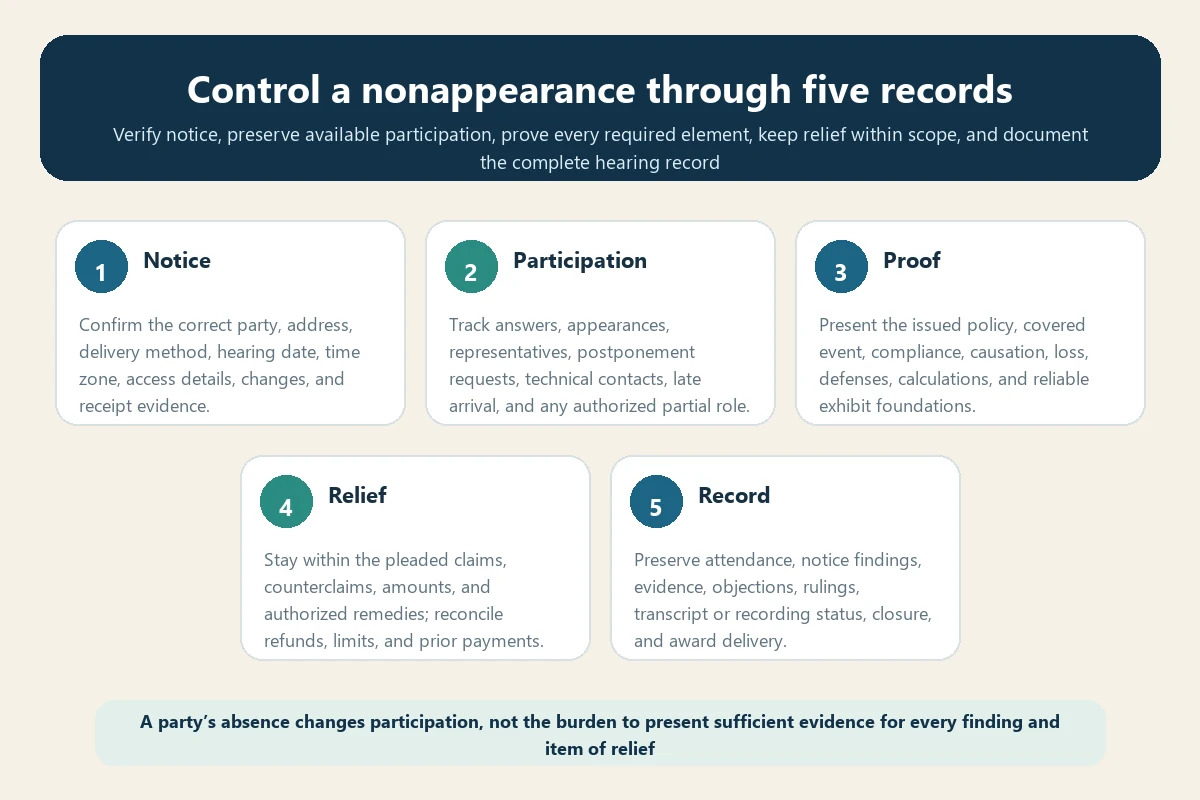
Verify due notice before relying on absence
Create a notice table with recipient, party role, address or portal account, delivery method, sent date, receipt evidence, event date, time zone, access link, telephone backup, language or accessibility accommodation, and every later change.
Check returned mail, bounced email, locked portal access, incorrect counsel status, address updates, calendar corrections, and last-minute orders. A generic proof that “something was sent” may not establish notice of the correct hearing at the correct time.
Separate administrator actions from arbitrator rulings
The administrator can transmit notices, manage files, and report participation status. The arbitrator makes procedural and merits rulings assigned by the rules. Do not ask staff to declare that you won or to decide whether notice was legally sufficient.
The AAA self-represented administration sheet explains the distinction and emphasizes written communications, copying other parties unless directed otherwise, and following deadlines.
Respond promptly if you may be absent
If illness, emergency, travel disruption, interpreter failure, technical problem, or another event threatens attendance, contact the authorized channel immediately. State the event, date learned, material effect, supporting facts, requested relief, available alternatives, and other party’s position if known.
Use the postponement request guide to show good cause and propose dates. A pending request does not cancel the hearing. Continue preparing and attend by any authorized workable method unless an order changes the schedule.
Preserve partial or alternative participation
Ask whether remote video, telephone, a different device, an authorized representative, reordered witnesses, a short recess, written statement, limited continuation, or documents-only submission can protect participation. Confirm that any alternative is permitted before relying on it.
The virtual hearing guide covers identity, attendance, backup channels, platform failure, witnesses, privacy, recording, and technical support.
Prepare to proceed without assuming victory
Bring the same organized case you would present if every party attended. Map the issued policy, insured status, covered event, exclusions, notice, compliance, causation, mitigation, nonrefundable loss, other recoveries, limits, deductible, and requested remedy.
| Required finding | Primary proof | Control question |
|---|---|---|
| Applicable contract | Certificate, declarations, issued form | Is this the correct version and date? |
| Covered event | Carrier, provider, physician, or authority record | What event caused the loss? |
| Compliance | Notice, portal receipt, claim records | Were conditions and deadlines met? |
| Amount | Invoice, payment, refund, credit records | What net loss remains? |
| Defense | Denial letter, policy clause, counterevidence | How is the strongest defense resolved? |
| Relief | Reconciled calculation and authority | Is each requested item authorized? |
Do not replace missing proof with “the other side did not deny it at the hearing.” Pleadings, attachments, exchanged files, admitted evidence, and testimony can have different statuses.
Use reliable exhibits and foundations
For each exhibit, identify source, date, completeness, authenticity, relevant pages, policy issue, and witness or record basis. Preserve full email chains, attachments, original-language materials, translations, and payment histories.
Coordinate the arbitration exhibit list with the evidence objections guide. An exchanged or uploaded document does not become admitted merely because no one appears to object.
Present witness testimony clearly
Establish identity, personal knowledge, chronology, referenced documents, and the fact each answer supports. Avoid speculation and legal conclusions. The arbitrator may ask questions even when no opposing cross-examination occurs.
Follow the witness testimony guide for examination structure, preparation, oath, interpreters, remote settings, corrections, and credibility controls.
Stay within the pleaded scope
Nonappearance is not permission to add a new claim, increase damages, change the policy theory, or seek relief never disclosed. Compare the demand, amendments, answer, counterclaims, scheduling order, and final request.
If a correction or amendment is necessary, seek authorization and notice through the governing process. Do not surprise an absent party with a larger demand that was never served.
Reconcile damages line by line
Use a table for traveler, vendor, charge date, currency, original amount, refund, credit, third-party recovery, claimed balance, limit, deductible, and exhibit citation. Explain the exchange-rate source and date when relevant.
Remove refunded, refundable, duplicated, unsupported, or excluded amounts. Identify authority separately for interest, costs, fees, or nonmonetary relief. An unopposed spreadsheet still needs traceable inputs.
Address known defenses fairly
The arbitrator may have the answer, denial letter, or prior submissions even when the respondent is absent. Identify the strongest coverage defense and explain why the policy and evidence resolve it. Do not pretend it disappeared with the party.
Distinguish admissions, denials, insufficient-knowledge responses, affirmative defenses, jurisdiction objections, and counterclaims using the arbitration answer guide.
Handle late arrival or restored connection
Record when the participant joined, why they say access failed, what occurred in their absence, and the arbitrator’s directions. Do not privately decide that the late party has forfeited all participation.
Possible rulings include a recess, summary of prior procedural events, renewed question, limited recall of a witness, continuation, acceptance of a written response, or proceeding without repeating completed evidence. The arbitrator controls fairness and efficiency.
Protect against unauthorized private communication
Continue copying all parties on merits communications as required, even when one is silent. Do not send a private argument to the arbitrator because the other party missed the hearing. Follow the case channel for questions and supplemental material.
Settlement communication, privileged advice, and protected data remain subject to their own controls. Absence does not waive every confidentiality or privilege interest.
Record attendance and procedural findings
The hearing record should identify start time, appearances, representatives, notice reviewed, attempts to contact the missing party, postponement status, arbitrator ruling, evidence presented, objections, exhibit rulings, breaks, late arrival, closure, and any supplemental deadline.
Use the hearing transcript guide to distinguish an authorized recording, reporter transcript, rough feed, and official record. Do not create a private recording without permission.
Do not confuse AAA absence with FINRA default procedure
FINRA’s Customer Code includes both a failure-to-appear rule and a specialized default procedure for defined inactive or barred industry respondents. That specialized securities process does not govern an AAA travel insurance dispute merely because someone uses the word “default.”
Use the exact forum, agreement, rule set, party type, and case posture. Never copy default forms or deadlines from another provider without authority.
Track record closure and the award
Confirm whether the record closes at the end of the hearing or remains open for a requested document, calculation, brief, or notice response. Do not submit new evidence after closure without authorization.
When the award arrives, verify parties, claims, relief, amounts, dates, delivery, corrections, payment duties, and any permitted next step using the arbitration award guide.
If you discover an award after missing the hearing
Preserve the envelope, email headers, portal history, notice records, address changes, technical logs, medical or emergency documentation, orders, hearing record, and award. Record when and how you first learned of each event.
Deadlines for corrections, court applications, or other remedies can be short and jurisdiction-specific. Obtain legal advice promptly. Do not assume that nonattendance automatically voids the award or that reopening is available.
Avoid common default-hearing mistakes
- Treating every missed deadline as a default hearing.
- Assuming sent notice proves receipt of the correct event details.
- Believing absence creates an automatic win.
- Using unadmitted uploads as if they were evidence.
- Skipping known defenses because the respondent is absent.
- Increasing damages or adding relief without authorization.
- Sending private merits communications to the arbitrator.
- Ignoring late arrival or restored technical access.
- Failing to preserve attendance and notice findings.
- Importing a specialized default rule from another forum.
Final default hearing checklist
- Identify the exact form of nonparticipation and case posture.
- Verify due notice, correct recipients, date, time zone, and access.
- Preserve postponement requests and alternative participation.
- Obtain the arbitrator’s ruling on whether to proceed.
- Present sufficient proof for every required finding.
- Authenticate exhibits and establish witness knowledge.
- Address known defenses and reconcile damages.
- Keep relief within the pleaded and authorized scope.
- Record attendance, evidence, rulings, and closure.
- Verify award delivery and act promptly on any next step.
A fair default hearing is still an evidence hearing. Verify notice, protect any available participation, prove the contract and loss, address the known defense, request only authorized relief, and preserve a record that shows the award rests on evidence rather than absence alone.
