
If a travel insurance claim 1099 was not received, first determine whether the payer says an information return was required and issued. Rebuild the gross payment, identify the legal payer and recipient, confirm the form type and tax year, check delivery records, and request a replacement recipient statement through a verified channel.
Do not assume that every travel insurance payment produces a Form 1099, that no form means no tax issue, or that a prior W-9 request guarantees a form. Tax treatment can depend on what the payment replaces, who received it, prior deductions, interest, business context, settlement terms, and other facts. This guide is general U.S. information, not tax, legal, accounting, or insurance advice.
Start with the claim payment, not the missing envelope
Create a ledger for the underlying payment. Record the policy number, claim number, benefit, claimed amount, approved amount, deductible, offsets, interest, gross disbursement, withholding, fees, currency, payment method, payee, issue date, and date funds became available.
| Question | Record to obtain | Why it matters |
|---|---|---|
| What was paid? | Claim decision and benefit calculation | Identifies the underlying transaction |
| Who paid it? | Legal disbursing entity | The brand may not be the tax filer |
| Who received it? | Payee and taxpayer record | Claimant and recipient can differ |
| When was it paid? | Check, ACH, card, or wire record | Tests the expected tax year |
| Was tax withheld? | Gross-to-net payment advice | May identify an expected form |
| Was a form issued? | Payer tax-document status | Separates missing delivery from no filing |
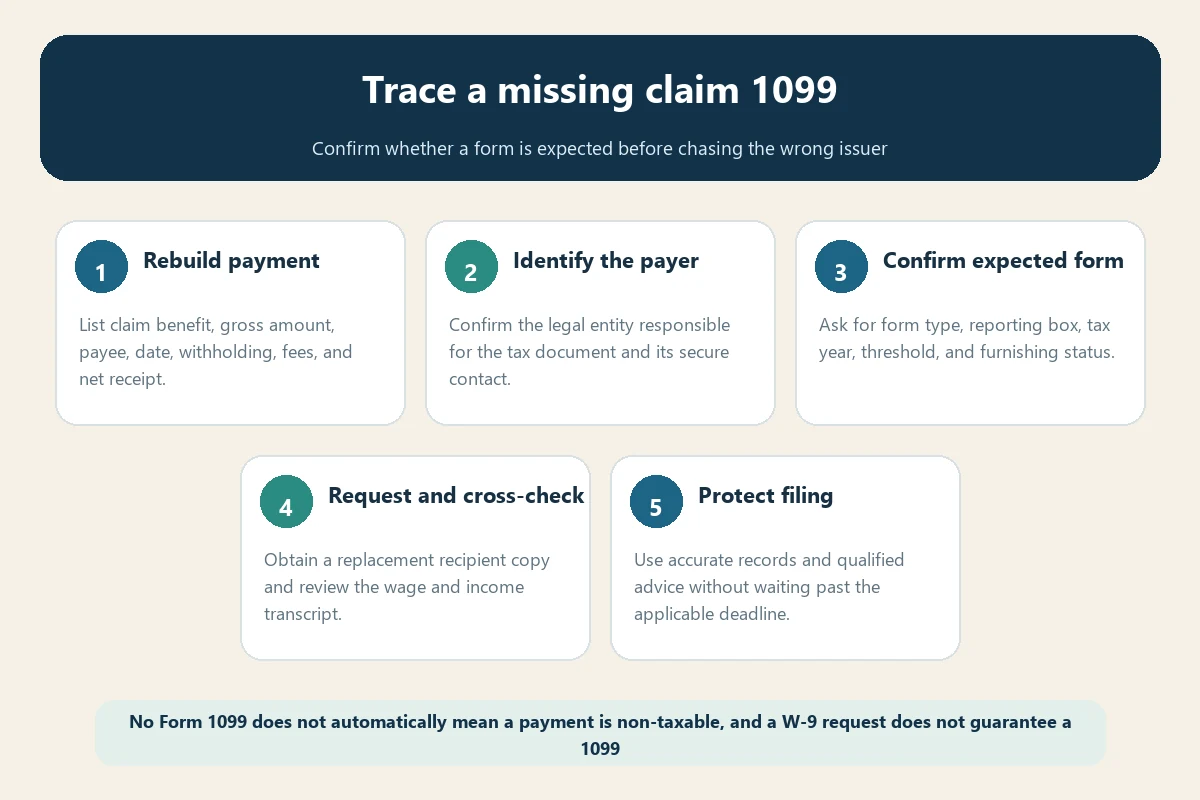
Determine whether a Form 1099 is actually expected
A travel policy can pay trip cancellation reimbursement, medical expense, baggage value, delay benefits, accidental death benefits, provider charges, settlement proceeds, interest, attorney-related amounts, or another category. These payments do not automatically share one information-reporting rule.
Ask the payer whether it considers any component reportable, which form and box it selected, the gross amount, recipient, reporting year, and reason. The IRS guide to information returns lists many common forms and directs users to form-specific instructions, but it is not a substitute for analyzing the actual claim payment.
A W-9 request does not guarantee a 1099
Form W-9 supplies a U.S. payee’s taxpayer identification information and certifications. A company may collect it during vendor, settlement, or claims processing even when the later reporting outcome depends on payment type, amount, recipient, and other rules.
Use the travel claim W-9 request guide to confirm the requester, purpose, payee, and secure delivery route. Preserve the submission receipt, but do not treat it as proof that a particular 1099 was filed.
Identify the legal payer and tax-document team
The insurer’s consumer brand, policy underwriter, third-party administrator, settlement company, bank, attorney, or payment vendor may use different legal names. The claims portal may show only the administrator while another entity is responsible for tax reporting.
Ask for the legal payer name, payer TIN ending, tax-document department, secure portal, and phone number. Verify contact details independently. Do not send a Social Security number or full tax form to an address found only in an unsolicited message.
Check electronic and paper delivery
Search the claims portal, insurer account, payment-vendor portal, secure message center, and tax-document section. Review email for a notice that an electronic statement is ready, including spam and archived folders, but avoid unexpected sign-in links. Navigate independently to the verified portal.
For paper delivery, confirm the address used, apartment number, forwarding order, returned-mail status, and mailing date. Ask whether the statement was furnished electronically with prior consent, mailed, or suppressed because the payer determined no form was required.
Confirm the recipient before requesting a duplicate
The traveler, claimant, policyholder, beneficiary, provider, attorney, business, estate, and bank-account owner can be different parties. A form may have gone to the legal payee or another joint recipient rather than the person who managed the claim.
If the payment had two payees, the two-payee claim check guide addresses endorsement and deposit evidence. Separately ask the payer whose name and TIN it reported and how it allocated the amount.
Match the expected tax year
The trip date, insured loss, claim filing, approval, check issue, ACH initiation, card funding, availability of funds, and reporting year may not match. Ask the payer which event placed the payment in the stated year and obtain its dated payment ledger.
A check that expired and was reissued can create a confusing timeline. The expired claim check reissue guide helps preserve issue, void, stop-payment, and replacement evidence without deciding the tax year.
Reconcile gross payment, withholding, and net receipt
A missing form is especially important when the payment advice shows federal or state tax withheld. Compare the approved gross amount with withholding, non-tax fees, currency conversion, and the actual bank credit. Request the form type and box where withholding was reported.
The claim payment tax withholding guide explains how to verify the tax type, base, rate, payee, and information return. Use the payment fee deduction guide to keep bank or processing charges out of the tax calculation.
Send a precise replacement-form request
Contact the payer or issuing agency and ask for a replacement recipient copy. Current IRS guidance tells taxpayers missing tax documents to contact the employer, payer, or issuing agency. See the official IRS page on missing tax documents.
Your written request should include:
- claim and payment references;
- legal recipient name and masked TIN;
- gross payment, withholding, and payment date;
- tax year and form type you were told to expect;
- current verified mailing or portal details;
- a request for the issue and delivery date;
- a request for a secure replacement statement; and
- a case number and response deadline.
Do not ask the payer to email an unprotected tax form. Use its authenticated portal, encrypted delivery, or verified mailing process.
Distinguish a replacement from a correction
If the payer says the filed form is accurate but the recipient copy was lost, request a duplicate or replacement copy. If the payer’s amount, recipient, TIN, form type, box, or year is wrong, a mere duplicate preserves the error.
Use the incorrect travel claim 1099 correction guide when the reported data need correction. Ask whether the payer will update its IRS filing and furnish a corrected recipient statement, not only revise the claim portal.
Use an IRS wage and income transcript carefully
An IRS wage and income transcript can show information reported on Form 1099 series documents. The official IRS Topic 159 explains access through an online account or Form 4506-T.
Transcript timing matters. The IRS notes that current processing-year information may not yet be complete, and a missing transcript entry does not prove that no statement exists or no later filing will appear. See the IRS transcript services FAQ.
Do not let transcript limitations create a false conclusion
A transcript reflects information the IRS received; it does not determine whether the travel claim was correctly characterized or taxable. It may omit state information, lag payer corrections, or display a payer name different from the customer-facing brand.
Compare the transcript with the claim decision, payment advice, recipient copy, payer confirmation, and bank records. Protect transcript files because they contain sensitive financial and identity information.
Protect the return filing deadline
Do not wait indefinitely for a missing form. Organize accurate payment records and consult a tax professional about the correct return treatment, an extension where available, and what to do if a later statement differs. The absence of a form does not by itself remove an otherwise applicable reporting obligation.
Likewise, do not invent a form, guess a payer TIN, or copy a procedure intended for a different 1099 type. Form-specific rules matter. Record every contact date and the payer’s promised delivery date so advice can account for the unresolved document.
Handle a form that arrives after filing
Compare a late form with the figures and characterization used on the filed return. If they match, retain the form with the return records. If they differ, ask the payer whether the form is accurate and obtain tax advice about whether an amended federal or state return is required.
Do not automatically amend solely because a document arrived late; first determine whether the filed return was inaccurate. Conversely, do not ignore a material mismatch. Preserve the envelope, portal notice, download timestamp, and payer correspondence to establish when the information became available.
Escalate when the payer will not answer
Escalate from general claims service to the tax-reporting, information-returns, compliance, legal, or executive-resolution team. Send a concise ledger and prior correspondence. Ask the payer to state clearly whether it filed a form, the form type, recipient, amount, year, and replacement method.
If the dispute also concerns claim handling, the NAIC state insurance department directory links to official regulators. Insurance departments generally do not prepare tax returns or retrieve IRS transcripts, so keep the insurance and tax-document issues distinct.
Protect against missing-form scams
A scammer may claim that a tax form, refund, or insurance payment is being held until you pay an IRS release charge or reveal a TIN, bank password, or one-time code. Verify the payer independently and use only its secure channel.
The travel claim payment scam guide covers changed bank instructions, fake tax demands, remote access, and identity theft. A replacement tax document should not require gift cards, cryptocurrency, or a payment to an individual.
Keep a complete missing-form file
Retain the policy, claim decision, gross-to-net calculation, payment proof, W-9 or W-8 receipt, delivery consent, address record, portal screenshots, replacement request, transcript, late or corrected form, filing workpapers, and professional advice.
The final file should show whether a form was expected, which legal entity was responsible, who the recipient was, what amount and year applied, how the replacement was obtained, and how the tax return reconciled the actual payment.
Bottom line
When a travel insurance claim 1099 is not received, rebuild the payment first and ask the legal payer whether it filed an information return. Verify the form type, recipient, year, amount, withholding, and delivery method; request a secure replacement; use transcripts only as a timing-sensitive cross-check; and protect the filing deadline with accurate records and qualified tax advice.