
If a travel insurance settlement with attorney fees produced a 1099, compare the settlement agreement with the law firm’s client ledger before relying on the net check. A payer may issue information returns to the claimant, the attorney, or both, depending on the payment, payees, and reporting rules.
Do not assume that every insurance claim payment is a taxable settlement or that legal fees are automatically deductible. Tax treatment can depend on what the payment replaces, the claims released, allocation, physical injury, business context, interest, and applicable federal and state law. This guide is general information, not tax or legal advice.
Start with the signed settlement agreement
Obtain the final signed agreement, release, claim decision, payment instructions, fee agreement, and closing or disbursement statement. Drafts and email summaries may not contain the final payees or allocation.
| Document field | What to record | Why it matters |
|---|---|---|
| Parties | Insurer, administrator, claimant, counsel | Identifies payer and recipient roles |
| Claims released | Policy, contract, damages, interest | Supports payment characterization |
| Gross settlement | Total obligation before deductions | Starting point for reconciliation |
| Payees | Claimant, attorney, provider, lienholder | Explains checks and information returns |
| Allocation | Benefit, damages, interest, fees, costs | Separates distinct components |
| Tax language | Reporting promises and disclaimers | Shows payer intent but not final liability |
Map the gross settlement to the client distribution
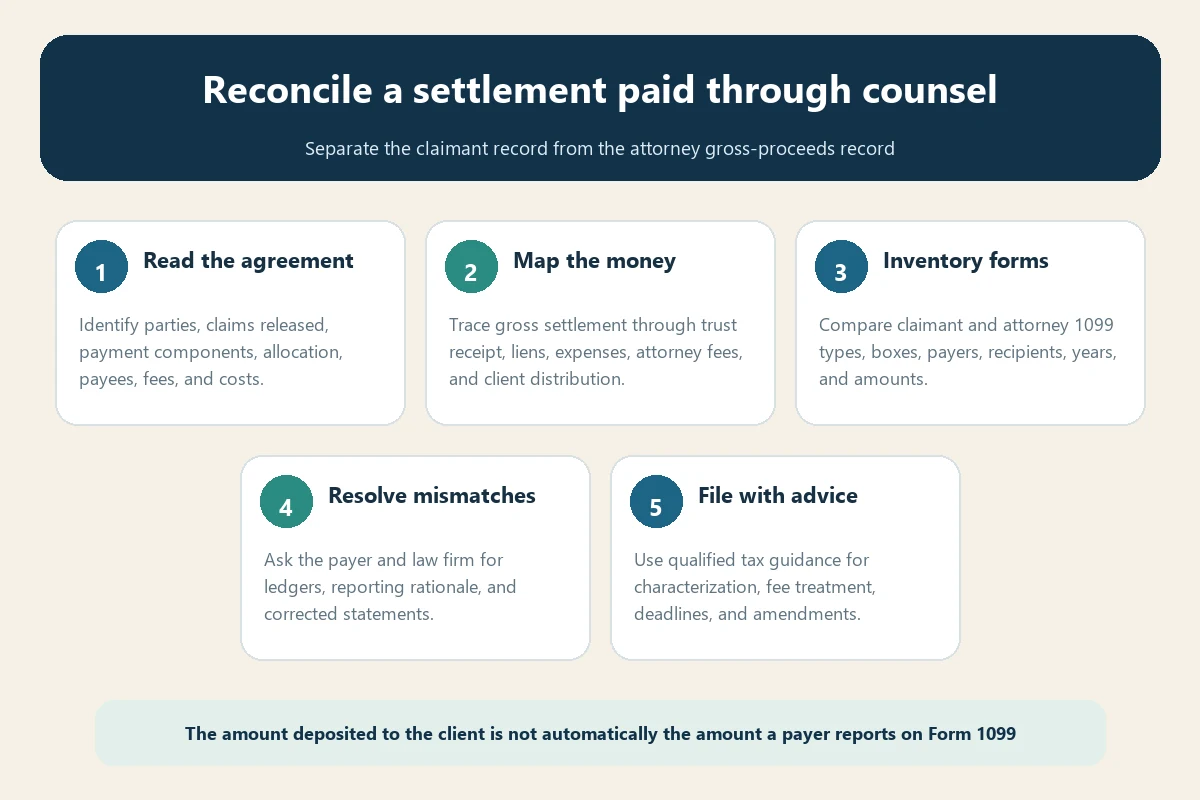
Create a line-by-line equation: gross settlement received by the law firm, less medical or other liens, reimbursed litigation costs, attorney fee, withholding, and other authorized deductions, equals the amount distributed to the client. Include any direct payments the insurer made outside the trust account.
The net amount deposited to the claimant is not necessarily the amount an information return reports. It is only one line in the money trail. Obtain trust receipt, settlement check, deposit confirmation, client ledger, invoices, and distribution proof.
Separate policy benefits from a legal settlement
A routine policy reimbursement can become part of a broader negotiated resolution involving disputed benefits, interest, penalties, contractual claims, or other allegations. The agreement should identify what the payer intended each amount to resolve.
IRS guidance on settlements and judgments emphasizes the nature and origin of the claim and the payer’s intent. A label such as “settlement” or “insurance proceeds” alone does not settle the tax analysis.
Understand the claimant and attorney records
The current IRS Instructions for Forms 1099-MISC and 1099-NEC distinguish attorney fees for legal services from gross proceeds paid to an attorney in connection with legal services. Gross proceeds may be reported to the attorney even when the attorney is not the ultimate owner of all funds.
The same instructions give an example in which an insurance company pays a claimant’s attorney to settle a claim and reports gross proceeds to the attorney. They also explain that other reporting may apply to the claimant. Therefore, two forms do not automatically mean the settlement was paid twice.
Form 1099-MISC box 10 is not the attorney’s net fee
Box 10 can report gross proceeds paid to an attorney, which may include money held for and later distributed to a client. It should not be read as proof that the entire box is the law firm’s fee income.
Compare the attorney’s recipient statement with the trust ledger and fee invoice. The claimant should separately compare any form issued under the claimant’s TIN with the agreement and tax advice.
One joint check can produce more than one form
A settlement check may name the claimant and attorney together or be payable only to the law firm’s trust account. Check endorsement and deposit mechanics do not determine the claimant’s federal tax result.
The two-payee claim check guide helps document payees, endorsements, deposit restrictions, and replacement. Add the settlement ledger and information-return analysis as separate layers.
Compare every tax form field
Inventory each Form 1099 by payer name and TIN ending, recipient and masked TIN, form type, account number, tax year, populated boxes, federal and state withholding, and corrected status. Include forms delivered to both claimant and law firm.
Use the duplicate claim 1099 guide if two statements appear to report the same amount. Similar totals can represent claimant reporting and attorney gross proceeds rather than duplicate filing.
Reconcile legal fees and litigation costs separately
The fee agreement should state hourly, flat, contingent, statutory, or other compensation and identify responsibility for costs. The client ledger should distinguish attorney fees from court filing, expert, records, travel, copying, and other expenses.
Do not assume the tax return allows a deduction for every amount withheld by counsel. IRS Publication 525 discusses taxable and nontaxable income and certain attorney-fee issues, but individualized treatment depends on the underlying recovery and current law.
Interest may require its own reconciliation
A settlement can include prejudgment, post-judgment, delayed-payment, or negotiated interest. Ask whether interest is separately stated and whether another form or box reports it.
Do not allocate interest merely by comparing the net check with the settlement headline. Obtain the payer’s calculation and match it with the agreement, law firm ledger, and information returns.
Check withholding against gross and net figures
If the payer or law firm withheld federal, state, foreign, or backup tax, identify the authority, rate, base, recipient, deposit, and tax-form box. Do not treat a trust-account deduction or lien as tax withholding.
The claim tax withholding guide explains gross-to-net reconciliation. A missing or mismatched withholding box needs prompt correction because the claimant may rely on the credit.
Verify W-9 requests and taxpayer identity
The payer may request Forms W-9 from the claimant and attorney before issuing settlement checks. Each request should be tied to a verified legal entity, payee role, and secure delivery channel.
Use the claim W-9 verification guide. Do not email a full Social Security number through ordinary correspondence or substitute the law firm’s TIN for the claimant’s without documented authority.
Ask the payer for its reporting rationale
Contact the insurer or settlement payer’s tax-reporting team. Provide the settlement reference and a field-by-field form comparison. Ask the payer to identify the transaction and legal recipient behind each form.
Request written confirmation of:
- gross settlement and each allocated component;
- every check or transfer, payee, and date;
- the claimant’s form, box, amount, and tax year;
- the attorney’s form, box, amount, and tax year;
- federal and state withholding;
- any reporting agent acting for the insurer;
- whether a correction is required; and
- when corrected recipient statements will be furnished.
Ask the law firm for a closing package
The law firm should be able to provide the signed fee agreement, settlement statement, trust ledger, settlement check or transfer record, lien payments, expense detail, fee invoice, client distribution, and forms it received or issued.
Compare the gross trust receipt with the insurer’s payment record. If the law firm’s ledger begins with a different amount, identify any direct payment, withheld sum, prior advance, or separate check.
Correct the right record
If the payer used the wrong recipient, TIN, form, box, amount, or year, a revised client ledger alone will not correct the payer’s IRS filing. Ask for the actual information-return correction and a corrected recipient statement.
The incorrect claim 1099 guide explains the evidence needed. Keep original and corrected forms because they establish the reporting sequence.
Use IRS transcripts as a cross-check
An IRS wage and income transcript can show information-return data reported under the claimant’s taxpayer record. The official IRS Topic 159 explains transcript access.
Compare payer, form, year, and amount, but remember that current-year data and corrections can lag. The law firm’s own recipient statement generally will not appear on the claimant’s transcript when it uses the attorney’s TIN.
Protect the tax return deadline
Do not wait indefinitely for the insurer or attorney to reconcile a mismatch. Give a qualified tax professional the agreement, release, fee contract, client ledger, all forms, bank records, transcripts, and correction correspondence.
Ask how to characterize the recovery, handle legal fees and costs, claim valid withholding, file accurately by the deadline, and amend if a later correction changes a filed return. Do not copy a tax entry from an unrelated settlement example.
Watch for settlement and tax-release scams
A scammer may impersonate counsel or the insurer, change trust-account instructions, demand a tax-release fee, or ask for remote banking access. Independently verify wire instructions and tax requests using known contacts.
The claim payment scam guide covers changed bank instructions, gift cards, cryptocurrency, one-time codes, and identity theft. A legitimate Form 1099 correction does not require paying an individual to unlock settlement funds.
Keep one permanent settlement file
Retain the policy, pleadings or demand, agreement, release, fee contract, payer ledger, trust ledger, settlement checks, lien payments, expenses, client distribution, W-9 receipts, original and corrected forms, transcripts, tax returns, and advice.
The final file should trace every dollar from the payer’s gross obligation through counsel’s account to the claimant and show why each information return was issued.
Bottom line
When a travel insurance settlement is paid through an attorney, reconcile the gross agreement—not only the client’s net check—with every 1099. Separate claimant reporting from attorney gross proceeds, document fees, costs, liens, withholding, and distributions, correct payer errors, and obtain qualified advice for the underlying recovery.
