
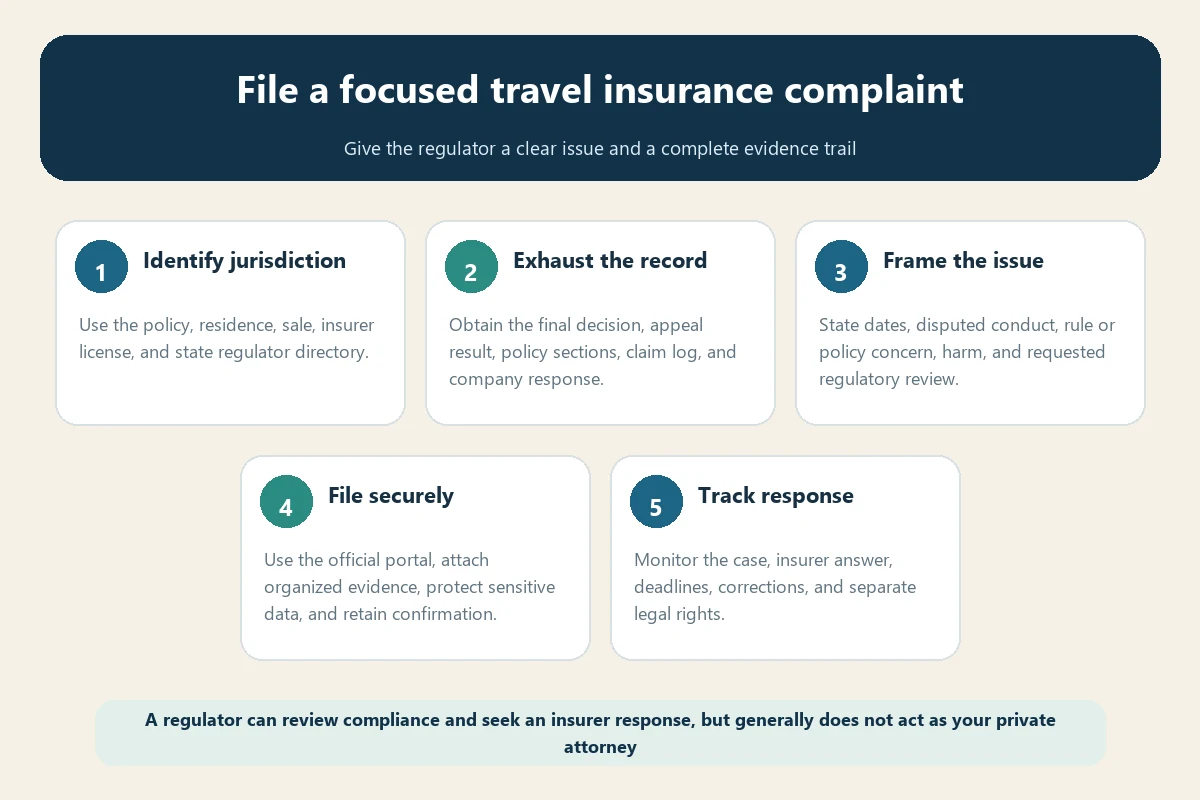
To file a travel insurance complaint with a state insurance department, identify the correct jurisdiction and licensed insurer, obtain the final claim or appeal decision, organize the policy and evidence, describe the disputed conduct with dates, and request a specific regulatory review through the official portal.
A regulator complaint is not the same as an internal appeal, lawsuit, arbitration, chargeback, airline complaint, or fraud report. State insurance departments can review insurer and producer compliance, obtain responses, and investigate regulatory concerns, but they generally do not serve as the claimant’s private attorney. This guide is general information, not legal advice.
Decide whether the issue belongs with an insurance regulator
Use the policy and transaction to identify the actor. Travel protection can involve a licensed insurer, producer, administrator, assistance company, booking platform, airline, cruise line, hotel, credit-card issuer, or non-insurance waiver.
| Issue | Likely first route | Record to preserve |
|---|---|---|
| Claim denial or delay | Insurer appeal, then insurance regulator | Decision, policy, claim log |
| Misrepresentation at sale | Insurer or producer, then regulator | Quote, advertisement, receipt |
| Airline refund | Carrier, then applicable travel authority | Ticket, cancellation, refund request |
| Card benefit administration | Benefit administrator and issuer | Benefit guide and card statement |
| Identity theft or scam | Financial institution and law enforcement | Messages, transaction, account record |
| Legal damages or limitation deadline | Qualified attorney | Complete chronological file |
Identify the licensed insurance company
The brand on the website may not be the insurer that issued the policy. Check the declarations, certificate, schedule, policy footer, claims decision, and state-required notices for the underwriting company’s legal name and NAIC number if shown.
Also record the producer, administrator, plan sponsor, and assistance provider. A complaint naming only a booking brand can be delayed while the regulator identifies the licensed entity.
Choose the correct state or jurisdiction
Travel insurance can connect to the purchaser’s residence, policy delivery, point of sale, licensed producer, insurer domicile, and trip. Do not assume the destination state or insurer headquarters is automatically the right regulator.
Use the NAIC state insurance department directory to locate official regulators and complaint portals. If jurisdiction is unclear, ask the consumer-services unit where to file and whether it will transfer the matter.
Use the official regulator portal
Navigate from the regulator’s government website rather than an advertisement or complaint-service intermediary. Verify the domain, privacy notice, file limits, accepted formats, signature requirement, and confirmation process.
Some state agencies accept online, mail, fax, phone, or in-person complaints, but evidence submission and status tracking differ. Keep the official case number and a complete copy of everything submitted.
Complete the insurer’s internal process first when practical
Send the insurer a focused written request for reconsideration or appeal and ask for a final response. This gives the regulator the company’s position and shows which dispute remains unresolved.
The denied travel claim appeal guide explains how to map evidence to policy language. The broader travel insurance claim filing guide helps confirm that the original submission and delivery record are complete. Do not delay a regulatory complaint when a statutory, policy, or lawsuit deadline is near; obtain legal advice about timing.
Obtain the complete claim record
Collect the policy, certificate, schedule, purchase confirmation, application, advertisements relied on, claim form, document requests, submissions, acknowledgments, adjuster notes available to you, decision, appeal, payment, and correspondence.
Create a document index with dates and short descriptions. Regulators can understand a 200-page file faster when the complaint points to the exact exhibit supporting each statement.
Build a one-page chronology
List the insurance purchase, trip and loss, notice, claim submission, each major document request, complete-file date, decision, appeal, final response, payment, and complaint date. Use objective dates and quote short policy phrases only where necessary.
Separate delay caused by the claimant, supplier, medical provider, administrator, and insurer. A precise chronology is stronger than saying the company “ignored everything for months.”
Frame the complaint as a reviewable issue
State what the company did, when it did it, which policy provision or regulatory duty appears relevant, what evidence contradicts the response, and what review you request. Avoid accusing individuals of crimes without evidence.
Examples include an unexplained denial, failure to address appeal evidence, repeated requests for already supplied documents, inaccurate payment calculation, misleading sales representation, unlicensed activity, privacy concern, or failure to provide required notices.
Distinguish a coverage disagreement from claim handling
A regulator may examine whether the insurer applied the issued contract and complied with state insurance law. It may not be able to rewrite unambiguous coverage, resolve every factual dispute, award punitive damages, or determine complex private legal rights.
Explain both the coverage position and the process concern. For example: the insurer cited an exclusion but did not address the exception language or medical evidence submitted on appeal.
Compare the company’s stated basis with the documented patterns in the travel insurance claim denial guide. Cite only the reason and evidence that actually apply to your policy rather than submitting a generic list of objections.
Quote the policy accurately
Identify the policy form number, state endorsement, edition date, benefit, definition, exclusion, limitation, proof-of-loss condition, appeal clause, and applicable page. Attach the complete policy rather than a cropped screenshot.
Do not quote marketing language as if it replaces the contract. If advertising influenced the purchase, include it as a separate sales-practice exhibit and explain the reliance.
Describe the remedy carefully
Ask for realistic regulatory action: obtain and evaluate the insurer’s response, review compliance, require a corrected explanation or calculation where warranted, confirm licensing, or investigate a pattern. State the disputed dollar amount separately.
If the dispute concerns a deduction from an approved benefit, preserve the itemized calculation and use the claim payment fee guide to separate an authorized policy reduction from an unexplained charge.
Do not demand that the regulator act as a court, impose a particular penalty, or represent you. Preserve private remedies and consult counsel when damages, bad faith, contractual limitation periods, or litigation are involved.
Attach evidence in a useful order
Create a cover index and use clear filenames such as 01-policy.pdf, 02-claim-decision.pdf, 03-appeal.pdf, and 04-final-response.pdf. Combine related pages without exceeding the portal’s file limits.
Highlight or annotate copies sparingly. Never alter the original evidence. Keep source files, metadata, and delivery confirmations in a separate archive.
Protect medical and identity information
A complaint may require policy, health, financial, or identity records. Follow the official portal’s instructions and redact unrelated account numbers, passwords, full card data, or third-party information when permitted.
Do not upload one-time codes, banking credentials, or complete identity documents unless the regulator specifically requires them through a secure route. Ask how confidential medical exhibits are handled.
Use a concise complaint narrative
A useful structure is:
- identity of insurer, policy, claim, and jurisdiction;
- one-sentence description of the covered event;
- chronology of claim, decision, and appeal;
- specific unresolved issue;
- policy or regulatory concern;
- key exhibits by filename;
- disputed amount or non-monetary harm; and
- requested regulatory review.
Keep emotional context brief and factual. The complaint specialist needs a reviewable record, not a marketing review or social-media post.
Do not mix unrelated disputes
An airline cancellation, travel-agent refund, insurer denial, credit-card chargeback, and medical billing issue can arise from one trip. Separate each actor, contract, amount, and remedy.
USAGov’s travel complaint directory explains routes for airlines, hotels, travel agencies, and other travel businesses. Use the insurance regulator for the insurance conduct within its jurisdiction.
For a dispute involving a non-insurance seller or another local business, the official state consumer protection office directory can identify the appropriate state agency. File separate, accurate narratives when different agencies oversee different actors.
Track the insurer’s regulatory response
Record the complaint number, assigned specialist, filing date, insurer response deadline, extensions, correspondence, and closure. Read the insurer’s answer line by line and identify any missing document or inaccurate factual claim.
Submit a concise rebuttal only when the portal permits and new information materially affects the review. Repeating the original narrative without addressing the answer adds little.
Understand possible outcomes
The insurer may reconsider, pay, request more evidence, correct a calculation, explain the denial, maintain its position, or change a process. The regulator may find no violation, refer the issue, seek additional information, or use complaint data in broader oversight.
A complaint closure does not necessarily determine all private contract or legal rights. Read the closure letter and obtain advice about remaining deadlines and options.
Preserve appeal and lawsuit deadlines
Do not assume a regulator complaint pauses policy deadlines, contractual limitation periods, statutes of limitation, arbitration deadlines, or tax and chargeback time limits. Continue tracking every clock separately.
If a deadline may expire, consult a qualified attorney promptly. A regulator’s consumer-assistance process is not a substitute for legal representation.
Escalate fraud and identity theft separately
If the dispute involves a fake insurer, forged payment, stolen identity, altered bank instructions, or criminal conduct, notify the relevant financial institution and appropriate authorities in addition to the insurance department.
The claim payment scam guide covers evidence preservation, payment recall, credential protection, and verified insurer contact.
Keep a permanent complaint file
Retain the original policy and claim file, chronology, exhibit index, complaint, submission confirmation, regulator correspondence, insurer response, rebuttal, closure letter, payment or correction, and legal advice.
The final file should let another reviewer understand the licensed entity, jurisdiction, disputed conduct, policy language, evidence, regulatory response, outcome, and deadlines.
Bottom line
To file a travel insurance complaint with a state insurance department, choose the correct regulator and licensed insurer, complete the internal record, frame one factual and reviewable issue, attach organized evidence, request realistic regulatory action, and track the insurer’s response without giving up other rights or deadlines.
