
A travel insurance complaint response should be reviewed as a documented position, not accepted or rejected on tone alone. Preserve the complete response, map every statement to the issued policy and claim record, verify dates and calculations, identify unanswered material points, and send a concise rebuttal only through the regulator’s authorized channel.
The company’s response may resolve an error, explain its decision, request evidence, maintain the denial, or raise facts that were not in the original claim file. A regulator reviews conduct within its authority; it does not automatically decide every private contract dispute or replace an attorney. This guide is general information, not legal advice.
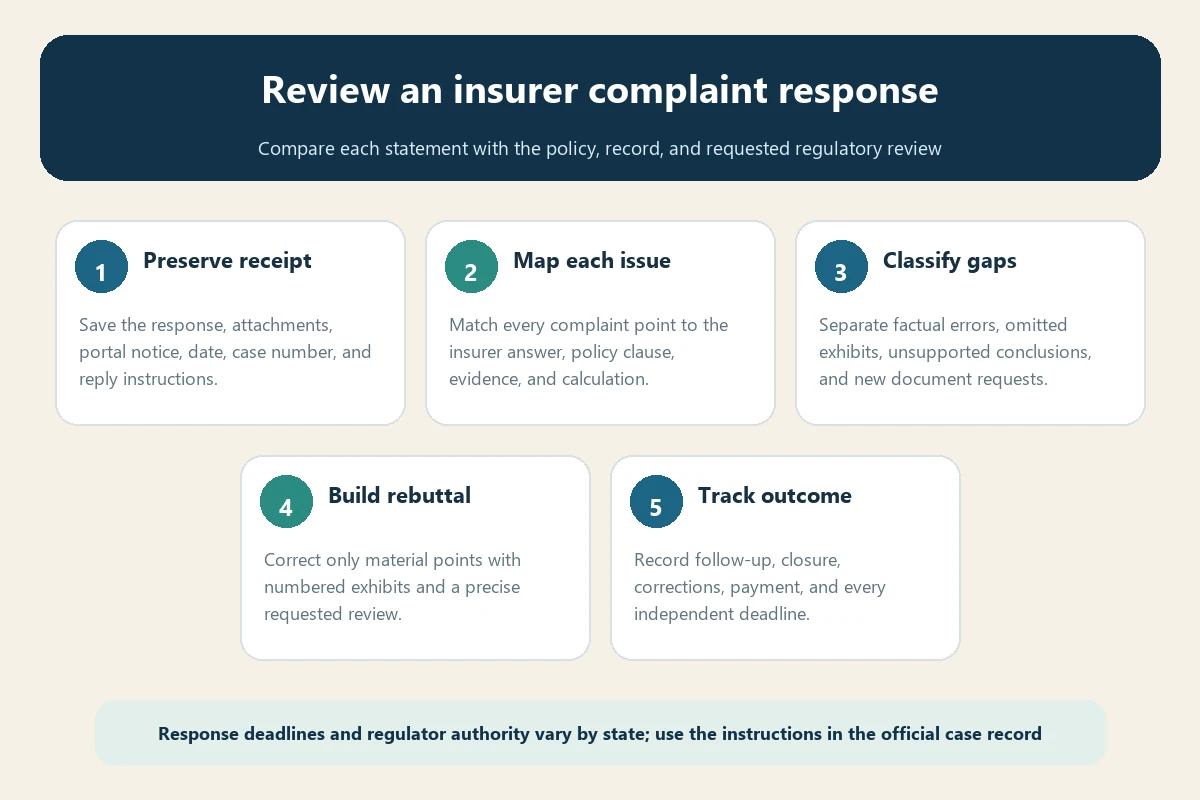
Save the complete response before analyzing it
Download the response, attachments, cover message, portal notification, submission date, case number, and reply instructions. Preserve the original files rather than relying on screenshots. If the portal will expire, export the record and record the visible deadline immediately.
Keep the envelope or message headers when timing or delivery matters. Do not rename original evidence destructively; store a working copy with a clear index. The claim status follow-up guide provides a simple log for dates, contacts, promised actions, and outstanding items.
Read the regulator’s instructions first
Confirm whether the response was sent for information, comment, rebuttal, acceptance, or another action. Note the permitted reply method, file limits, deadline, confidentiality warning, and whether the insurer will receive your submission.
The New York Department of Financial Services complaint page, for example, tells consumers that they can check case status and add information through its portal, and warns that a complaint may be shared with the company. Procedures differ by jurisdiction, so follow the instructions attached to your own case.
Create an issue-by-issue response matrix
List each material point from the original complaint in the first column. Add the insurer’s answer, cited policy provision, supporting exhibit, factual accuracy, unresolved question, and proposed follow-up in separate columns. This prevents a polished narrative from hiding a missing answer.
| Review item | Question to ask | Best evidence |
|---|---|---|
| Identity and jurisdiction | Is the correct licensed insurer responding? | Policy declarations and regulator case record |
| Chronology | Are submission, request, decision, and appeal dates accurate? | Dated delivery confirmations and correspondence |
| Coverage position | Does the cited provision appear in the issued form? | Complete policy, schedule, and endorsements |
| Evidence | Did the response address the decisive documents? | Exhibit index and original files |
| Calculation | Can every amount and reduction be reproduced? | Benefit worksheet, receipts, refunds, and payment record |
| Requested review | Was the regulator-facing concern actually answered? | Original complaint and company response |
Verify the responding legal entity
Travel plans can include an insurer, producer, administrator, assistance company, booking platform, and claims vendor. Confirm that the response identifies the underwriting company and explains any role assigned to another entity.
If the company name or NAIC number differs from the policy, ask the complaint specialist whether the correct licensee received the inquiry. Do not assume that a familiar brand owns the coverage decision.
Rebuild the chronology from primary records
Compare every date in the response with purchase confirmation, policy delivery, loss notice, claim submission, document uploads, acknowledgments, requests, decisions, appeal, payments, and the complaint. A one-day error can affect a deadline or an assertion that a file was incomplete.
State corrections neutrally: identify the response page, inaccurate date, correct date, and supporting exhibit. Avoid claiming intentional misconduct when a clerical or system error is the only fact established.
Check the policy version and endorsement
Confirm the form number, edition date, state endorsement, schedule, benefit, definition, exclusion, limitation, deductible, proof condition, and appeal provision. A response may quote valid wording from a different plan summary or omit an exception found on the next page.
Use the travel insurance denial reasons guide to classify the stated basis, then test that basis only against your issued documents. Marketing pages and sample certificates do not replace the contract delivered to the insured.
Test whether the evidence was actually addressed
Mark each decisive exhibit as acknowledged, discussed, contradicted, or omitted. A response that lists an attachment but does not explain its effect may leave the central issue unresolved.
For each omitted item, explain in one sentence what it proves and where it appears. Do not resend an entire unindexed file when three numbered pages answer the disputed point.
Separate a missing document from a rejected document
“Not received,” “insufficient,” “not contemporaneous,” and “does not satisfy the policy” are different positions. Ask which document was expected, when it was requested, how it was transmitted, and what requirement remains unmet.
If you have delivery proof, attach it beside the document. If the document was received but rejected, address the stated reason rather than proving delivery again. The travel insurance claim filing guide helps reconstruct the original submission trail.
Recalculate the disputed amount independently
Build a worksheet showing each claimed expense, currency, conversion date and source, refund or credit, deductible, sublimit, policy reduction, prior payment, and remaining amount. The response should be reproducible from the documents it cites.
If a fee or deduction appears, compare it with the claim payment fee guide. Ask for the contractual or statutory basis of an unexplained reduction without assuming every difference is an improper charge.
Distinguish coverage from claim-handling conduct
A coverage dispute asks whether the contract pays under the facts. A handling concern may involve response timing, failure to address material evidence, repeated requests, inaccurate statements, licensing, required notices, or another regulated practice. The same case can involve both, but the analysis should keep them separate.
The California Department of Insurance Consumer Services Division describes separate work involving claims-related complaints and claim-handling practices. That description illustrates regulator functions; it does not establish the rule or outcome for another state.
Do not assume one nationwide response deadline
Complaint procedures and company response periods vary by state, license, communication, and issue. The South Carolina Department of Insurance consumer page states a seven-day response period for insurance entities in its process, while California publishes a 21-day standard for a licensee’s written response to certain commissioner inquiries. Those examples are jurisdiction-specific, not universal deadlines.
Use the date and instruction in your own case. If the response is late, ask the assigned specialist about status rather than importing another state’s rule.
Classify what the response changed
- Resolved: the insurer corrected the record, paid, recalculated, or supplied the requested explanation.
- Partially resolved: one issue was answered but another material point remains.
- New evidence requested: the company identified a specific missing record.
- Position maintained: the insurer relies on the same facts and policy language.
- New basis raised: the response introduces a fact, exclusion, calculation, or defense not previously stated.
- Outside authority: the regulator or insurer identifies an issue belonging to another process.
This classification determines whether a rebuttal is useful. A response that fully corrects the problem may require confirmation and recordkeeping, not another lengthy submission.
Write a focused rebuttal
Begin with the case number and one-sentence purpose. List only material errors or omissions, each with the response page, corrected fact, relevant policy text, exhibit number, and requested regulatory review. Close by identifying what is now resolved and what remains open.
Do not rewrite the full travel history, repeat emotional descriptions, or attach unrelated medical and financial records. A concise rebuttal makes it easier for the reviewer to compare competing statements.
Use a safe rebuttal structure
- Case, policy, claim, and responding insurer.
- Date and title of the company response.
- Issues now resolved.
- Material factual corrections.
- Unanswered policy or handling points.
- Numbered new or previously omitted exhibits.
- Specific review requested from the regulator.
- Statement that separate deadlines remain preserved.
Use measured language and distinguish personal inference from documented fact. Quote short passages accurately and attach the complete source where required.
Respond to a new document request carefully
Determine whether the request is relevant, sufficiently specific, already satisfied, and permitted by the regulator’s channel. Ask for clarification when it seeks an undefined category such as “all records” without dates or subject limits.
Transmit sensitive health, identity, or banking material only through an authorized secure route. Redact unrelated data when permitted, keep the original, and record exactly what was sent.
Handle a new denial reason explicitly
If the response introduces a new exclusion or factual theory, identify it as new and test it independently. Ask whether the company is replacing, supplementing, or clarifying the earlier decision.
The denied claim appeal guide explains how to connect evidence to the exact denial wording. Preserve appeal rights even when the regulator complaint remains open.
Track closure without treating it as a court judgment
Save the closure letter, findings or explanation, insurer response, rebuttal, payment or correction, referral, and any continuing instructions. Record whether the agency found no violation, lacked authority, obtained a response, referred the matter, or kept information for oversight.
A closure may not decide every contract claim, lawsuit deadline, arbitration right, chargeback period, or appeal. Ask qualified counsel about legal consequences instead of assuming the complaint paused another clock.
Preserve the final audit file
Retain the complaint, exhibits, confirmations, insurer response, response matrix, rebuttal, regulator correspondence, closure, payment record, and a final chronology. Keep originals read-only and maintain a separate working folder.
The file should allow a new reviewer to understand the policy, issue, evidence, company position, regulatory question, correction, outcome, and remaining deadlines without reconstructing the case from scattered emails.
Bottom line
Review a travel insurance complaint response by preserving it, mapping every material issue, checking the correct policy and chronology, testing evidence and calculations, separating coverage from handling, and replying only to documented gaps. A short, indexed rebuttal is stronger than a broad accusation and helps the regulator see precisely what remains unresolved.
