
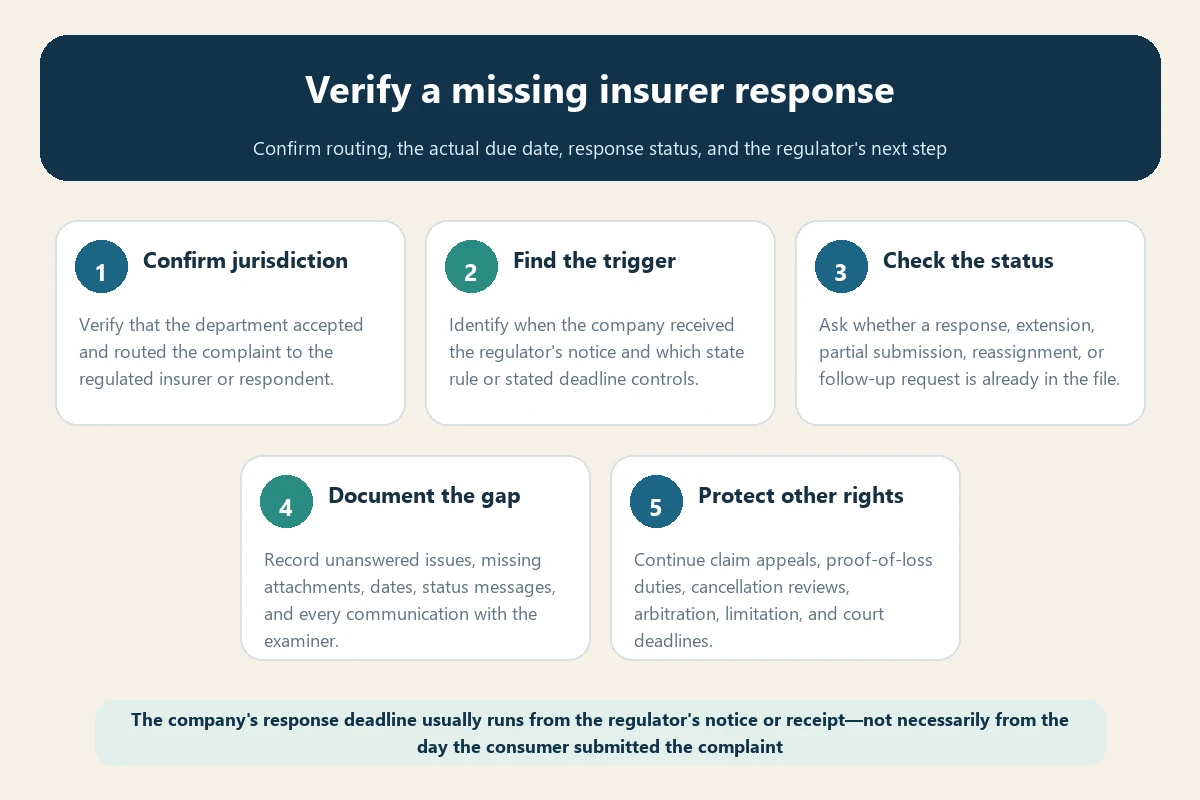
If your travel insurance complaint insurer is not responding, first confirm that the state insurance department accepted the matter, sent it to the correct regulated company, and established a response deadline. The deadline commonly runs from the regulator’s notice or the company’s receipt—not from the day you submitted the complaint.
Do not assume silence means the insurer ignored a legal duty. The department may still be screening jurisdiction, the complaint may have gone to the wrong entity, the company may have received an extension, or a response may be awaiting analyst review. State procedures differ. This guide is general information, not legal advice.
Separate four different delays
Identify which stage is actually stalled:
- Intake delay: the department has not yet accepted, numbered, or assigned the complaint.
- Routing delay: the department accepted the complaint but has not sent it to the insurer or proper respondent.
- Company response delay: the insurer received the regulator’s inquiry but did not respond by the applicable due date.
- Agency review delay: the company responded, but the analyst has not completed review or shared the outcome.
Only the third category is truly a missing insurer response. Use portal status, examiner confirmation, and dated notices rather than inference.
Confirm the department has jurisdiction
A state department may need to identify the licensed underwriting insurer, policy jurisdiction, administrator, producer, or assistance company before sending the case. The brand on a travel website may not be the legal insurer responsible for the policy.
Ask whether the department accepted the complaint within its authority and which entity received it. If the case was referred elsewhere, request the agency name, referral date, new reference number, and instructions. The wrong state insurance department guide helps diagnose jurisdiction before blaming a company that never received the inquiry.
Find the date the regulator sent the complaint
Look for a transmittal date, company-received date, portal event, or examiner message. Record whether the stated period uses calendar days or business days and whether it begins on sending, receipt, or another event. Note holidays, service method, and any special instruction in the notice.
Your consumer submission date may precede company notice by days or weeks. Counting from the wrong trigger can create a false overdue claim.
Do not use one state’s deadline nationwide
Official state pages show material differences:
- Washington says an insurance company’s response is due within 15 business days after it receives the complaint.
- Nevada says the company generally must reply to the issues and respond to the Division within 20 business days.
- Illinois says state law allows 21 days for an insurer or agent to respond to a complaint.
- A Connecticut Insurance Department bulletin requires regulated entities to respond to Consumer Affairs inquiries within 10 calendar days, with discretionary extensions for good cause.
These are jurisdiction-specific examples, not a menu from which a consumer may choose. Use the rule and notice governing your own matter.
Review the official Washington complaint process, Nevada Division of Insurance complaint page, Illinois complaint process, and Connecticut timely-response bulletin for the exact state examples.
Ask whether an extension was requested or granted
An insurer may ask the regulator for more time because of record volume, legacy files, third-party information, staffing, catastrophe conditions, or another documented reason. An extension is not automatic and its availability depends on the regulator.
Ask the examiner whether an extension exists, when it was requested, the revised due date, and whether the consumer will receive notice. Connecticut’s bulletin, for example, says a regulated entity unable to meet its timeframe must promptly request an extension, explain the need, and show good cause; the department retains discretion.
Check whether the response is in agency review
The insurer may have responded without sending you a direct copy. The analyst may be reviewing confidential material, requesting clarification, comparing policy terms, or waiting for missing attachments before communicating the result.
Ask a neutral status question: “Has the company responded, and if so, is the response complete and under review?” Do not ask staff to forward protected material through an insecure channel.
A partial answer may still be incomplete
A response can arrive on time yet fail to address every issue. Compare it with a numbered issue list. Check whether it identifies the issued policy, applicable clause, claim chronology, disputed documents, reason for denial or delay, requested corrective action, and attachments cited.
Illinois’s official process says that if an insurer or producer has not answered all questions or thoroughly investigated the complaint, the department will require it to do so. California’s justified-complaint regulations describe a complete response as one addressing all raised issues and including documentation needed to support the licensee’s position, within the applicable context.
Use the official California justified-complaint regulations as a California-specific source. The travel insurance complaint response review guide provides a detailed comparison framework.
Send a concise status request
Re: Complaint [number]. Please confirm whether the department sent the complaint to [legal insurer name], the date and method of transmission or receipt, the applicable company response deadline, whether an extension was granted, and whether a response is now under review. If the response is overdue or incomplete, please advise what follow-up the department will take and whether you need anything further from me.
Send it through the approved portal or to the assigned examiner. Do not open a second complaint solely to ask for status.
Preserve proof without flooding the case
Save the acknowledgment, complaint number, routing notice, portal events, status messages, extension information, company communications, and every follow-up. Maintain a simple log with date, sender, recipient, channel, subject, and next promised action.
Do not resend the entire claim file with each inquiry. Submit only genuinely new or requested evidence, labeled by exhibit and relevance.
Continue dealing with the insurer directly when appropriate
A regulator complaint does not always prevent routine claim communication. Continue using the insurer’s designated appeal, claim, and secure-document channels. Ask for confirmation of each submission and written answers to claim-specific questions.
Do not negotiate away rights or accept an inaccurate statement merely to provoke a response. Keep the regulator case and insurer appeal as distinct records.
Do not confuse a complaint response with a claim decision
The company’s regulator response may explain its position but not constitute the formal appeal decision required by the policy. Conversely, a claim appeal letter sent to you may not satisfy the regulator’s request for information.
Ask which document serves which process. The denied travel insurance claim appeal guide helps preserve the insurer-facing route independently.
What the department may do about nonresponse
Depending on state authority and facts, the department may send a reminder, set a new deadline, escalate to supervisory or enforcement staff, require a complete response, record the failure, or take administrative action. The consumer should not promise a fine or enforcement result.
Connecticut’s bulletin says untimely and inadequate responses without just cause may support administrative action and a reasonable fine. That is Connecticut’s published position under its cited authority, not a universal outcome.
When to escalate the status inquiry
Escalate inside the department when the confirmed due date passed, no approved extension appears, and repeated case-specific inquiries receive no meaningful status. Ask for the examiner’s supervisor or consumer-services escalation route without accusing staff.
If the department itself is silent, follow the measured sequence in the travel insurance complaint no state response guide.
Request the record if status remains unclear
If the case closes or a formal review requires knowing what was submitted, ask for participant access or use the proper records procedure. Request the company response, releasable attachments, agency correspondence, closure notice, and disposition specifically.
The travel insurance complaint file request guide explains how access, exemptions, redactions, and public-record processes differ by state.
Protect every outside deadline
Waiting for a company response to the regulator may not pause claim appeals, proof-of-loss duties, cancellation review, premium due dates, contractual limitations, statutes of limitation, arbitration, or court deadlines. Put each on a separate calendar.
If a deadline will arrive before the response, make the best timely submission permitted, state what information remains pending, and seek qualified legal advice where needed. Do not assume the regulator complaint tolls time.
Watch for a response that arrives after closure
Occasionally a company document or correction may arrive after an initial closure or status change. Ask whether the department will reopen, supplement, or issue an updated communication. Preserve both versions.
The reopen travel insurance complaint guide explains how to present a material post-closure development.
Frequently asked questions
When does the insurer’s response clock start?
It depends on the state procedure and notice, often from regulator transmission or company receipt. Do not count automatically from the consumer’s submission date.
Will the insurer send the response directly to me?
Not always. It may respond through the regulator’s company portal, after which an analyst reviews and shares appropriate information or findings.
Does an extension mean the regulator favors the insurer?
No. An extension can be a procedural decision. Ask for the revised date and stated status rather than inferring bias.
What if the insurer answered only one issue?
Give the examiner a numbered comparison showing the unanswered questions and missing support. Ask whether a supplemental company response will be required.
Can I sue because the company missed the complaint deadline?
A regulatory response requirement does not automatically create a private lawsuit or damages remedy. State law and facts control; obtain legal advice about any private claim.
A useful follow-up starts by locating the real delay. Confirm jurisdiction, routing, company receipt, the controlling deadline, any extension, and whether a response is already under analyst review. Document the status, ask the regulator for the next procedural step, and keep every other insurance and legal deadline moving.
