
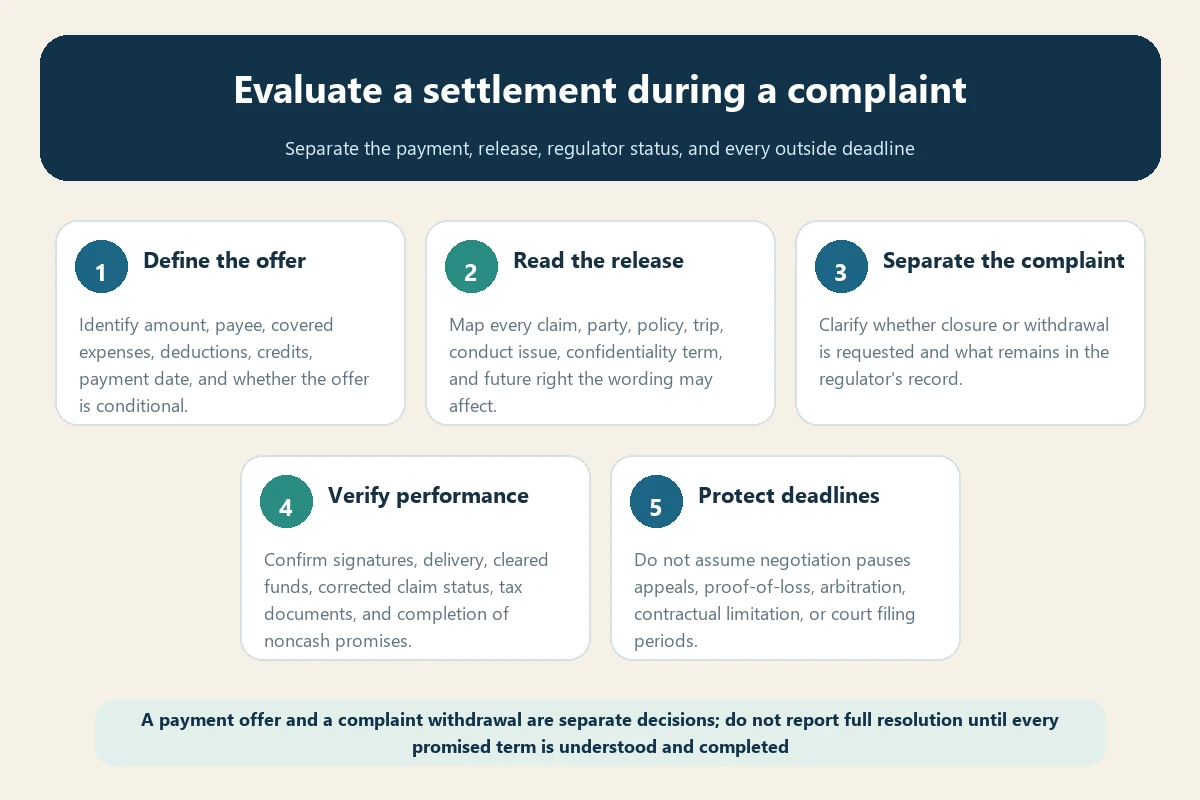
A travel insurance settlement during a state complaint can resolve part or all of a claim, but the payment offer, release, and regulator case are separate matters. Read the complete written proposal, calculate the net result, map every released right, and ask the examiner how settlement affects complaint status before reporting that the dispute is resolved.
Do not assume a settlement is an admission, that a complaint must be withdrawn, or that negotiation pauses another deadline. State law, policy terms, settlement language, and complaint procedures vary. This guide is general information, not legal advice.
Identify who made the offer and in what capacity
The proposal may come from the underwriting insurer, claims administrator, assistance company, producer, defense counsel, settlement unit, or regulator-facilitated process. Confirm the legal entity, its authority, the claim and policy involved, and whether the state department negotiated, transmitted, or merely learned of the offer.
A regulator forwarding an offer does not necessarily recommend it. Ask procedural questions without asking agency staff to act as your lawyer.
Get every term in writing
Do not rely on a phone summary. Request the proposed agreement, release, payment calculation, covered claim or benefit, included and excluded expenses, payee, payment method, performance date, tax form if any, confidentiality terms, non-disparagement terms, withdrawal language, and signatures required.
If the company says the written release will arrive only after verbal acceptance, state that you cannot evaluate unknown terms. A settlement is more than a dollar figure.
Reconcile the settlement amount
Create a line-by-line table:
- Amount originally claimed.
- Each covered expense accepted.
- Each expense denied or excluded.
- Deductible, coinsurance, sublimit, or policy maximum.
- Supplier refund, airline credit, card benefit, or other recovery.
- Interest, fees, or costs included or excluded.
- Gross offer, deductions, and net payment.
Check whether the offer is new money or includes an amount already paid. Confirm currency and exchange-rate method for foreign expenses. Do not settle based on a headline number that double-counts a prior payment.
Distinguish full settlement from partial payment
A company may offer payment for one benefit while another remains disputed. State whether accepting the amount resolves only trip delay, for example, or also cancellation, medical, baggage, bad-faith, interest, and future claims.
If you intend to accept an undisputed amount without releasing the rest, the agreement must reflect that intention. Do not add handwritten reservations without confirming they are accepted by all required parties.
Map the release clause
Highlight every defined party and released matter:
- The insurer, administrator, producer, affiliates, employees, and vendors.
- The named claim, policy, trip, incident, and benefit.
- Known and unknown claims.
- Contract, statutory, tort, interest, fee, and claim-handling issues.
- Past, present, and future losses.
- Subrogation, reimbursement, lien, and third-party rights.
A release broader than the disputed amount can affect rights not priced into the offer. Obtain qualified legal advice when the scope, value, pending litigation, or future medical consequences are material.
Check complaint withdrawal language separately
The agreement may ask you to withdraw the state complaint, notify the regulator of resolution, request closure, or refrain from further complaints. Those phrases are not equivalent.
Ask exactly what statement you must make, when, and whether it is factually accurate. Do not tell the regulator the matter is fully resolved before payment clears and noncash promises are completed. The travel insurance complaint withdrawal guide explains why closure, deletion, and withdrawal differ.
Understand how settlement may be coded
The National Association of Insurance Commissioners’ historical complaint disposition report includes “Compromised Settlement/Resolution” and “Claim Settled” among codes for closed confirmed complaints. This shows settlement is a recognized complaint outcome, but the code does not reveal the agreement’s amount, release, confidentiality, or performance.
Read the official NAIC complaint disposition report within its stated data scope. The complaint status codes guide explains why disposition is not a substitute for the written closure.
Do not assume the regulator will stop all review
A consumer settlement can resolve private relief while a department retains complaint data or independently considers licensing, market-conduct, or enforcement concerns. Ask the examiner whether the complaint will close, what disposition will be recorded, and whether the agency expects further information.
Do not promise that settlement will erase the complaint or stop every agency action. The regulator’s authority is governed by state law.
Review confidentiality and non-disparagement terms
Determine what information is confidential, who may receive it, what disclosures are permitted to regulators, tax advisers, attorneys, family, auditors, or courts, how compelled disclosure is handled, and what remedy applies to breach.
Do not agree to conceal information the law requires you to provide or to make a false statement to a regulator. If the language restricts cooperation with government, obtain legal advice.
Also compare the proposed confidentiality language with the regulator’s disclosure and retention rules in the travel insurance complaint privacy guide. A private agreement may not control the agency’s existing records.
Check whether a cooling-off right actually applies
Do not assume every insurance settlement can be rescinded for three days. California publishes a three-business-day rescission rule for certain settlements in a specific department-referred residential property, earthquake, and automobile mediation program, with exceptions and defined effects. That statute is not a nationwide travel insurance rule.
The official California Insurance Code mediation provisions illustrate why a cooling-off right must be tied to the exact program and authority. Read your agreement and governing law before signing.
Separate ordinary complaint negotiation from formal mediation
An examiner communicating with both sides does not automatically make the interaction privileged mediation. A formal program may have eligibility rules, mediator duties, confidentiality, fees, tolling, rescission, and release limitations that ordinary complaint handling lacks.
Ask whether the matter is in a named statutory mediation program and request the governing notice. Do not import protections from another insurance line or state.
Evaluate an “unsatisfactory” offer without overclaiming
An offer may be too low because it omits covered expenses, misapplies a deductible, ignores currency conversion, double-counts refunds, or demands an overbroad release. Show the calculation and clause rather than merely calling it unfair.
Illinois’s consumer complaint rules identify unsatisfactory settlement offers within the complaint framework and describe regulator handling under Illinois law. Review the official Illinois insurance complaint rules as a state-specific example, not proof of a private entitlement in another jurisdiction.
Prepare a written counterproposal
Identify accepted and disputed terms. Provide a revised calculation, specific release boundary, realistic performance date, permitted disclosures, and proposed complaint-status language. Keep the counteroffer distinct from the evidence submission to the regulator.
State whether negotiations are confidential or without prejudice only when governing law or agreement supports those terms. Labels alone may not create protection.
Keep the examiner accurately informed
Tell the examiner that an offer is pending, accepted subject to performance, rejected, or partially resolved. Avoid disclosing privileged legal advice. If the portal accepts comments, reference the complaint ID and update only material status.
If the insurer’s offer responds to a factual error in its earlier submission, compare it using the complaint response review guide.
Verify performance before final closure
After signing, track:
- Agreement delivery and all signatures.
- Payment issue date, method, payee, and cleared funds.
- Claim status and written coverage correction.
- Refund or credit posting.
- Policy restoration or document correction.
- Any tax, lien, reimbursement, or subrogation paperwork.
If performance fails, notify the company and examiner with the agreement term, due date, and proof. Ask whether the complaint should remain open or be reopened.
Preserve the complete settlement record
Save every version, redline, offer email, calculation, exhibit, acceptance, signature page, payment proof, regulator update, and closure notice. Do not keep only the final signature page.
If you later need the agency’s copy, use the travel insurance complaint file request guide, recognizing that confidentiality and access rules differ.
Protect all outside deadlines
Negotiation may not pause an insurer appeal, proof-of-loss obligation, contractual limitation, statute of limitation, arbitration, administrative review, or court deadline. A settlement offer can expire while those clocks continue.
Calendar the offer deadline and every independent deadline. Make any protective filing permitted by the governing process and obtain legal advice when necessary.
Use a settlement review checklist
- Verify parties and authority.
- Reconcile gross and net payment.
- Identify full versus partial resolution.
- Map the release and unknown-claim language.
- Review confidentiality and regulator cooperation.
- Separate withdrawal from private settlement.
- Confirm performance dates and remedies for breach.
- Calendar every outside deadline.
- Seek legal, tax, or other professional advice where material.
Frequently asked questions
Must I withdraw the complaint to receive payment?
Only the actual offer and governing law can answer that. Ask whether withdrawal is a condition, whether it is lawful, and what statement the company expects. Obtain advice before accepting broad terms.
Does settlement mean the insurer admitted wrongdoing?
Not necessarily. Agreements often deny liability. Read the document and do not describe an admission that is not there.
Can I accept part of the offer?
Only if the company agrees to a partial resolution without releasing the remainder. Get the scope in writing before acceptance.
Will the complaint disappear after settlement?
Usually settlement and record retention are separate. Ask the department what status and disposition will remain and review its privacy rules.
Should I close the complaint before the check arrives?
It is generally safer to clarify the department’s process and verify all promised performance before reporting complete resolution. Follow any signed agreement and obtain advice where needed.
A settlement during a complaint should be evaluated as several linked decisions, not one number. Confirm the economics, release, confidentiality, complaint status, signatures, performance, and deadlines. Report resolution accurately only after the terms are understood and completed.
