
A travel insurance arbitration interpreter helps a participant understand and communicate during conferences, testimony, objections, and argument. The role is to interpret accurately and neutrally—not to improve an answer, summarize testimony, explain policy coverage, act as an advocate, or provide legal advice.
Arrange language services early under the arbitration agreement, governing rules, preliminary order, and hearing protocol. Confirm approval, notice, cost, qualifications, confidentiality, remote access, and the correction process. This U.S. consumer guide provides general information, not legal advice.
Define the exact language need
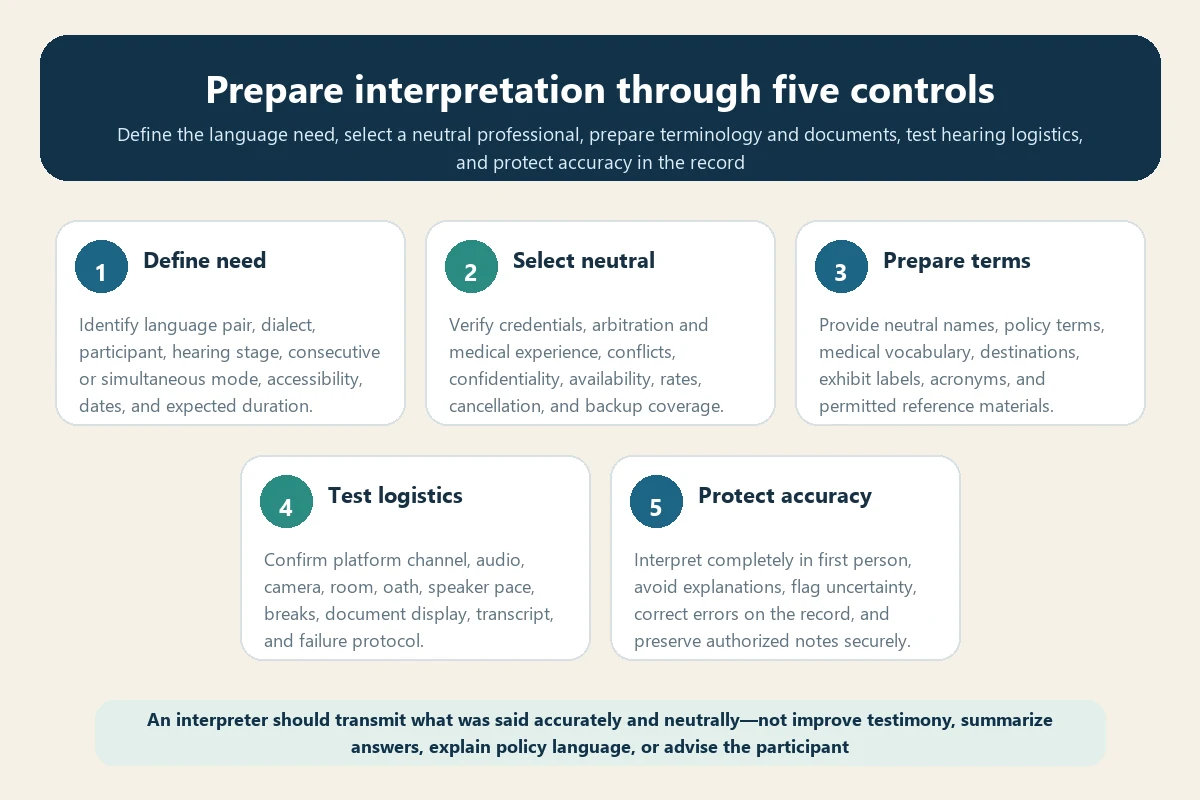
Record the source and target languages, regional dialect, participant, hearing stage, dates, time zones, expected duration, in-person or remote format, and whether interpretation is consecutive or simultaneous. “Spanish interpreter” may be too broad when dialect, location, or specialized terminology affects comprehension.
Ask whether interpretation is needed for the entire proceeding or only for one witness. Separate language access from disability accommodations such as captions, sign-language interpretation, or assistive listening.
Distinguish interpretation from translation
| Service | Primary task | Planning concern |
|---|---|---|
| Consecutive interpretation | Speaker pauses for oral interpretation | Longer hearing time |
| Simultaneous interpretation | Interpretation delivered while speaker continues | Channels, equipment, team rotation |
| Sight translation | Oral rendering of a written passage | Permission and document complexity |
| Document translation | Written text in another language | Certification, version, deadline |
| Captioning | Spoken language converted to text | Accessibility and terminology accuracy |
Do not assume an oral interpreter will translate a large medical record or policy during the hearing. Written translation requires separate scope, time, review, formatting, and exchange.
Check the governing AAA rule
Current AAA Consumer Arbitration Rule R-27 states that a party wanting an interpreter for any part of the process must arrange directly with the interpreter and pay the service cost. Retrieve the applicable rule version from AAA’s official consumer rules, forms, and fees page.
Also check the agreement, applicable law, case order, provider guidance, and any agreement to allocate costs differently. Do not treat an interpreter invoice as an AAA administrative fee or assume it will be shifted in the award.
Raise interpretation at the preliminary hearing
Ask the arbitrator to address language, mode, interpreter identification, qualifications, conflicts, oath or affirmation, confidentiality, remote channel, witness sequence, document use, transcript, objections, correction, breaks, backup, and cost.
Use the arbitration preliminary hearing checklist to place these decisions in a written order rather than relying on informal assumptions.
Select a qualified professional
Evaluate credentials, language pair, dialect, court or arbitration experience, consecutive and simultaneous skill, medical and insurance vocabulary, remote-hearing competence, availability, security, and references.
AAA’s official hearing services page describes on-demand accredited interpreters for in-person and virtual settings. Availability through a service does not replace case-specific approval or selection diligence.
Check neutrality and conflicts
Disclose relationships with the parties, representatives, insurer, administrator, witnesses, clinicians, suppliers, translation vendor, and dispute. Ask whether the interpreter previously translated a contested document or communicated substantively with a witness.
A family member, friend, employee, or advocate may understand the language but have a conflict, lack technique, or become a fact witness. Convenience is not a substitute for neutrality and competence.
Obtain a complete written estimate
Ask about hourly or half-day minimums, preparation, travel, remote platform, equipment, second interpreter, overtime, waiting, cancellation, document review, glossary work, recording, transcript support, taxes, and backup coverage.
Simultaneous work or a long hearing may require two interpreters who rotate to preserve accuracy. Budget for the actual scheduled time, including openings, breaks, witness delays, and closing arguments.
Do not confuse provider practices
FINRA’s official arbitration process guidance says hearings are conducted in English and the requesting party generally arranges and pays for interpretation, with a hardship-waiver process in that forum. FINRA rules do not govern an AAA travel insurance case.
Use another forum only as a comparative planning example. Apply the assigned provider’s rules and actual case order.
Prepare a neutral terminology list
Provide names, roles, destinations, airline and hotel names, policy terms, acronyms, medical conditions, medications, tests, dates, currencies, claim numbers, exhibit labels, and requested benefit categories.
The list supports accurate pronunciation and consistent terminology. It must not tell the interpreter which facts are favorable or how to change a witness’s answer.
Address travel-insurance terminology
Terms such as covered reason, unforeseen event, pre-existing condition, look-back period, waiver, medically necessary, trip cost, nonrefundable, supplier credit, secondary coverage, subrogation, and proof of loss can have policy-specific meanings.
Provide the issued policy form and agreed glossary if authorized. The interpreter should render the term consistently, not decide its legal meaning.
Prepare medical vocabulary carefully
Identify diagnoses, symptoms, procedures, medications, anatomy, dates, clinicians, facilities, and abbreviations that may arise. Medical interpretation errors can change causation, timing, treatment, or travel-fitness evidence.
Do not ask the interpreter to explain medicine or resolve an ambiguous chart. A treating clinician or qualified expert provides substantive evidence; the interpreter transmits language.
Control document translation
For a foreign-language medical record, police report, supplier notice, receipt, or correspondence, identify the source file, language, complete page range, formatting, translator, certification, deadline, and whether both source and translation must be exchanged.
Use the document exchange checklist to keep stable exhibit numbers and versions. Do not present an undisclosed translation or silently revise a disputed one.
Decide how interpretation will be delivered
Consecutive interpretation allows the witness and interpreter to alternate, making the process easier to monitor but longer. Simultaneous interpretation can be faster but requires separate audio channels, specialized skill, equipment, and often team rotation.
Ask the arbitrator to select the method and set speaking pace, segment length, interruption protocol, and how objections pause interpretation.
Use first-person and complete interpretation
The interpreter should generally preserve person, tone, register, uncertainty, qualifications, and incomplete statements. “I canceled on Tuesday” should not become “the claimant says the trip was canceled around Tuesday.”
The interpreter should not omit repetition, soften language, answer for the witness, or add explanations. If clarification is necessary, the interpreter should identify the request as the interpreter’s own statement.
Prepare the witness to work with an interpreter
Ask the witness to speak in short complete segments, pause, avoid overlapping speech, use direct answers, explain acronyms, and allow interpretation to finish before continuing. The witness should speak to the arbitrator or questioner, not privately confer with the interpreter.
Use the witness testimony guide to preserve truthful preparation and personal knowledge. Do not rehearse a translated script.
Test virtual interpretation channels
Confirm platform language channels, permissions, audio routing, microphones, headphones, camera, speaker identification, reporter feed, captions, interpreter handoff, private consultation, and reconnection.
Conduct the test with the actual participant, interpreter, device, room, and likely document display. Follow the virtual hearing guide for security and failure recovery.
Protect confidentiality and data
The interpreter may hear medical, financial, passport, booking, and claim information. Confirm confidentiality obligations, secure document delivery, authorized recipients, device security, note handling, recording restrictions, retention, and destruction.
Do not email the entire claim file if only selected exhibits are needed. Use the provider-approved secure channel and the minimum necessary access.
Plan breaks to preserve accuracy
Interpretation requires sustained concentration. Schedule reasonable breaks, especially for simultaneous work, technical testimony, or long sessions. Confirm how a break is requested without interrupting substantive testimony unfairly.
Record whether the witness remains under oath and which communication restrictions apply during the break.
Handle interpretation objections promptly
If a participant believes an answer was omitted or mistranslated, raise the issue immediately and identify the word or passage. Allow the interpreter to clarify, repeat, spell, or correct on the record under the arbitrator’s direction.
Do not argue directly with the interpreter or replace the official interpretation with a bilingual representative’s private version. The arbitrator controls the procedure.
Correct errors transparently
A correction should identify the original interpretation, corrected interpretation, reason, affected testimony, and any need to repeat a question or permit follow-up. Preserve both the error and correction in the authorized record.
If the issue is discovered in a transcript, follow the transcript and case-order correction process. Do not silently edit quoted testimony.
Coordinate interpretation with the transcript
Confirm whether the transcript records the source language, interpreted English, or both; how speakers are labeled; and how corrections will appear. A bilingual transcript may require additional reporting and cost.
The hearing transcript guide helps distinguish rough text, certified transcript, audio, official record, and authorized errata.
Prepare a backup interpreter plan
Record who replaces an unavailable or disconnected interpreter, how conflicts and qualifications will be checked, which materials may be shared, and when the hearing pauses. Do not continue material testimony when a participant cannot understand it.
Add primary and backup contact information to the hearing protocol and test any second interpreter’s access before the session.
Common interpreter mistakes
- Waiting until hearing week to identify language, dialect, and mode.
- Using a family member or advocate without conflict and competence review.
- Assuming oral interpretation includes certified document translation.
- Failing to prepare policy, medical, destination, and exhibit terminology.
- Letting the interpreter summarize, explain, or answer for a witness.
- Speaking in long overlapping segments that cannot be rendered accurately.
- Ignoring security, transcript, recording, and note-retention rules.
- Continuing testimony after an interpretation or connection failure.
Final interpreter checklist
- Define language pair, dialect, participant, stage, mode, dates, and format.
- Confirm rule, approval, notice, qualifications, neutrality, cost, and backup.
- Prepare neutral policy, medical, travel, and exhibit terminology.
- Control translations, secure documents, virtual channels, and transcript setup.
- Use complete first-person interpretation and correct errors on the record.
- Calendar breaks, document deadlines, technical tests, and post-hearing review.
Coordinate language services with the arbitration hearing preparation checklist and the case timeline. Accurate interpretation protects more than convenience: it supports each participant’s meaningful opportunity to understand the proceeding, present evidence, answer questions, and be heard.
