

Travel insurance arbitration arbitrability is the gateway question: does a particular dispute belong in arbitration, and who decides that question—a court, an arbitrator, or the administrator acting only within its administrative role?
The answer can turn on the exact agreement, how the traveler accepted it, a delegation provision, incorporated rules, the parties and claims, state contract law, and federal arbitration law. This U.S. consumer guide provides a record-building framework, not legal advice or a prediction about any dispute.
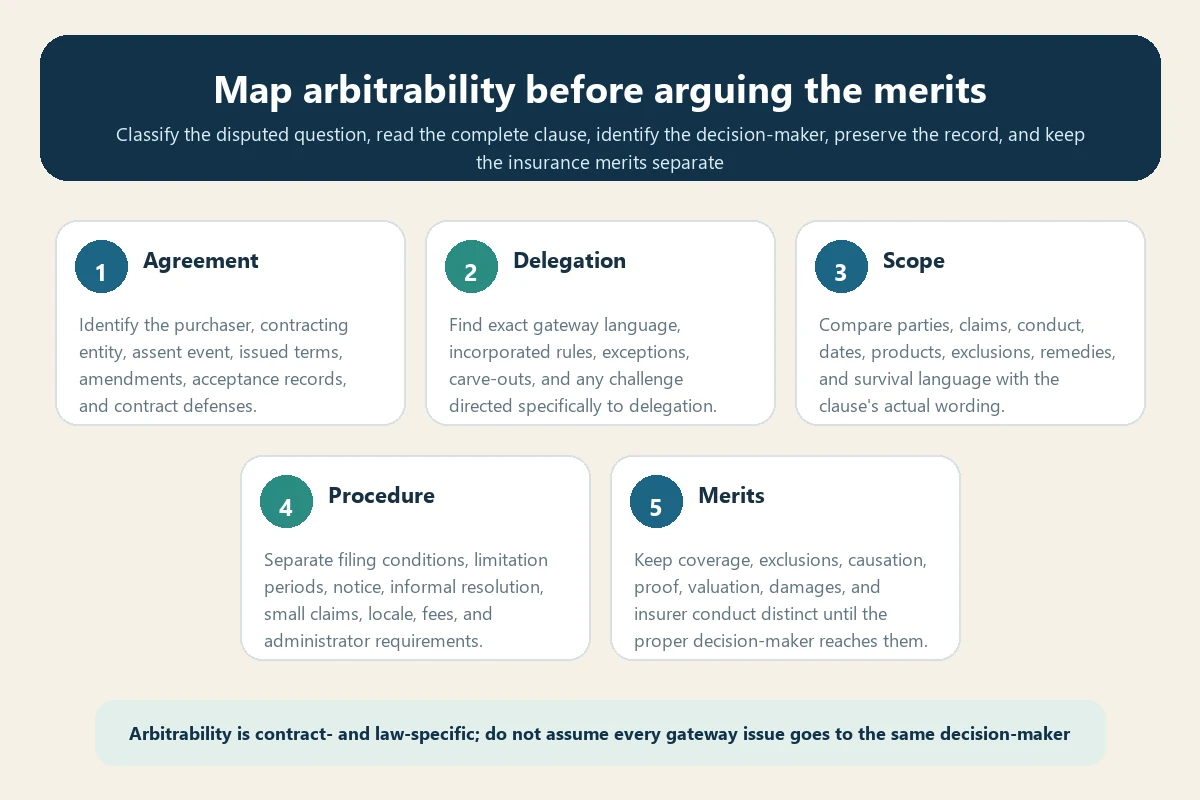
Define the question before choosing the decision-maker
“Arbitrability” can hide several different disputes. One party may deny that any arbitration agreement was formed. Another may accept the agreement but dispute whether it covers the traveler, insurer, administrator, benefit, date, or legal claim. A third may contest a filing condition or the forum’s procedure.
Write the question in one sentence. For example: “Did the purchaser assent to the arbitration terms displayed after checkout?” differs from “Does a broad clause cover a statutory claim about claim handling?” Precise classification prevents a coverage argument from being mistaken for a contract-formation argument.
Start with the Federal Arbitration Act text
Section 2 of the Federal Arbitration Act addresses written arbitration provisions in covered transactions and preserves generally applicable grounds for revoking a contract. Sections 3 and 4 separately address stays and petitions to compel arbitration.
Do not turn that general framework into a universal answer. Governing law, jurisdiction, the transaction, the requested relief, and the wording of the agreement still matter. Preserve the statutory edition and authorities actually relied upon.
Read the complete travel protection package
A travel purchase may involve a policy or certificate, a plan description, assistance services, a supplier cancellation waiver, booking-platform terms, disclosures, and separate website terms. Record which entity issued each document and which document contains the disputed clause.
Preserve the version delivered at purchase, not merely today’s webpage. Save the checkout sequence, confirmation email, hyperlinks, screenshots, timestamps, policy number, state of residence, purchase date, and amendment history. Formation cannot be audited from an isolated paragraph.
Separate formation from validity and scope
- Formation: whether the parties made an arbitration agreement at all.
- Validity or enforceability: whether a formed agreement can be enforced under applicable law.
- Scope: whether the agreement covers this party, claim, event, or requested remedy.
- Procedure: whether a notice, waiting period, filing step, deadline, or forum rule was satisfied.
- Merits: whether the travel insurance claim is covered and what relief is due.
Use separate headings in every submission. Combining these issues invites the decision-maker to answer a different question from the one intended.
Identify any delegation provision
A delegation provision assigns specified gateway questions to an arbitrator. The U.S. Supreme Court’s official Henry Schein opinion explains that who decides arbitrability is itself a question of contract and rejects a judicial “wholly groundless” shortcut when a valid delegation applies.
Quote the exact delegation text, including exceptions. Note whether it refers to formation, existence, validity, enforceability, interpretation, scope, or applicability. Also record incorporated rules and their edition. Do not summarize all of these concepts as “jurisdiction.”
Direct a challenge to the correct provision
A challenge to the overall travel protection contract, the arbitration clause, and a delegation provision are not automatically interchangeable. Identify the language challenged, the factual basis, the governing rule, the requested decision, and why that decision-maker has authority.
The arbitration due process guide helps audit fairness safeguards. Keep that audit distinct from the threshold question of who decides arbitrability.
Test who and what the clause covers
Create a scope matrix with columns for party, legal claim, challenged conduct, relevant date, product, clause phrase, exclusion, and requested relief. List the exact names of the insurer, underwriter, administrator, producer, booking platform, supplier, traveler, purchaser, and beneficiary.
Broad phrases such as “arising out of” or “relating to” still require textual analysis. Check third-party language, affiliates, agents, successors, beneficiaries, survival after cancellation, and carve-outs. The complaint versus arbitration guide can help distinguish a regulatory complaint from a private dispute-resolution demand.
Do not confuse arbitrability with insurance coverage
Whether cancellation, interruption, delay, baggage loss, or emergency medical expense is covered is usually a merits question. It requires the policy wording, exclusions, facts, proof, causation, valuation, and claim record. Arbitrability instead asks whether and where that merits question will be resolved.
Maintain two files: a gateway file for assent, clause language, delegation, scope, and procedure; and a merits file for the policy and evidence. Cross-reference them without allowing one to replace the other.
Review the current AAA jurisdiction rule
The current AAA Consumer Arbitration Rules contain a jurisdiction rule addressing an arbitrator’s power to rule on jurisdiction, including objections concerning the existence, scope, or validity of the arbitration agreement. Read the complete current rule and filing documents rather than relying on a quotation from an older article.
AAA administration, an arbitrator’s jurisdiction ruling, and a court’s legal determination are distinct. The administrator can screen clauses and administer cases without issuing a judicial enforceability opinion.
Preserve objections without arguing only labels
An effective objection identifies the challenged term, evidence, authority, decision-maker, requested relief, and deadline. State whether the request is dismissal, a stay, referral to a court, referral to an arbitrator, limited information exchange, or a ruling that a specified claim is outside scope.
Use the arbitration motion practice guide to organize the requested order, evidence, response schedule, and preserved objection. A bare statement that the forum “has no jurisdiction” may be too ambiguous.
Build a formation evidence table
For online or post-purchase terms, record the screen shown, hyperlink placement, font and contrast, required action, checkbox text, confirmation page, email delivery, attachment, ability to download, and any later version. Preserve device and account records when legitimately available.
For a telephone or agent-assisted purchase, retain scripts, recordings, notes, disclosures, delivery records, and the authority of the purchaser. If another person bought the plan, identify traveler, purchaser, cardholder, and named insured separately.
Map procedural conditions separately
Some clauses require informal notice, negotiation, a waiting period, a specified demand, service at an address, or individual filing. Others preserve a small-claims option. Classify each provision before asserting that noncompliance eliminates arbitrability.
The arbitration demand guide covers party names, clause attachment, claim statement, relief, service, fees, and filing confirmation. Maintain proof of every attempted cure.
Check small-claims language and forum boundaries
A small-claims carve-out may permit an individual claim in a court of competent jurisdiction while excluding appeals, transfers, consolidated matters, or claims above a monetary limit. Read both the contract and the court’s current rules.
Do not assume that choosing small claims resolves every scope dispute. The proper path may depend on eligibility, amount, defendant location, service, counterclaims, and the current AAA rule governing disagreements about small-claims jurisdiction.
Track timing without waiving the merits
Create a chronology for purchase, delivery, loss, claim, denial, appeal, informal notice, demand, response, administrator correspondence, motions, and rulings. Put contractual limits, statutory periods, and case deadlines on separate rows.
The arbitration timeline guide provides a control ledger. A gateway dispute does not necessarily pause every other deadline, so obtain case-specific advice where rights may expire.
Use limited information requests strategically
Ask only for material needed to decide the gateway issue: the operative agreement, assent record, relevant contract versions, entity relationships, incorporated rules, amendment notices, or service proof. Explain how each item bears on formation, delegation, or scope.
The document exchange checklist helps define custodian, date range, format, privilege, privacy, and missing-item follow-up. Avoid turning a threshold phase into full merits discovery without authorization.
Prepare for a focused preliminary hearing
Propose an issue list, briefing dates, evidence scope, stipulations, hearing format, record method, and requested form of ruling. Ask whether the merits schedule is stayed, continues in parallel, or will be reset after the gateway decision.
The preliminary hearing checklist helps convert disagreement into a manageable order. Confirm every ruling in writing.
Preserve the decision and its boundaries
When a ruling issues, record exactly what was decided: formation, delegation, scope, procedural compliance, or merits. Note claims and parties included or excluded, governing clause version, factual assumptions, preserved defenses, next deadlines, and any opportunity for correction or review.
Use the reasoned award guide when the requested explanation matters. A gateway ruling may not be the final award, and review paths can differ.
Avoid common arbitrability mistakes
- Using today’s terms instead of the terms delivered at purchase.
- Calling formation, enforceability, scope, procedure, and merits one issue.
- Ignoring a delegation provision or its exceptions.
- Failing to identify each company and person’s contractual role.
- Treating AAA administration as a court enforceability ruling.
- Arguing insurance coverage before identifying the proper decision-maker.
- Using “jurisdiction” without stating the precise disputed question.
- Missing deadlines while waiting for a gateway ruling.
- Requesting full merits discovery for a narrow formation issue.
- Failing to preserve the objection and resulting prejudice.
Final arbitrability checklist
- Preserve the complete purchase-time agreement and assent record.
- Define formation, validity, scope, procedure, and merits separately.
- Quote the arbitration and delegation language exactly.
- Identify the requested decision and proper decision-maker.
- Map every party, claim, date, product, carve-out, and remedy.
- Review the current administrator rules and statutory text.
- Build a focused gateway evidence file and chronology.
- Preserve objections, responses, rulings, and deadlines.
- Keep the insurance coverage record ready but distinct.
- Confirm what the gateway decision does—and does not—resolve.
A strong arbitrability analysis is not a slogan about courts or arbitrators. It is a disciplined map of the agreement, delegation, scope, procedure, evidence, decision-maker, and preserved deadlines, with the underlying travel insurance merits held ready for the forum that has authority to decide them.
