
Travel insurance arbitration unconscionability asks whether a clause is unenforceable under the generally applicable contract law of the controlling state because of the circumstances of agreement, the challenged terms, or the required combination of both.
It is not enough to call arbitration inconvenient, mandatory, or one-sided. The analysis requires the correct state test, purchase-time evidence, exact clause language, a properly targeted challenge, and a precise remedy. This U.S. consumer guide is general information, not legal advice.
Separate contract fairness from procedural due process
Unconscionability usually examines contract formation and terms. Due process in an administered arbitration examines whether the actual proceeding provides notice, a neutral, reasonable access, information exchange, a fair hearing, remedies, and an appropriate award.
The arbitration due process guide covers the second inquiry. Maintain separate headings and evidence for each.
Begin with FAA equal treatment
FAA Section 2 makes written arbitration provisions enforceable subject to grounds that exist at law or in equity for revoking any contract. Unconscionability can be such a generally applicable defense.
But a rule cannot disfavor arbitration because it is arbitration or obstruct its fundamental attributes. Identify how the same state doctrine applies outside arbitration.
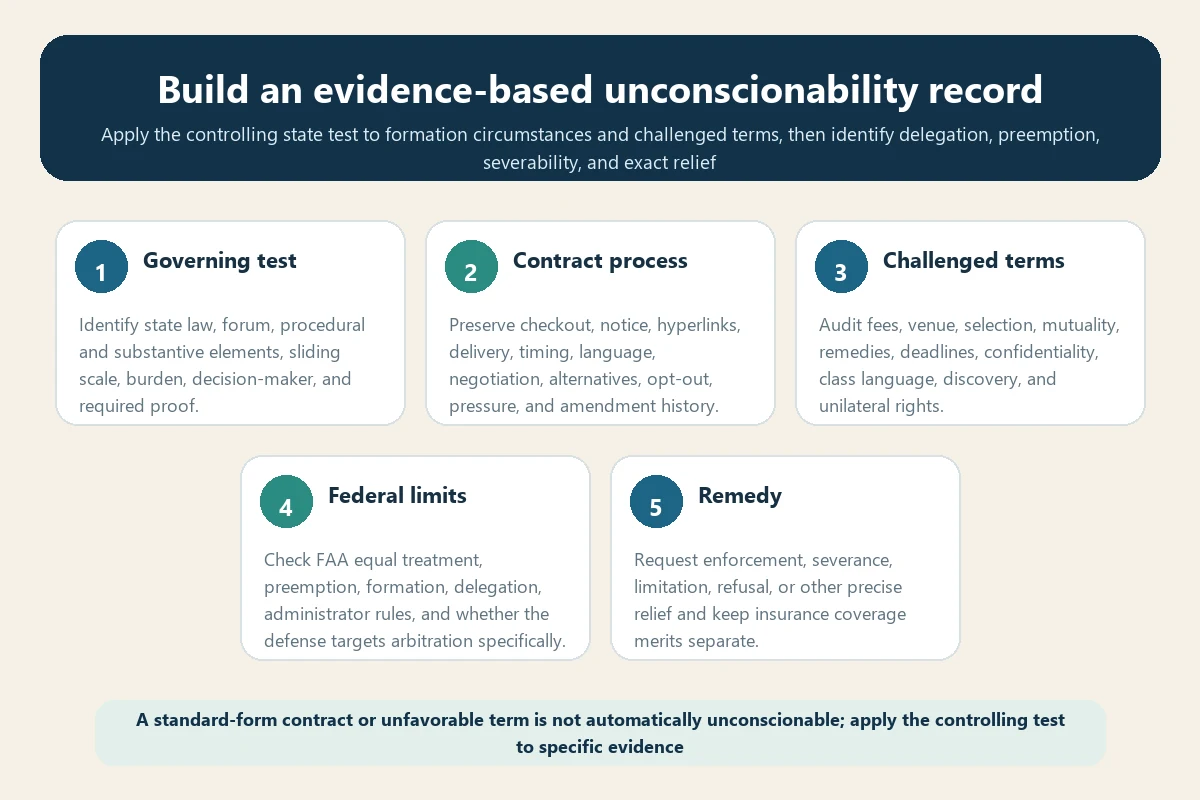
Use the controlling state’s actual test
States describe unconscionability differently. Some require both procedural and substantive unconscionability, sometimes on a sliding scale. Others use different elements, thresholds, terminology, or remedies.
Record the forum, choice-of-law clause, state of residence, purchase location, contracting entities, transaction contacts, and governing cases. Do not import California terminology into every state.
Study a current travel-related decision carefully
In the 2026 federal decision Puntillo v. International Travel Network, the court addressed formation and unconscionability arguments involving travel care purchased with airline tickets. The court examined notice, contract presentation, opt-out, forum language, and class treatment under California law.
Use the decision as an example of issue-by-issue analysis, not as a nationwide result or prediction. Small factual differences and different state law can change the outcome.
Build the purchase-time contract file
Preserve every screen from quote through payment, checkbox text, hyperlink location, font, contrast, button label, confirmation page, email, attachments, policy delivery, timestamps, device type, account record, and later amendments.
Identify whether the arbitration terms belonged to the insurer, plan administrator, booking platform, travel supplier, or another entity. A current webpage is not proof of what the purchaser saw.
Audit procedural unconscionability evidence
Depending on governing law, relevant facts may include oppression, surprise, bargaining power, hidden terms, time pressure, language access, ability to review, negotiation, alternatives, opt-out, and the manner of assent.
Create a fact table with evidence for and against each factor. A standard-form or adhesive contract may contribute to the analysis but is not automatically unenforceable.
Build a two-sided evidentiary matrix
For every procedural factor, record the consumer’s evidence, the business’s contrary evidence, the source, authenticity, disputed facts, and why the fact matters under the controlling test. Include screenshots, declarations, emails, delivery logs, interface records, call recordings where lawful, and the complete agreement.
For every substantive term, add the exact language, practical operation, current administrator rule, actual cost or distance, available exception, comparable obligation on the other party, and requested remedy. This structure exposes assumptions early and prevents a brief from describing only unfavorable facts.
Distinguish undisputed facts from inferences. If targeted information is missing, request only what is necessary to resolve the element and explain why less burdensome evidence is inadequate.
Examine notice and surprise precisely
Measure where the arbitration disclosure appeared, what action signified assent, how the link was labeled, whether terms were available before purchase, and whether confirmation materials repeated the clause.
Separate “I did not read it” from “the process did not reasonably present it.” The first is a personal fact; the second requires objective interface and delivery evidence.
Analyze any opt-out process
Record the deadline, permitted delivery method, address, required content, consequences, confirmation procedure, and whether opting out affected the purchase or benefits. Preserve any notice sent and proof of receipt.
An opt-out can affect procedural analysis under some law, but its presence does not answer every formation, scope, or substantive-term question.
Audit substantive unconscionability term by term
Substantive analysis often focuses on overly harsh, one-sided, or unreasonably favorable terms under the controlling test. Quote each challenged provision and explain its practical effect using actual amounts, distances, deadlines, remedies, and party obligations.
Do not combine every objection into one conclusion. A court may reject one challenge, sever another term, and enforce the remainder.
Calculate arbitration costs accurately
Separate consumer filing fees, business fees, arbitrator compensation, attorney fees, experts, records, travel, technology, interpreter costs, and possible fee shifting. Identify current waivers or hardship procedures.
The arbitration cost guide provides an evidence ledger. Compare realistic arbitration and court costs without unsupported maximum figures.
Test location and hearing access
Map required locale, consumer residence, loss location, witnesses, documents, virtual options, disability needs, language access, and travel expense. Quote who selects the location and who may modify it.
The virtual hearing guide helps turn a general burden into a concrete access plan. A distant location clause may operate differently when current rules permit a virtual hearing.
Review mutuality and unilateral rights
List which claims each side must arbitrate, court carve-outs, provisional relief, collection rights, amendment power, forum selection, arbitrator selection, and survival provisions. Compare practical obligations rather than counting words.
Contract law does not necessarily require identical promises. Apply the controlling state’s consideration and unconscionability rules to the exact structure.
Test arbitrator selection and neutrality terms
Identify who selects the administrator, how the neutral list is created, each party’s ranking or strike rights, required qualifications, disclosure duties, replacement procedures, and any unilateral appointment power. Compare the written clause with the incorporated rules rather than reading one in isolation.
The arbitrator selection guide helps build objective criteria and a disclosure log. Evidence of a specific conflict or structurally one-sided selection method is different from a generalized suspicion that repeat administrators always favor businesses.
Audit remedy and deadline restrictions
Identify damages caps, fee limits, shortened claim periods, confidentiality, evidence limits, class or representative provisions, and restrictions on statutory relief. Determine whether another contract section or governing rule changes the result.
Keep the policy’s notice and suit-limitation terms separate from arbitration filing terms. Put every deadline on the arbitration timeline ledger.
Target delegation separately
A delegation provision may assign enforceability questions to an arbitrator. A challenge to the arbitration agreement generally may not be the same as a challenge specifically directed to delegation.
The arbitrability guide maps the decision-maker, while the severability guide maps the contractual layer. Use both before drafting.
Review current AAA consumer safeguards
The current AAA Consumer Arbitration Rules address clause review, fees, location, virtual hearings, neutral appointment, information exchange, remedies, and awards. Preserve the edition governing the dispute.
Current safeguards can affect practical burden, but administrator review is not a judicial ruling that a clause is enforceable under state law.
Address FAA preemption directly
The Supreme Court’s decision in AT&T Mobility v. Concepcion explains that the FAA saving clause permits generally applicable defenses but not rules that stand as obstacles to the FAA’s purposes by disfavoring arbitration.
State the neutral contract rule, explain its application outside arbitration, and distinguish any requested procedure that would fundamentally change bilateral arbitration.
Choose a remedy based on the proven defect
Possible outcomes can include enforcement, refusal to enforce, severance of a term, limitation of an application, replacement through a contractual or statutory mechanism, or further fact development. The remedy depends on governing law and the parties’ severability language.
Request precise relief. Explain whether removing a term preserves the agreed process or requires rewriting the bargain.
Keep the insurance claim merits ready
Unconscionability does not decide whether cancellation, interruption, delay, medical expense, evacuation, or baggage loss is covered. Maintain the policy, exclusions, chronology, proof, causation, valuation, communications, and damages separately.
Continue meeting claim, court, statutory, and arbitration deadlines unless a valid order changes them.
Avoid common unconscionability mistakes
- Calling all mandatory arbitration unconscionable.
- Using one state’s test in another jurisdiction.
- Relying on current terms instead of purchase-time evidence.
- Equating a standard form with automatic invalidity.
- Combining procedural and substantive facts without elements.
- Using hypothetical fees instead of current schedules.
- Ignoring opt-out, virtual hearing, or hardship procedures.
- Failing to challenge delegation specifically.
- Ignoring FAA equal treatment and preemption.
- Requesting total invalidation without analyzing severability.
Final unconscionability checklist
- Identify governing state law, forum, burden, and elements.
- Preserve the complete purchase and delivery record.
- Separate formation, procedural unfairness, and substantive terms.
- Quote each challenged provision and practical effect.
- Calculate real fees, location burden, deadlines, and remedies.
- Analyze mutuality, opt-out, amendments, and alternatives.
- Target arbitration, delegation, and subterms separately.
- Address administrator safeguards and FAA preemption.
- Match the requested remedy to the proven defect.
- Preserve the travel insurance merits and every deadline.
A professional unconscionability analysis is evidence-driven and jurisdiction-specific. It reconstructs the contracting process, tests each challenged term under neutral state law, respects federal equal-treatment limits, and asks for a remedy no broader than the proven defect.
