
Travel insurance arbitration equitable estoppel becomes an issue when a person or company that did not sign the relevant agreement asks to enforce its arbitration clause. The argument often says a claimant cannot rely on a contract for a claim while rejecting the same contract’s dispute process.
This U.S. consumer guide explains how to map parties, agreements, claims, transactions, state law, evidence, and defenses without confusing estoppel with other nonsignatory doctrines. It is not legal advice.
Start with the enforcement direction
Record who requests arbitration and who resists it. Identify whether a nonsignatory seeks to compel a signatory, a signatory seeks to compel a nonsignatory, or two nonsignatories dispute enforcement.
Direction matters because state rules may frame the analysis differently. Never assume that a theory working for one party automatically works in reverse.
Create a legal-entity map
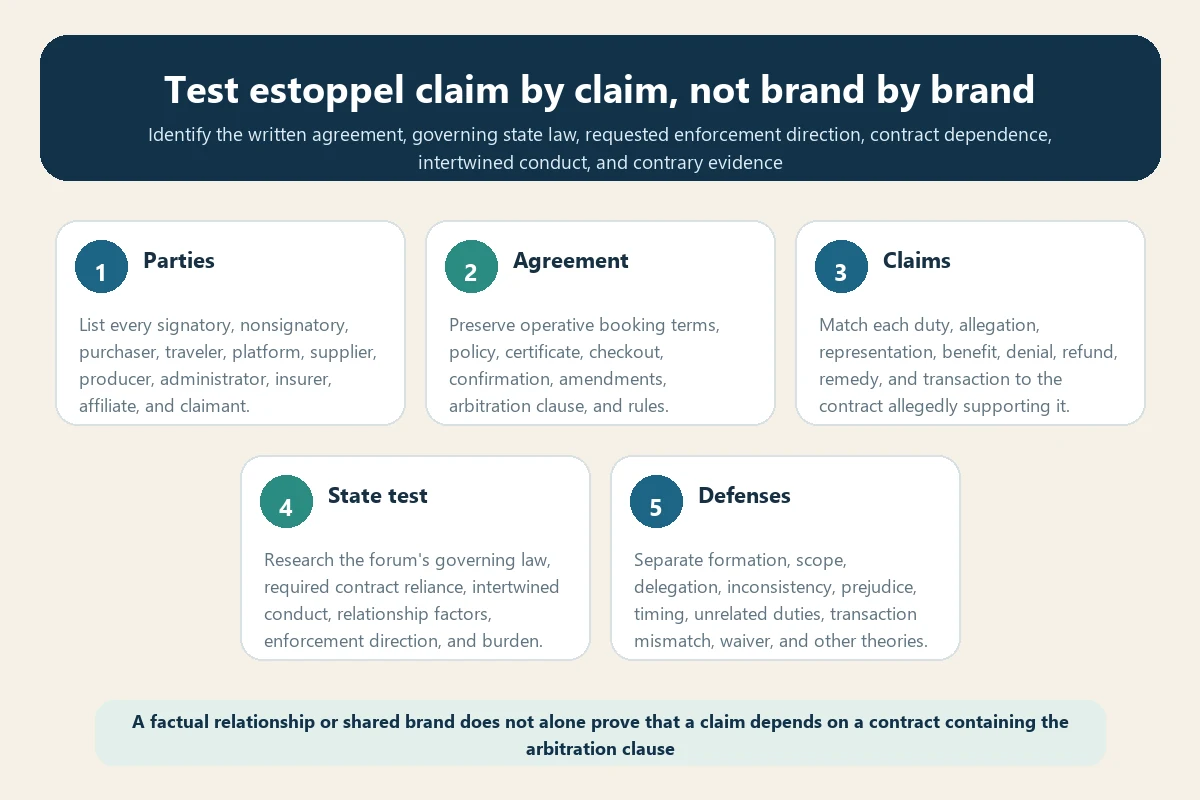
List the purchaser, traveler, account holder, insured, beneficiary, booking platform, travel supplier, producer, insurer, administrator, assistance company, affiliate, and claimant. Use legal names rather than brand labels.
A shared logo, website, corporate family, or customer-service channel does not establish that every entity signed the same contract.
Inventory every potentially relevant agreement
Preserve booking terms, platform terms, supplier rules, policy, certificate, checkout screen, confirmation, account agreement, amendments, and incorporated arbitration rules. Mark each document’s parties, date, version, governing law, and dispute clause.
A single checkout can involve several contracts. The insurance policy and platform terms should not be merged merely because the premium appeared beside the trip price.
Prove the operative version and assent
Estoppel does not eliminate formation questions. Reconstruct the screen shown, notice placement, hyperlink, assent action, purchaser identity, timestamp, confirmation, and version retained for the transaction.
Use the travel insurance clickwrap guide to audit the digital acceptance record before analyzing nonsignatory enforcement.
Understand the federal starting point
Section 2 of the Federal Arbitration Act addresses written arbitration provisions in transactions involving commerce and preserves generally applicable contract defenses. It does not supply one nationwide equitable-estoppel test for every travel dispute.
Courts usually look to applicable state contract law for the specific nonsignatory doctrine. That makes the choice-of-law analysis a required step, not a footnote.
Use the Supreme Court decision precisely
In GE Energy Power Conversion France SAS v. Outokumpu Stainless USA, the U.S. Supreme Court held that the New York Convention does not conflict with domestic equitable-estoppel doctrines that may allow nonsignatories to enforce arbitration agreements.
The decision did not declare every nonsignatory entitled to arbitration. It left the domestic state-law doctrine and the facts of the asserted theory to further analysis.
Identify the governing state standard
Research the forum’s choice-of-law rules, any contractual selection, transaction contacts, and controlling appellate decisions. Record the elements, burden, and enforcement direction stated in those cases.
Some formulations focus on claims that rely on contract terms. Others also examine substantially intertwined allegations or coordinated misconduct. Do not transplant wording from another jurisdiction.
Test whether the claim depends on the contract
For each count, ask whether the claimant must prove a contractual duty, promised benefit, coverage provision, refund right, representation incorporated into the agreement, or breach of a defined obligation.
Quote the allegation and the contractual language allegedly necessary to establish it. A claim’s connection to travel does not by itself show dependence on the contract containing arbitration.
Separate reference from necessary reliance
A complaint may mention a booking, policy, or premium as background while asserting an independent statutory or tort duty. Conversely, relabeling a contract claim as negligence may not remove its dependence on promised performance.
Create two columns: facts that merely identify the transaction and terms required to prove liability or relief. This exposes conclusory assertions on both sides.
Map intertwined allegations carefully
If governing law recognizes an intertwined-conduct path, identify the alleged coordination between the signatory and nonsignatory. Record the actors, communications, representations, payment flow, claim handling, and requested remedy.
Common ownership, sales cooperation, or sequential customer service may be relevant evidence, but it is not a substitute for the jurisdiction’s stated elements.
Keep third-party beneficiary separate
Equitable estoppel asks whether a party’s position or claim-contract relationship makes avoidance of arbitration inequitable under governing law. Third-party-beneficiary doctrine focuses on contractual intent to confer an enforceable benefit.
Use the third-party beneficiary guide to analyze intent language, enforcement rights, and direction without blending the two theories.
Separate agency and incorporation theories
Agency, assumption, incorporation by reference, assignment, alter ego, and veil piercing each require their own facts and legal tests. A party may plead alternatives, but one label cannot prove another.
Build a theory table with elements, supporting evidence, contrary evidence, governing authority, and the party bearing the burden.
Compare current platform drafting
Travelocity’s current official terms illustrate provisions covering claims involving travel providers and companies offering products through the service, beneficiary language, and defenses including estoppel.
Current terms demonstrate drafting patterns only. Save the version accepted for the disputed booking, because later edits do not prove earlier notice or assent.
Match the correct transaction
A traveler may have multiple bookings, policies, account sessions, companions, premiums, cancellations, or claims. Assign a transaction identifier and date to every agreement and allegation.
Do not use acceptance for one trip to compel a dispute arising from another without proving the clause and scope connect them.
Separate platform and policy duties
A platform may promise booking services while an insurer promises specified benefits under a policy. An administrator may handle documentation without underwriting coverage. A supplier may control the trip service but not the insurance decision.
Match each defendant to the duty allegedly breached before deciding whether the claim relies on platform terms, policy language, or an independent source.
Audit every cause of action individually
Analyze breach of contract, declaratory relief, bad faith, consumer-protection, negligent misrepresentation, unjust enrichment, and other claims separately. State the duty source, contract dependence, alleged conduct, injury, and remedy for each.
A court may reach different arbitration conclusions for different claims or defendants in the same complaint.
Examine inconsistent positions with evidence
Identify the exact benefit, right, or contractual proposition the claimant invokes and the exact arbitration obligation the movant says accompanies it. Cite pleadings, demand letters, claim forms, and requested relief.
A general accusation of unfair inconsistency is not a substitute for the required doctrinal connection.
Check scope after nonsignatory status
Even if equitable estoppel permits a party to invoke an agreement, the dispute must still fall within the clause’s scope. Read defined claims, covered parties, temporal limits, exclusions, carve-outs, survival, and remedies.
The arbitrability guide helps separate who decides threshold questions from whether the underlying claim is covered.
Analyze delegation without skipping formation
A delegation clause may assign some enforceability and scope disputes to an arbitrator. Record its text, incorporation language, applicable rules, and any challenge specifically directed to delegation.
Do not assume that a broad delegation provision conclusively establishes that a particular nonsignatory formed or may enforce the underlying agreement. The updated terms guide explains why later webpage language cannot replace proof of the operative contract.
Preserve timing, waiver, and prejudice facts
Build a chronology of complaint filing, removal, answers, discovery, motions, settlement activity, notices, and arbitration demands. A late request may create separate waiver or procedural arguments.
Use the arbitration waiver guide to document litigation conduct without confusing waiver with equitable estoppel.
Document claims and communications
Save the policy, certificate, booking receipt, premium charge, claim submission, denial letters, appeal, refund communications, terms archive, screenshots, account records, and support transcripts. Preserve native files and metadata where possible.
Create an index recording source, custodian, date, transaction, contract, party, issue, and page or screen reference.
Build a reproducible claim-contract matrix
Use one row per claim and defendant. Include signatory status, moving party, resisting party, asserted agreement, formation proof, contract language relied upon, independent duty, intertwined allegations, state-law element, defense, delegation, and scope.
This structure lets a reviewer reproduce the analysis instead of accepting a global conclusion about the entire case.
Avoid common analytical errors
- Treating all companies under one travel brand as the same legal party.
- Using today’s terms without preserving the purchase-time version.
- Calling any factual connection “intertwined” without applying state law.
- Assuming a policy claim necessarily relies on platform terms.
- Merging estoppel, beneficiary, agency, assignment, and alter-ego theories.
- Skipping formation, delegation, scope, waiver, or transaction matching.
Use a focused review sequence
- Map every entity and signatory relationship.
- Preserve each operative contract and acceptance record.
- Identify governing state law and the exact estoppel standard.
- Match each claim, duty, allegation, and remedy to a contract or independent source.
- Test nonsignatory theories separately and in the correct direction.
- Analyze delegation, scope, timing, waiver, and defenses.
- Record the result in a claim-by-claim matrix.
Know when tailored legal review matters
Seek qualified counsel promptly when filing deadlines, significant losses, multiple entities, international agreements, class allegations, deceased or minor travelers, disputed assent, or simultaneous court and arbitration proceedings are involved.
Counsel can determine governing law, procedural deadlines, preservation duties, and whether estoppel or another nonsignatory doctrine applies to the actual documents and claims.
Final takeaway
Travel insurance arbitration equitable estoppel is a contract-and-claim analysis, not a shortcut based on commercial relationships. The strongest file identifies every party, operative agreement, state-law test, claim dependency, transaction, scope term, and defense.
Keep formation, estoppel, third-party beneficiary, agency, delegation, scope, and waiver distinct. That discipline produces a clearer and more defensible decision about who may require arbitration.
