
Travel insurance condition precedent arbitration disputes require more than finding the words “condition precedent.” A condition can affect contract formation, the attachment of insurance risk, an insurer’s duty to pay, or the timing and procedure of arbitration. Each category requires different evidence and may have a different decision-maker.
This U.S. guide provides a document-first method for classifying the clause, proving compliance, and separating coverage conditions from pre-arbitration steps. It is educational, not legal advice.
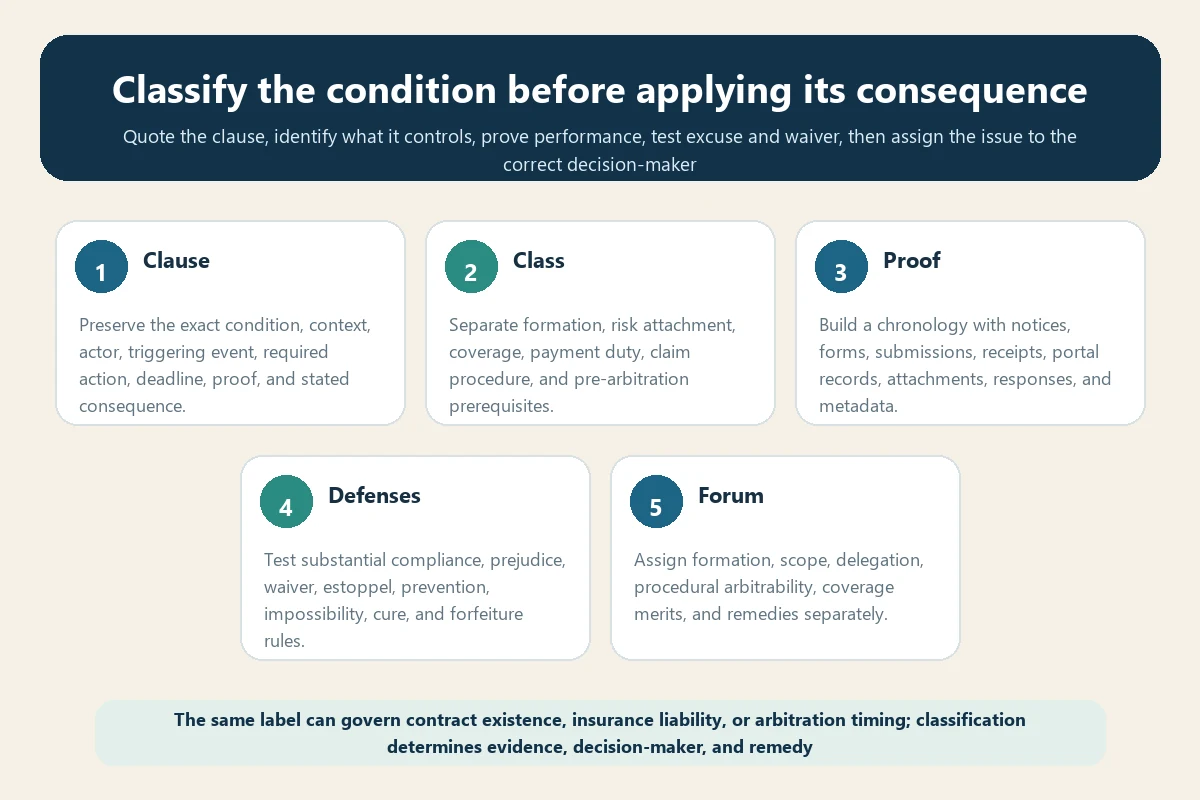
Quote the exact condition
Copy the complete sentence, surrounding paragraph, heading, cross-references, exceptions, timing language, and stated consequence. Preserve words such as if, unless, until, provided that, before, shall, and condition precedent.
Identify what must happen, who must act, when performance is due, what proof is required, and what the contract says follows from nonperformance.
Collect the complete policy package
Gather the certificate, declarations or schedule, benefits, definitions, exclusions, conditions, endorsements, amendments, application, purchase confirmation, claims instructions, and incorporated documents. Match form numbers, revision dates, state, plan, travelers, and coverage period.
A summary may omit exceptions or consequences. Use the incorporation-by-reference guide when the condition depends on external claim instructions or arbitral rules.
Classify formation conditions first
A condition to formation means no contract, amendment, or arbitration agreement becomes binding until the stated event occurs. Examples might involve approval, payment, delivery, signature, acceptance, or another objectively defined event.
Do not assume every “condition” concerns formation. Determine whether the language makes contract existence depend on the event or merely delays a duty under an existing contract.
Separate attachment of insurance risk
A travel policy can begin different benefits at different times. Pre-departure cancellation coverage may attach after purchase, while post-departure medical or baggage coverage begins when the trip starts.
Record purchase, premium receipt, effective date, scheduled departure, actual departure, cancellation, loss, and termination. The illusory-coverage arbitration guide explains how attachment allegations differ from proof that a benefit could never pay.
Identify conditions to the insurer’s duty
Policies may require timely notice, proof of loss, medical documentation, police or carrier reports, cooperation, authorization, mitigation, or submission to an examination. Quote whether compliance is expressly tied to liability or payment.
Distinguish the existence of coverage from the maturity of a payment duty. A covered event can occur even though a later claim obligation remains unperformed.
Distinguish a covenant from a condition
A covenant is a promise whose breach may support a remedy. A condition controls whether a duty arises. Some provisions can operate as both, but labels and consequences depend on governing law and the contract.
Do not convert every mandatory “shall” into forfeiture. Identify whether the policy expressly states denial, loss of rights, suspension, or another consequence.
Determine governing law before applying consequences
Review choice-of-law terms, state of residence, policy situs, place of contracting, forum rules, and insurance statutes. States differ on strict compliance, substantial compliance, notice prejudice, waiver, excuse, impossibility, and forfeiture.
Separate substantive insurance law from the procedural rules of a court or arbitral forum.
Build a performance chronology
Record the triggering event, knowledge, notice, requested form, submission, acknowledgment, follow-up, extension, denial, appeal, pre-suit demand, mediation, arbitration demand, and filing. Save original emails, portal receipts, tracking, attachments, and call records.
For each deadline, identify the start rule, time zone, calendar or business days, extension, and actual completion time.
Prove the responsible actor
Determine whether the traveler, policyholder, beneficiary, provider, carrier, tour operator, insurer, administrator, or representative had the duty. Preserve authority and delivery evidence.
One person’s nonperformance should not automatically be attributed to another without contractual or agency support. Use the arbitration agency guide for disputed authority.
Document exact compliance
Match every element of the clause with evidence. If notice required specified information, show what was sent. If proof required a physician statement or carrier report, identify the document and date.
Do not rely only on a portal status. Preserve the actual file, confirmation, recipient, and metadata.
Analyze substantial compliance separately
If literal performance is disputed, determine whether governing law recognizes substantial compliance for that kind of condition. Identify the essential purpose of the requirement and what information or protection the insurer actually received.
Substantial compliance is not permission to ignore a material requirement. Present the deviation, reason, effect, and counterevidence precisely.
Test prejudice only where the law requires it
Some jurisdictions require an insurer to show prejudice from late notice or another breach; others treat certain express conditions differently. Do not import a notice-prejudice rule into every travel-insurance condition.
Preserve evidence of lost investigation opportunity, changed records, unavailable witnesses, increased cost, or the absence of practical harm.
Evaluate waiver and estoppel independently
Identify conduct allegedly relinquishing strict compliance: accepting late documents, requesting continued performance, deciding merits without reserving the condition, or making inconsistent representations.
Waiver and estoppel have jurisdiction-specific elements. The equitable-estoppel arbitration guide explains why reliance and detriment require proof rather than a generalized fairness argument.
Consider prevention and excuse
Document whether the other party prevented performance, supplied an unusable portal, withheld a form, gave conflicting instructions, or refused information needed before the deadline. Preserve every request and response.
Also examine impossibility, impracticability, emergency circumstances, incapacity, and other recognized excuses under governing law. A difficult condition is not automatically excused.
Separate policy conditions from arbitration prerequisites
A proof-of-loss condition may concern benefit payment. A negotiation, notice, appeal, or mediation step may control when arbitration can begin. They are not interchangeable.
Create separate rows for the coverage merits and the dispute-resolution process, including each clause, actor, deadline, evidence, consequence, and decision-maker.
Use Supreme Court procedure doctrine accurately
In BG Group v. Republic of Argentina, the Supreme Court discussed procedural prerequisites such as time limits, notice, and other conditions precedent to an obligation to arbitrate. The decision distinguishes such procedural questions from whether a valid arbitration agreement exists.
The case involved an international investment treaty, not travel insurance. Use its classification reasoning carefully and confirm how governing law applies to the actual clause.
Identify who decides formation
Courts ordinarily must address whether an arbitration agreement was formed unless governing law and a valid arrangement require otherwise. Preserve offer, assent, identity, delivery, incorporation, and authority.
A condition to formation cannot simply be relabeled as a procedural timing issue. State what event controls existence and what evidence proves or disproves it.
Identify who decides procedural compliance
Questions about whether notice, negotiation, waiting periods, or similar prerequisites were satisfied may be presumptively for an arbitrator in some settings. Contract language and applicable law can change the analysis.
Quote any provision assigning procedural arbitrability and preserve the incorporated rules. Do not assume the court or arbitrator decides every condition.
Analyze delegation independently
A delegation clause can assign certain gateway disputes to an arbitrator. Identify its exact scope, formation, incorporation, clarity, and any challenge directed specifically to delegation.
Map formation, scope, procedural prerequisites, coverage, and remedies as separate decisions.
Apply the Federal Arbitration Act accurately
9 U.S.C. §2 addresses written arbitration provisions involving commerce and generally applicable contract grounds. It does not classify every policy or procedural condition.
Determine FAA applicability, state insurance law, and any other federal issue rather than assuming one statute supplies every answer.
Use travel-insurance risk cases cautiously
A federal travel-insurance decision in Haas v. Travelex discusses whether starting the trip was a condition to attachment of post-departure risk at the pleading stage.
The decision does not establish that every canceled trip earns a proportional refund or that every post-departure benefit failed to attach. Confirm procedural posture, contract language, governing law, and later history.
Distinguish denial from forfeiture
A claim may fail because the event was outside coverage, because an exclusion applies, or because a condition was not satisfied. These rationales require different evidence and can produce different remedies.
Compare the denial letter with the complete claim file and the travel-insurance claim-denial guide. Record any rationale added after the initial decision.
Connect nonperformance to the requested remedy
Specify whether the claimed consequence is delayed payment, total forfeiture, dismissal without prejudice, stay, arbitration after cure, premium refund, damages, severance, or another result.
A missed procedural step may be curable. A failed formation condition may have a different consequence. Avoid demanding a remedy broader than the clause and governing law support.
Create a condition matrix
Use columns for clause, classification, triggering event, actor, action, deadline, evidence, consequence, governing law, compliance, excuse, prejudice, waiver, decision-maker, and remedy.
Mark every item proven, disputed, or unknown. This reveals when the word “condition” is doing too much analytical work.
Questions for qualified counsel
- Is the clause a formation condition, coverage condition, payment condition, or procedural prerequisite?
- What law governs its interpretation and consequence?
- Was it performed literally or substantially?
- Do prejudice, waiver, prevention, or excuse apply?
- Who decides formation, scope, delegation, procedure, and merits?
- Can the failure be cured, and what deadlines remain?
Practical takeaway
Never stop at the label “condition precedent.” Quote the travel-insurance clause, classify what it controls, identify the actor and deadline, preserve performance evidence, and apply the governing rule for consequence and excuse.
Then separate policy coverage from arbitration procedure. Formation, attachment of risk, claim payment, pre-arbitration notice, scope, delegation, and remedies can each require a different decision-maker and outcome.
Late notice does not have one nationwide consequence; the result can depend on governing state law, policy type, wording, reason for delay, actual prejudice, and burden of proof. Use this travel insurance notice prejudice arbitration guide to preserve the timeline, test harm, and separate coverage forfeiture from arbitration waiver and procedure.
A cooperation clause does not make every request unlimited, and an incomplete response is not automatically a material, prejudicial refusal. Use this travel insurance cooperation clause arbitration guide to map each request, authority, relevance, response, obstacle, prejudice claim, cure, and the separate arbitration questions.
