
A travel insurance arbitration reopen hearing request asks the arbitrator, after the hearing has closed but before the award, to receive specified evidence, hear limited testimony, correct a material record gap, or revisit a defined issue. It is not an automatic second chance to improve a case that could have been presented earlier.
The arbitration agreement, current provider rules, closure notice, agreed award period, prior orders, and applicable law control. This U.S. consumer guide provides general information, not legal advice. Reopening before an award differs from post-award clarification, modification, appeal, vacatur, or a new claim.
Confirm the hearing is actually closed
Locate the arbitrator’s closure declaration and identify whether any transcript, brief, calculation, written statement, or authorized post-hearing evidence remained outstanding. The last live session is not always the closure date.
Use the hearing transcript guide and post-hearing brief guide to distinguish an open submission schedule from a closed record. If the record is still open, the correct request may be permission to submit within the existing process rather than reopening.
Verify the pre-award window
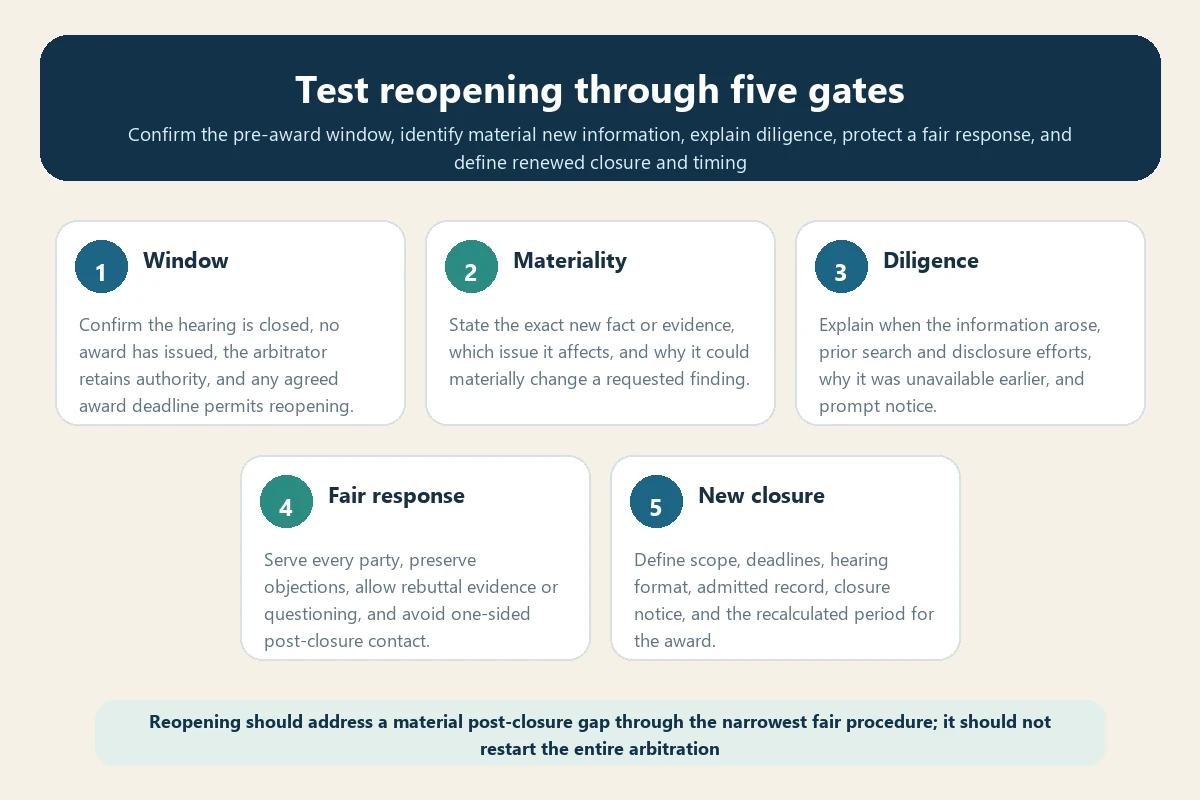
Current AAA Consumer Arbitration Rule R-38 permits reopening when a party requests it and the arbitrator approves, or when the arbitrator acts on their own initiative, at any time before the award is made.
Once an award has issued, use the specific post-award procedure and deadline. Do not label a request to re-decide the merits after award as a motion to reopen the hearing.
Check any agreed award deadline
Current Rule R-38 states that the hearing may not be reopened when reopening would prevent the award within a specific time agreed in the arbitration agreement, unless the parties agree to extend that time. Identify the exact contractual period and calculate it from the correct event.
Do not assume the arbitrator or administrator can unilaterally change an agreed limit. If consent is needed, state the proposed extension, purpose, and new schedule in writing.
Identify one material reason to reopen
State the exact evidence, testimony, calculation, correction, or event and connect it to a disputed policy element, defense, causation issue, loss amount, witness credibility, or requested relief. Explain what finding may change.
A general desire to “complete the record” is insufficiently precise. Use an issue-to-proof table:
| New item | Material issue | Why current record is insufficient |
|---|---|---|
| Provider correction | Date or medical fact | Existing note contains documented error |
| Carrier source record | Cause of delay or cancellation | Earlier status lacked final operational reason |
| Refund confirmation | Net loss | Refund posted only after closure |
| Native message file | Authenticity or full context | Submitted screenshot was incomplete |
| New controlling event | Requested relief | Temporary remedy became unnecessary |
Not every post-closure update justifies more evidence. Some changes can be handled through settlement notice, withdrawal, agreed calculation, or another authorized procedure.
Explain why the information was unavailable earlier
Provide a dated chronology of requests, follow-ups, subpoenas if applicable, provider contacts, portal checks, disclosure efforts, expected delivery, actual receipt, and prompt notice. Distinguish genuinely new information from a document that was overlooked in your own files.
Reopening should not reward strategic withholding. If the delay resulted from an error, acknowledge it precisely and explain the corrective controls rather than disguising it as newly discovered evidence.
Show reasonable diligence
Identify what a reasonable search covered: custodians, file locations, email accounts, claim portal, vendors, medical providers, carrier records, translation, native exports, and prior productions. Preserve receipts and failed attempts.
Use the document exchange checklist to show the production history and the arbitration subpoena guide when a nonparty record was pursued through an authorized compulsory process.
Request the narrowest workable reopening
Ask for a defined page, witness, calculation, or issue rather than reopening every claim and defense. State whether the request can be resolved through written submission, a short virtual conference, limited testimony, supplemental exhibit, or agreed correction.
Define page limits, dates, response, reply if any, examination time, exhibit treatment, objections, transcript, and renewed closure. A narrow procedure reduces cost and unfair surprise.
Follow the authorized motion process
Check whether advance permission, a letter request, motion, conference, response period, or proposed order is required. State the relief first, then authority, closure and award status, materiality, diligence, prejudice, proposed response, and revised schedule.
The motion practice guide helps separate permission to file, the motion itself, and the arbitrator’s ruling.
Serve every party and avoid private contact
Submit through the administrator or ordered channel and copy all parties as required. Do not send a new receipt, explanation, or “quick correction” privately to the arbitrator after closure.
Record delivery method, recipients, timestamp, attachments, page count, response deadline, and receipt. A request to reopen should not become the vehicle for an unauthorized one-sided merits submission.
Protect the other party’s response rights
Propose enough time to authenticate the item, investigate source, obtain rebuttal proof, consult an expert, translate material, question a witness, or recalculate loss. Identify any expedited need and why the shorter period remains fair.
If new testimony is requested, address oath, direct and cross-examination, interpreter, remote protocol, exhibits, and recording through the witness testimony guide.
Preserve objections to the new material
Reopening does not automatically admit an exhibit or establish a fact. Identify relevance, materiality, source, authenticity, completeness, privilege, duplication, translation, privacy, and unfair-surprise issues.
Use the evidence objections guide and request a cure or limited use when appropriate. Record the offered version and ruling separately.
Update the exhibit and ruling logs
Assign the authorized exhibit number or supplemental label, preserve the stable file, map it to the issue and witness, and record offered, objected, admitted, limited, reserved, withdrawn, or excluded status.
Do not renumber the entire hearing set. Update the master index and keep the earlier closed-record version for historical accuracy.
Handle changed damages carefully
A post-closure refund, credit, reimbursement, chargeback, or corrected invoice can change net loss. Provide the transaction date, payer, currency, amount, status, source record, and revised line-item calculation.
Do not ask to increase the claim beyond the authorized pleading through a reopening request. If amendment is necessary, identify the separate authority, notice, and opportunity to respond.
Address privacy and privilege
Newly received medical, payment, passport, or third-party records may need redaction, restricted access, or a privilege review. Do not let urgency bypass protection.
Use the arbitration confidentiality guide for secure transfer, access, privilege logs, retention, and deletion controls.
Oppose reopening issue by issue
Answer whether the award has issued, authority remains, an agreed deadline permits reopening, the item is genuinely new and material, diligence was reasonable, delay is justified, the request is narrow, and the proposed response process cures prejudice.
Offer a less disruptive alternative: an agreed correction, stipulation, short written response, limited-purpose admission, updated calculation, or denial without prejudice to a separate authorized process.
Prepare a clear reopening order
The proposed order should identify granted and denied scope, evidence or witness, deadlines, response, hearing format, examination, exhibits, privacy, transcript, costs, existing rulings preserved, renewed closure, and award period. State whether any previous closure date is superseded for timing purposes.
If reopening is denied, record the ruling and continue waiting for the award. Do not keep submitting revised requests without new authority or facts.
Calculate the renewed award period correctly
Current AAA Rule R-38 states that after the reopened hearing closes, the arbitrator has 30 calendar days to make the award, or 14 calendar days in a documents-only procedure, subject to the governing provisions. Record the actual new closure date.
Update the arbitration timeline from the written reopening and closure notices, not from an assumed date.
Do not confuse reopening with post-award correction
Before the award, reopening can address further evidence or argument within the rule. After the award, current AAA Rule R-49 concerns clarification and clerical, typographical, technical, or computational errors and does not authorize re-determining decided merits.
Use the arbitration award guide once the award is transmitted. Preserve the exact delivery time because post-award deadlines may run from transmission.
Compare other standards without importing them
FINRA Rule 12609 permits its panel to reopen the record before an award on its own initiative or party motion unless law prohibits it. That securities rule does not govern an AAA travel insurance case.
29 C.F.R. § 4221.7 uses materiality, good cause, unfair injury, comments, and written scheduling in a specialized federal pension arbitration context. These factors can illustrate disciplined analysis but are not the AAA consumer standard unless independently applicable.
Avoid common reopening mistakes
- Assuming the record closed at the last live session.
- Filing after the award as though pre-award authority remains.
- Ignoring a contractually fixed award deadline.
- Calling overlooked evidence newly discovered.
- Failing to explain prior search and prompt notice.
- Requesting a complete retrial for one limited issue.
- Submitting new evidence privately with the request.
- Providing no fair response or examination opportunity.
- Assuming reopened material is automatically admitted.
- Failing to record new closure and award dates.
Final reopen hearing checklist
- Verify closure, award status, rule edition, and arbitrator authority.
- Check any agreed deadline for making the award.
- Identify one material new item or issue.
- Explain availability, diligence, and prompt notice.
- Request the narrowest fair procedure.
- Serve every party and provide response rights.
- Control exhibits, objections, testimony, privacy, and costs.
- Obtain a written order defining scope and schedule.
- Record the renewed closure date.
- Recalculate the award period from confirmed closure.
A persuasive reopening request does not ask to start over. It identifies a genuinely material pre-award gap, proves diligence, protects every party’s response, limits the procedure to what is necessary, and gives the arbitrator a clear path to close the record again and issue a timely award.
