

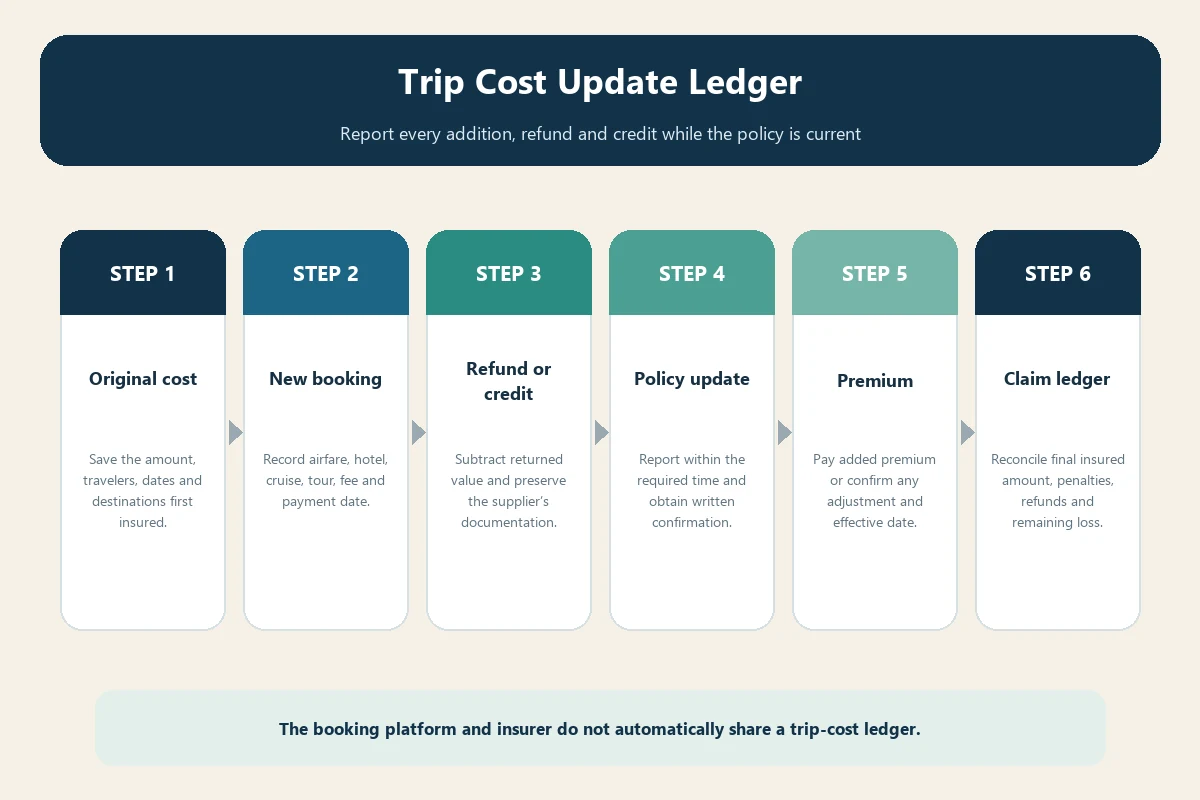
When prepaid nonrefundable trip cost changes after travel insurance is purchased, contact the insurer or administrator promptly and request a written policy update. Add each new airfare, hotel, cruise, tour, rental, or other eligible cost within the certificate’s reporting rule and pay any additional premium. Reduce the amount after refunds or cancellations when appropriate. Do not assume the booking platform, travel agent, cruise line, or card automatically reports changes to the insurer.
This article is educational, not legal, tax, financial, or insurance advice. Update procedures, deadlines, premium rules, and benefit conditions vary. Follow the current certificate and administrator’s written instructions.
Key takeaways
- The insurer usually sees only the trip cost, dates, destinations, and travelers reported to it.
- Later payments can require updates within a policy-defined time to preserve some time-sensitive benefits.
- Insure the eligible nonrefundable exposure, not a headline itinerary total.
- Refunds, credits, cancelled components, and traveler changes may require reductions or amendments.
- Keep the endorsement or revised declarations after every change.
Reviewed: August 16, 2026.
Why a policy update matters
Trip cancellation and interruption limits can be tied to the insured trip cost. Optional coverage or a pre-existing-condition waiver can require all eligible prepaid nonrefundable costs to be insured. If the trip grows but the policy remains unchanged, a claim can be capped or eligibility can be questioned.
An update can also change premium, dates, destination, traveler count, or plan availability. Obtain a revised declarations page rather than relying on a phone note.
Build a live trip-cost ledger
| Date | Supplier | Paid | Refundable now | At risk | Reported |
|---|---|---|---|---|---|
| Jan 5 | Cruise deposit | $500 | $500 | $0 | Jan 5 |
| Feb 2 | Airfare | $1,200 | $0 | $1,200 | Feb 3 |
| Mar 10 | Cruise final payment | $5,000 | $0 | $5,000 | Mar 11 |
The figures are illustrative. The certificate decides whether refundable cost must still be insured for a particular benefit and when the exposure is measured.
Start with the original purchase
Save the original declarations, quote inputs, policy purchase receipt, first trip payment, covered travelers, dates, destination, and insured cost. Every later amendment should reconcile back to that baseline.
If the original first-payment date was wrong, correct it before adding cost. Our first trip payment guide shows how to audit the transaction history.
Incremental cruise or tour payments
A cruise or tour can have an initial deposit, installments, final payment, optional excursion, single supplement, and pre- or post-trip package. Add each eligible cost as it is paid or becomes nonrefundable according to the policy.
Do not wait until final payment if the certificate requires earlier reporting of each addition. Record the supplier invoice and penalty schedule.
Airfare added later
Flights are often booked after a land tour or cruise. Add the at-risk airfare, taxes, seat charges, and other eligible components under the policy’s trip-cost definition. A refundable ticket may be treated differently from a basic nonrefundable fare.
Points, miles, redeposit fees, credits, and cash taxes require written classification. Do not assign a retail price to points unless the certificate permits it.
Hotels and vacation rentals
A reservation can move from fully refundable to partially or fully nonrefundable. Some insurers ask for the amount paid; others focus on prepaid nonrefundable cost. The policy can require an update when payment is made or exposure changes.
Capture the booking terms before the cancellation deadline and record any platform service fee.
Excursions and event tickets
Private tours, shore excursions, museum tickets, sports events, and show tickets can add significant cost. Ask whether they are travel arrangements under the policy and whether a supplier default or cancellation affects coverage.
Report eligible additions promptly and keep the refund terms.
Car rental and rail passes
A rental may be pay-later, prepaid, or bundled with a nonrefundable fee. Rail passes can be refundable before validation or subject to change fees. Only the actual at-risk cost should be claimed, but benefit eligibility can require broader reporting.
Separate trip cancellation cost from rental collision coverage; they answer different risks.
Group trips
A group organizer can collect installments before paying suppliers. The traveler should keep every receipt and an allocation of the individual share. Ask the insurer whether the organizer’s payment or the traveler’s payment controls reporting.
When the group price changes, update the individual insured amount rather than the full group invoice.
Someone else adds a cost
A family member can buy airfare or a host can pay a hotel. Determine who owns the booking, receives refunds, and bears the loss. The traveler cannot assume reimbursement for another person’s expense.
Ask whether the third-party-paid arrangement can be included and which proof is required.
Adding a traveler
A new companion is not automatically insured because the trip cost increases. They may need their own enrollment, premium, eligibility review, and coverage dates. A traveler removed from the trip can require cancellation or amendment.
Confirm both the person and their cost on the revised declarations.
Changing dates
A supplier rebooking can move departure or return. Ask the insurer to extend the coverage period before the original policy ends. A longer trip can change premium or eligibility. Review the timing boundary in our trip interruption guide before changing departure or return. Do not assume the policy follows the airline ticket automatically.
Record old and new dates, cause, supplier credit, additional cost, and insurer endorsement.
Changing destinations
An itinerary can add a country, cruise port, remote region, or excluded destination. Update the insurer, especially when geography affects eligibility, assistance, or premium. A destination change can also alter evacuation exposure.
Check government restrictions, war exclusions, sanctions, and benefit territory.
Trip cost increases
When cost rises, the insurer may charge added premium. The update may become effective only after acceptance and payment. Ask whether the new amount is protected immediately, prospectively, or after endorsement.
Do not wait until a cancellation threat appears. Known or foreseeable events are not cured by increasing the policy later.
Trip cost decreases
A refund, supplier cancellation, discount, voucher, or removed traveler can lower exposure. Ask whether the insurer reduces premium, issues a refund, retains the original amount, or requires documentation. State and policy rules govern.
An unused insured limit does not create a larger claim. Claims are based on eligible loss after refunds and credits.
Supplier credit
A future travel credit can reduce cash loss but may have expiration, transfer, or blackout rules. Policies differ in how credits are valued. Report the credit and ask whether it reduces insured cost now or only at claim time.
Keep the supplier’s written credit terms.
Time-sensitive benefits
Pre-existing-condition waivers and CFAR can require early purchase and timely insurance of later additions. The exact reporting period varies by certificate. Missing a later-payment deadline can affect only the new cost, or it can affect broader eligibility, depending on the plan.
Ask what must be reported, by when, and what happens after a late update.
Pre-existing-condition waiver
A waiver can require all eligible trip cost to be insured and the traveler to be medically able to travel at purchase or later updates. Timing is only one condition. The pre-existing-condition guide covers the other requirements.
CFAR and full trip cost
CFAR commonly requires insuring the full prepaid nonrefundable trip cost and cancelling before a policy-defined deadline. Adding airfare or a tour without updating the plan can matter. Our CFAR guide explains the partial-reimbursement structure.
Premium change is not claim value
Paying more premium does not guarantee reimbursement of the added amount. The cancellation reason, coverage date, exclusions, documentation, refunds, and limits still apply.
An endorsement proves the plan accepted the update; it does not preapprove a future claim.
How to request an update
- Prepare the prior declarations and current ledger.
- Identify cost, date, destination, or traveler changes.
- Attach supplier invoices and refund terms.
- Contact the administrator through its official channel.
- Ask how the change affects premium and time-sensitive benefits.
- Pay any accepted additional premium.
- Save the revised declarations or endorsement.
- Verify the new figures and dates.
Claim reconciliation
At claim time, show every payment, refund, credit, cancellation penalty, and endorsement. A mismatch between the supplier ledger and insured amount can delay review. The travel insurance claim guide provides an evidence index.
Five update scenarios
- Cruise final payment: report the new nonrefundable balance.
- Refundable airfare added: ask whether full cost or only penalty is insured.
- Tour is cancelled: remove the component and record the refund.
- Trip extends three days: update return date, lodging, and cost.
- Companion joins: enroll the person and add their cost rather than changing only the total.
Questions to ask
- Which costs are eligible trip cost?
- When must each later payment be reported?
- Does the update require added premium?
- When does the added amount become covered?
- How do refundable arrangements and credits count?
- What happens if an update is late?
- Does late reporting affect a waiver or CFAR?
- Can dates, destinations, and travelers be changed?
- Will a decrease produce a premium refund?
- What document proves the amendment?
FAQ
Does travel insurance update automatically when trip cost rises?
Usually not. Contact the insurer or administrator and obtain written revised declarations.
Can airfare be added after buying the policy?
Often, yes, subject to the plan’s reporting, premium, and time-sensitive rules.
Should refundable cost be included?
The answer depends on the trip-cost definition and benefit requirements. Insure the amount the administrator confirms.
What if trip cost goes down?
Report the decrease and ask how it affects insured amount and premium. A claim cannot exceed the eligible loss.
Bottom line
Travel insurance is a living ledger until the itinerary is final. Report each cost, refund, traveler, date, and destination change under the certificate’s rule; pay accepted premium; and save the endorsement. Accurate updates protect limits, time-sensitive eligibility, and claim reconciliation.
