
You can often buy travel insurance after making the final trip payment, provided the plan is still available before departure, but coverage is not retroactive and some time-sensitive benefits may no longer be available. A late purchase can still provide valuable future trip cancellation for listed reasons, emergency medical, evacuation, delay, baggage, and assistance under the certificate. Compare what remains instead of assuming the policy is either “full coverage” or worthless.
This article is educational, not legal, tax, financial, or insurance advice. Availability, deadlines, effective dates, state rules, and benefit terms vary. Obtain the actual certificate and written confirmation for the current trip.
Key takeaways
- Final payment is a supplier date, not a universal insurance purchase deadline.
- Coverage begins only according to the policy’s effective-date rule.
- Known events, existing cancellation threats, and past losses are not fixed by a late purchase.
- Pre-existing-condition waivers, CFAR, and some other benefits can require earlier purchase.
- Late buyers should compare remaining benefits against the risks that are still future and uncertain.
Reviewed: August 16, 2026.
Final payment is a supplier milestone
A cruise, tour, or vacation rental sets a date when the remaining balance is due. That date can be months after the first deposit and has no universal relationship to the insurer’s purchase deadline. Some plans remain purchasable close to departure, while others close earlier.
Ask the insurer for the latest purchase time, effective date, and coverage that remains. Do not rely on a cruise or travel agent’s final-payment label.
First trip payment still matters
Time-sensitive benefits often measure from the first trip payment, not final payment. A small deposit, award redemption, or group payment can start the clock. Waiting until the balance is due can miss the early window.
Our first trip payment guide shows how to audit the transaction history.
What can still be available
Depending on the plan, a late purchase can still include:
- trip cancellation for future listed covered reasons
- trip interruption after departure
- emergency medical and dental
- medical evacuation and repatriation
- travel delay and missed connection
- baggage loss and delay
- 24-hour assistance
Each benefit has definitions, exclusions, limits, and effective dates. The list is not a guarantee.
Coverage is not retroactive
A policy bought today does not cover a loss, symptom, storm, strike, supplier problem, or other event that already occurred or became known. If a doctor already advised cancellation, a hurricane is named, or a supplier announced insolvency, the new plan generally cannot insure that known problem.
Ask what the insurer considers the event date and whether any current condition makes the benefit unavailable.
Trip cancellation effective date
Cancellation coverage can begin after purchase according to the plan, often at a specified time such as the next day. The exact rule matters when departure is close. A payment receipt alone is not the effective-date section.
Read when coverage starts, when it ends, and whether an application must be accepted.
Emergency medical effective date
Travel medical benefits commonly begin when the covered trip starts or the traveler leaves the defined home location. Buying months earlier does not make routine care during the waiting period a travel claim.
Confirm destination, trip dates, home-country coverage, and whether the benefit is primary or secondary.
Pre-existing-condition waiver
A waiver can require purchase within a defined period after the first trip payment, insuring the required trip cost, and medical ability to travel. At final payment, the early window may be closed. A plan without a waiver can still cover unrelated events and conditions outside its look-back definition.
Use the pre-existing-condition guide to evaluate the remaining coverage rather than treating every diagnosis as excluded.
CFAR may be unavailable
Cancel For Any Reason coverage commonly requires early purchase and insuring the full required cost. It also requires cancellation before a specified deadline and reimburses only a stated percentage. Waiting until final payment can make it unavailable.
Our CFAR guide explains the conditions.
Financial default coverage
Supplier financial-default benefits can have early-purchase, waiting-period, and eligible-supplier rules. Buying after warning signs or a public financial problem will not make the event unexpected.
Ask whether the supplier qualifies and whether the benefit remains available. Credit-card dispute rights and supplier refunds are separate.
Named storms and weather
Insurance covers unforeseen events, not a storm already named or disruption already forecast under the policy’s event rule. Buying immediately before a hurricane reaches the destination can be too late for that storm.
A late policy can still cover unrelated future events. Read the weather benefit and known-event notice.
Strikes and labor events
A strike can become known through a vote, notice, public announcement, or actual stoppage. The policy defines the trigger. A new plan bought after the event becomes foreseeable may exclude it.
The airline strike coverage guide explains the timing problem.
Existing symptoms and medical advice
A traveler who has symptoms, scheduled tests, a pending procedure, or advice not to travel must review pre-existing-condition and medical-ability rules. The policy will not transform a known need to cancel into an unforeseen event.
Answer the application accurately and preserve the clinical timeline.
Cancellation penalties already incurred
At final payment, a large portion of the trip may already be nonrefundable. Insurance can cover future listed events after its effective date, but not a reason that existed when the penalty was accepted. The amount at risk affects premium and claim limit.
Build the refundable-cost ledger before buying.
How to calculate late insured trip cost
List all prepaid amounts, current cash refunds, credits, points, redeposit fees, taxes, and penalties. Ask whether the plan requires full prepaid nonrefundable cost or another amount. Do not insure the advertisement price.
The refundable trip cost guide provides the waterfall.
Trip cost can still change
Airfare, hotel, excursions, or extensions may be added after final payment. Ask how quickly later costs must be reported and whether added premium is due. Save revised declarations.
A late purchase does not eliminate the duty to keep the policy accurate.
Medical-only or zero-trip-cost options
A traveler with refundable arrangements, award travel, or no prepaid loss may prefer a medical-focused plan. Some products allow zero trip cost while retaining medical or evacuation benefits, but cancellation and interruption can be absent or limited.
Compare medical maximum, deductible, age limits, pre-existing conditions, evacuation, repatriation, primary or secondary status, and assistance.
Annual policy after final payment
An annual plan can cover multiple future trips but may have a low or absent trip cancellation maximum, maximum trip length, and effective-date rules. It should not be used to repair a known loss on an already threatened trip.
Our annual senior travel insurance guide explains the trip-length and annual-limit structure.
Buying after departure
Most standard trip-cancellation plans must be purchased before departure. Specialized post-departure medical products can exist, but they may have waiting periods, no cancellation coverage, and different eligibility. Do not assume a plan can be backdated.
If the trip has started, disclose the departure and current location accurately.
Free-look period
Many plans provide a review period during which the buyer can cancel for a premium refund if no claim or departure has occurred, subject to state and certificate rules. Use it to read the complete policy immediately.
Do not treat the free-look period as extra time to buy a missing optional benefit. Some changes require a new application.
Compare three buckets
| Bucket | Example | Action |
|---|---|---|
| Future and uncertain | Unrelated illness next month | Compare remaining covered reasons |
| Time-sensitive and closed | Missed CFAR purchase window | Use refundable bookings or another risk strategy |
| Already known | Doctor already advised cancellation | Do not expect a new policy to pay |
Do not let trip cancellation dominate the comparison
A late buyer may focus on the money already paid and overlook the larger health or transport exposure. Compare emergency medical, local ambulance, evacuation, repatriation, direct payment, assistance, prescription replacement, and the traveler’s existing health-plan limits. These benefits can remain valuable even when CFAR or a pre-existing-condition waiver is unavailable.
At the same time, a high medical maximum does not restore a missed cancellation benefit. Score each remaining policy lane separately. Select the plan only if its future coverage addresses a real uncovered risk after Medicare, other insurance, supplier refunds, credit-card benefits, and personal payment capacity are considered.
Late-purchase checklist
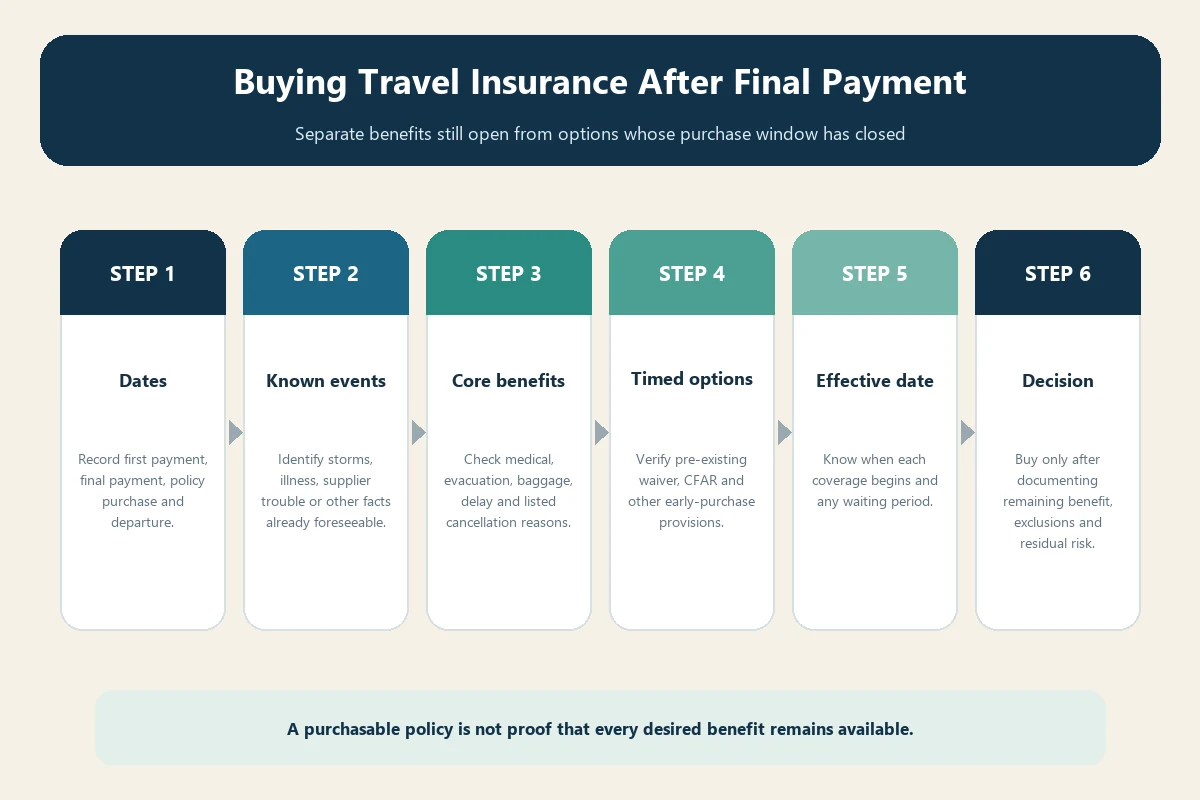
- Confirm first trip payment and final payment dates.
- List current nonrefundable exposure.
- Identify every known event or symptom.
- Ask which time-sensitive benefits remain.
- Confirm effective dates for each benefit.
- Compare emergency medical and evacuation independently.
- Verify age, destination, and trip-length eligibility.
- Buy only through an authorized channel.
- Read the certificate during the review period.
- Save the application, declarations, and receipt.
Claim evidence
A late-purchase claim needs a clear timeline: first payment, final payment, policy purchase, effective date, event, cancellation, supplier refund, and loss. The travel insurance claim guide helps index the evidence.
FAQ
Is final payment too late for travel insurance?
Not necessarily. Many plans can still be purchased, but some early-purchase benefits may be unavailable.
Will a late policy cover a condition I already know about?
Not automatically. Pre-existing-condition, known-event, and medical-ability rules apply, and coverage is not retroactive.
Can I get CFAR after final payment?
Often the early-purchase window will be closed, but the certificate decides. Do not assume availability.
Can I buy insurance after departure?
Standard trip-cancellation plans usually require purchase before departure. Specialized medical products may exist with different rules and no retroactive coverage.
Bottom line
Final payment is not the universal end of travel-insurance eligibility. Buy as soon as practical, but if final payment has passed, separate future insurable risks from missed time-sensitive benefits and known events. A late policy can still be valuable when its remaining benefits match the trip.
